
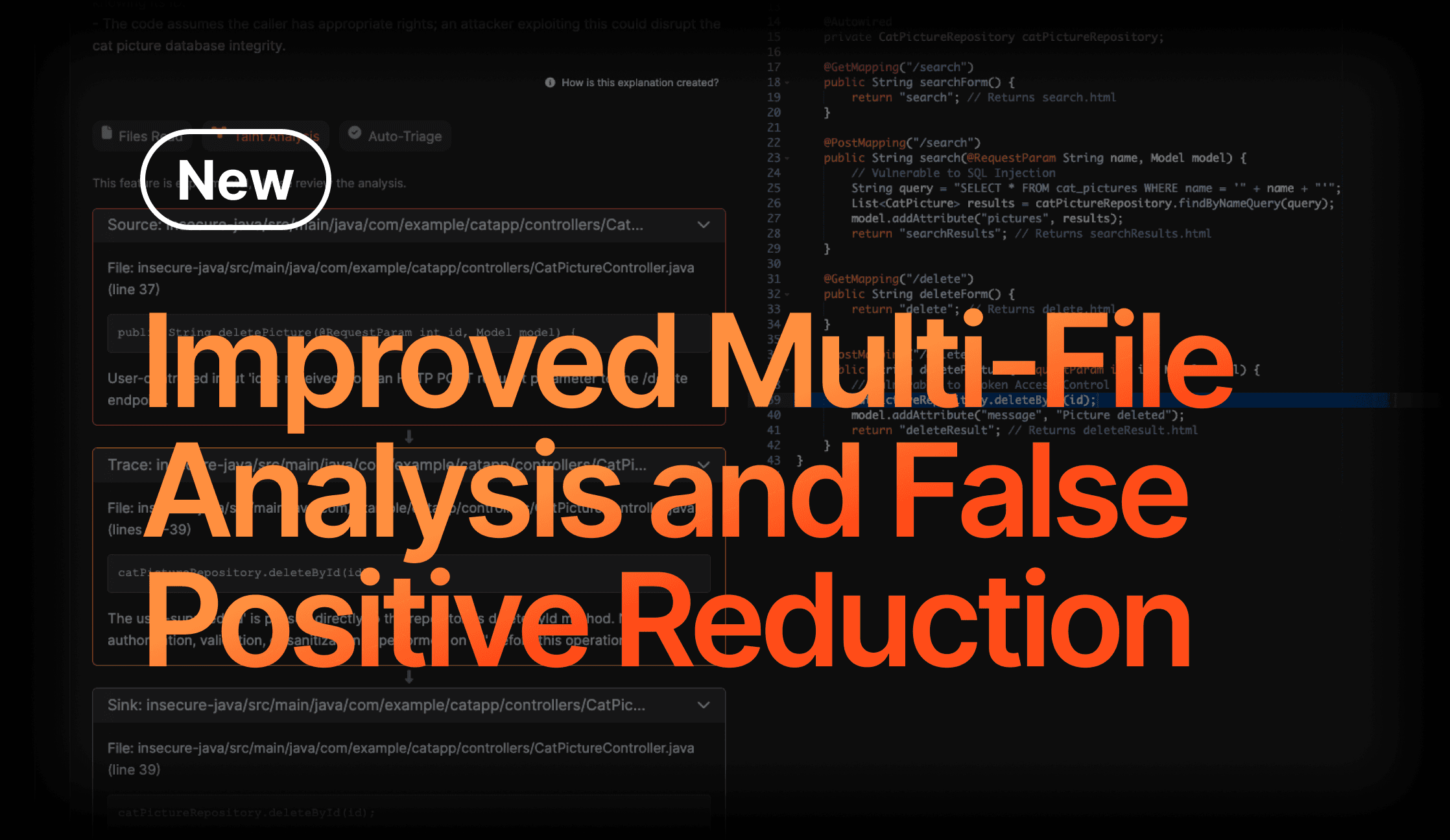
We’ve reimagined how static analysis should work—by deeply understanding the full context of your codebase. Our upgraded multi-file analysis engine transforms traditional scanning by going beyond file-by-file inspection in Corgea AI SAST. It now intelligently maps out your application structure, analyzing key relationships between files, imports, and dependencies to understand how your system actually behaves.
Here’s how it works:
-
We start by analyzing the primary file and automatically detect relevant imports, configuration files, and cross-referenced modules.
-
Unnecessary files like tests or build scripts are excluded, letting the system focus on what’s relevant to security.
-
This context is fed into our AI-powered false positive detection engine, which uses language-aware models, policy inference, and control flow understanding to determine whether a vulnerability is real and exploitable. For the underlying triage patterns, read our guide to reducing SAST false positives.
This allows us to:
-
Significantly reduce false positives (up to 40% fewer)
-
Detect vulnerabilities that span across files, not just those in isolation
-
Improve accuracy by accounting for real-world usage patterns and security controls
-
Save developers and security teams hours of unnecessary triage
-
Deliver confident, explainable security results
This upgrade is especially impactful in complex applications where critical context is often spread across multiple files—think microservices, layered configurations, or framework-based architectures. With Corgea’s new multi-file-aware engine, security scanning becomes not just faster, but smarter.
You don’t just get more findings—you get better ones.