
If you’re evaluating SonarQube vs Snyk, you’re likely comparing two different philosophies in application security tooling. SonarQube grew out of the code quality space and expanded into security through static analysis, secrets detection, and IaC scanning. Snyk started as a developer-first security platform focused on dependency vulnerabilities and broadened into SAST, container security, and infrastructure checks. Both are solid tools with strong developer adoption, but they approach AppSec from different angles and with different trade-offs. The reality both tools share is that they primarily help you detect problems. Remediation still falls on your developers to triage, schedule, and implement. Corgea takes a different approach: it can detect business logic flaws and authentication vulnerabilities that traditional scanners miss, and it auto-generates verified code fixes as pull requests, turning detection into resolution.
TL;DR: SonarQube excels at code quality gates, SAST, secrets detection, and IaC analysis with a developer-friendly quality gate model. Snyk is strongest at SCA, container security, IaC scanning, and broad platform integrations with a developer-first workflow. Both detect vulnerabilities but leave remediation to your developers. Corgea can detect business logic flaws and authentication vulnerabilities, and auto-generate verified code fixes as pull requests, turning detection into resolution.
What Is SonarQube?
SonarQube is a code quality and security analysis platform from SonarSource that helps engineering teams enforce standards for maintainability, reliability, and security before code reaches production. While many teams first adopt SonarQube for its “clean code” quality gates and technical debt tracking, it has evolved into a comprehensive static analysis platform with strong security capabilities.
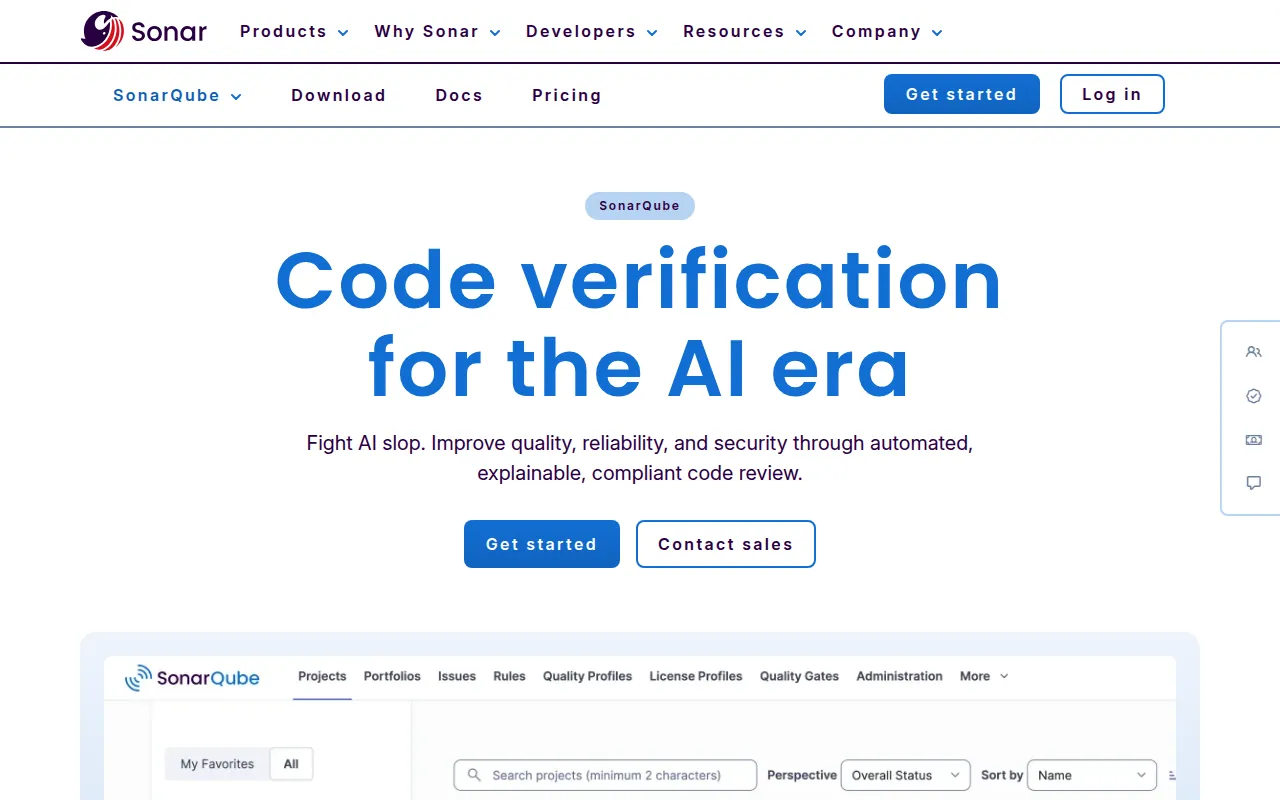
As of 2026, SonarQube supports a broad range of languages including Java, JavaScript, TypeScript, Python, C#, C/C++, Go, Kotlin, PHP, Ruby, Scala, Swift, and many others depending on edition. Beyond SAST, SonarQube offers taint analysis, security hotspots review, secrets detection, and infrastructure-as-code scanning for tools like Terraform, Kubernetes, Docker, CloudFormation, and Azure Resource Manager. Higher editions add Advanced Security features including SCA, malicious package detection, license management, SBOMs, and AI CodeFix.
Key capabilities include:
- Static analysis and quality gates for vulnerabilities, security hotspots, code smells, bugs, and maintainability issues across the SDLC.
- Taint analysis and injection detection for supported languages, with cross-file data flow tracking.
- Secrets and IaC scanning for hardcoded credentials and infrastructure misconfigurations.
- Pull request decoration and CI/CD integration across GitHub, GitLab, Bitbucket, Azure DevOps, and major build systems.
- Advanced Security features including SCA, malicious package detection, SBOM generation, and AI-assisted remediation in eligible commercial plans.
Known limitations and trade-offs:
- Security depth varies significantly by edition: features like SCA and AI CodeFix are only available in higher-tier commercial plans.
- No native DAST capability: SonarQube focuses exclusively on static analysis and does not perform runtime web application testing.
- Lines-of-code pricing can become expensive for organizations with very large codebases, especially when advanced features are needed.
See our SonarQube vs Checkmarx comparison →
What Is Snyk?
Snyk is a developer-first application security platform designed to integrate security testing into the workflows developers already use: IDEs, pull requests, CI/CD pipelines, and source control. Originally known for its software composition analysis (SCA) and open-source dependency scanning, Snyk has grown into a multi-product platform covering SAST with Snyk Code, container image scanning, IaC security, and cloud security posture management.
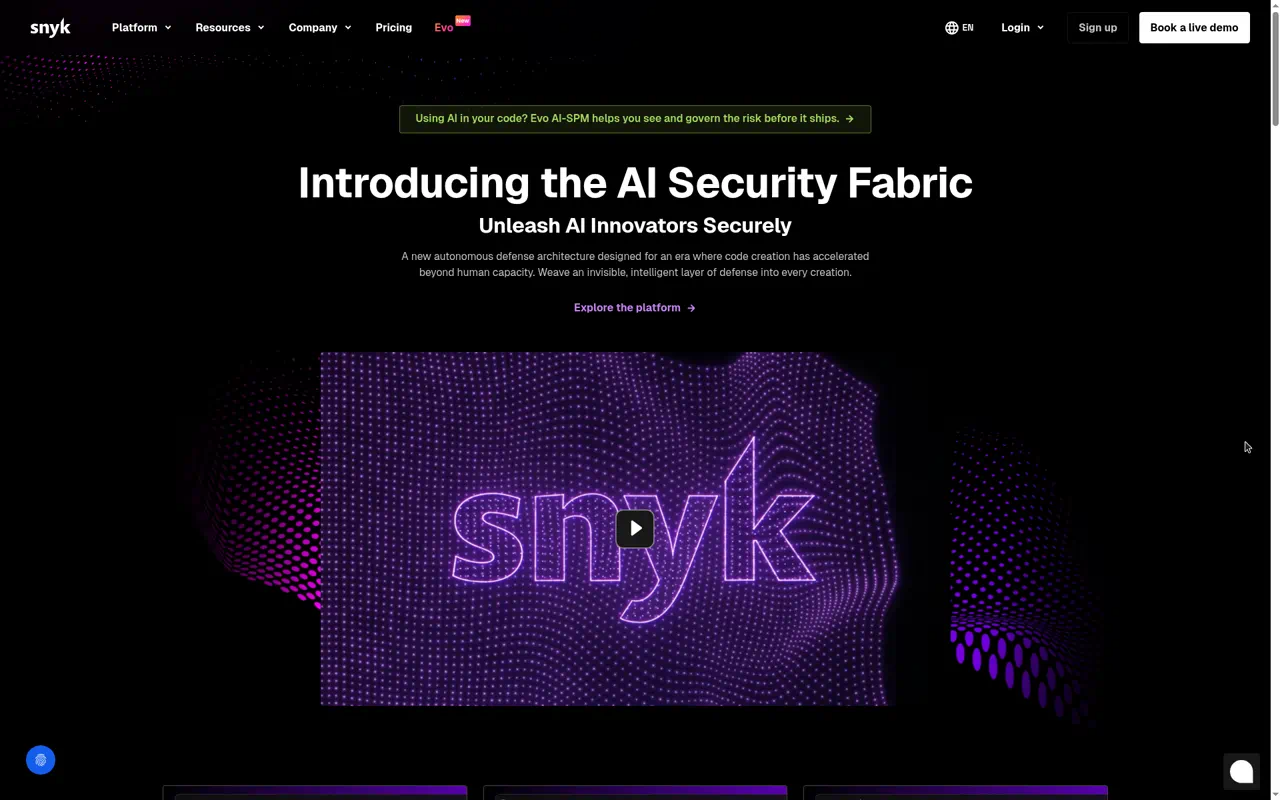
Snyk’s core value proposition is developer experience. The platform emphasizes early detection with actionable context, priority scoring based on exploitability and reachability, and automated fix capabilities including dependency upgrade PRs and AI-generated code patches through Snyk Agent Fix. Snyk supports flexible deployment models including full SaaS, Broker-connected self-hosted SCM environments, and local no-upload scanning for teams with strict data residency requirements.
Key capabilities include:
- Comprehensive SCA with one of the largest vulnerability databases, priority scoring, reachability analysis, and automated fix PRs for dependency upgrades.
- Snyk Code for SAST with semantic AI-based analysis, data-flow visualization, and IDE-native feedback loops.
- Container and IaC security for Docker images, Kubernetes manifests, Terraform, CloudFormation, and other infrastructure-as-code formats.
- Developer-centric integrations across GitHub, GitLab, Bitbucket, Azure Repos, major IDEs (VS Code, IntelliJ, Visual Studio), CLI, and APIs.
- Automated remediation support through Snyk Agent Fix for code findings and automatic dependency Fix PRs in supported workflows.
Known limitations and trade-offs:
- Pricing scales per developer and can climb quickly as teams add more product modules or grow contributor counts.
- Snyk Code language coverage is narrower than some competitors focused purely on SAST, though the platform as a whole covers many ecosystems.
- Automated fixes have boundaries: AI code fixes are limited to supported languages and currently do not support inter-file fixes or complex refactoring scenarios.
See our Snyk vs Semgrep comparison →
What Is Corgea?
Corgea is an AI-native application security platform that turns vulnerability detection into actual remediation. Unlike traditional scanners that stop at finding and reporting issues, Corgea can detect business logic flaws and authentication vulnerabilities that other tools miss, and it generates verified pull requests that fix vulnerabilities automatically. This makes it fundamentally different from both SonarQube and Snyk.
Corgea can work in two ways: it can replace existing security tools with its own AI-native SAST, SCA with AI reachability, secrets detection, container scanning, IaC analysis, and business logic testing. Or it can integrate with tools like SonarQube, Snyk, Checkmarx, GitHub Advanced Security, Semgrep, and others, ingesting their findings and converting them into reviewed, testable code changes.
What distinguishes Corgea is that it’s built around the premise that AppSec’s biggest problem is not a lack of detection tools, but a chronic remediation backlog. Teams have plenty of alerts. What they need is verified fixes submitted as pull requests that developers can review and merge using their existing code review processes. That’s what Corgea delivers: higher true positive rates (2x industry average), dramatically lower false positives (3x better than traditional tools), and auto-remediation that turns weeks-long fix backlogs into same-day resolution.
SonarQube vs Snyk vs Corgea: Comparison Table
| Feature | SonarQube | Snyk | Corgea |
|---|---|---|---|
| Primary Focus | Code quality, static analysis, security hotspots, quality gates | Developer-first AppSec platform across SCA, SAST, containers, IaC | Auto-remediation of vulnerabilities |
| SAST | ✅ Static analysis, taint analysis, security hotspots | ✅ Snyk Code with semantic AI analysis | ✅ AI-native SAST - Can detect business logic flaw and auth issues |
| SCA | ⚠️ Available through Advanced Security in commercial plans | ✅ Best-in-class SCA with large vulnerability database and reachability | ✅ SCA with AI Reachability |
| DAST | ❌ No native DAST | ⚠️ Available via Snyk API & Web add-on | ⚠️ Works with existing DAST findings |
| IaC Scanning | ✅ Terraform, Kubernetes, Docker, CloudFormation, ARM, Ansible | ✅ Native IaC scanning across multiple formats | ✅ Native IaC scanning |
| Container Scanning | ⚠️ Dockerfile analysis, not full container image scanning | ✅ Native container security with vulnerability and license scanning | ✅ Native container/image scanning |
| Secrets Detection | ✅ Native secrets analysis with custom patterns | ⚠️ Hardcoded secrets via code scanning, not standalone first-party product | ✅ Native secrets detection |
| Auto-Remediation / AI Fix | ⚠️ AI CodeFix for eligible issues, plans, and languages | ⚠️ Agent Fix plus automatic dependency Fix PRs | ✅ AI-generated PRs |
| CI/CD Integration | ✅ GitHub, GitLab, Bitbucket, Azure DevOps, quality gates | ✅ Strong GitHub, GitLab, Bitbucket, Azure Repos, IDE, CLI support | ✅ GitHub, GitLab, Bitbucket, Azure DevOps, PR-driven workflows |
| False Positive Handling | ✅ Quality profiles, security hotspots, taint analysis | ✅ Priority scoring, reachability, data-flow context | ✅ Fixes real issues, deprioritizes noise |
| Pricing Model | Lines-of-code based; free/community plus commercial tiers | Per-developer; free tier, Team from $25/dev/month | Free tier, Growth $39/dev/month, Scale $49/dev/month, Enterprise custom |
| Deployment | Cloud, self-managed Server, Data Center for HA | SaaS, Broker for self-hosted SCM, local no-upload engine | SaaS with enterprise single-tenant option |
Security Coverage: SonarQube vs Snyk vs Corgea
When comparing SonarQube vs Snyk on security coverage, the first question is what you’re trying to cover. SonarQube is strongest when your priority is static code analysis integrated into developer quality gates. It excels at finding code-level security issues, security hotspots that require human review, secrets in source code, and misconfigurations in infrastructure-as-code. For teams already using SonarQube for code quality, adding security scanning is a natural extension that uses the same quality gate infrastructure and pull request decoration developers already understand.
SonarQube’s coverage has grown significantly with Advanced Security features in commercial editions. SCA, malicious package detection, license management, and SBOM generation make it more than just a SAST tool. However, SonarQube is still not a complete AppSec platform in the way that Snyk positions itself. It has no native DAST, limited container security (Dockerfile analysis but not full image scanning), and its broader platform features are edition-gated, meaning smaller teams may not get access to the full security stack.
Snyk approaches coverage from a different angle: breadth across the application attack surface. Snyk is designed as a multi-product platform where each module (SCA, SAST, Container, IaC, Cloud) addresses a distinct security domain. For dependency vulnerabilities, Snyk is industry-leading with one of the most comprehensive vulnerability databases, automated fix PRs, and reachability analysis to prioritize what’s actually exploitable in your codebase. Snyk Code adds semantic SAST. Snyk Container scans images for vulnerabilities and licenses. Snyk IaC checks cloud configurations. This breadth makes Snyk appealing for teams that want one vendor covering multiple security categories.
The trade-off with Snyk is that it’s a collection of related products rather than a tightly integrated single analysis engine. Different Snyk products have different strengths, different language support matrices, and different fix capabilities. That’s fine for teams comfortable with a platform approach, but it can mean complexity in understanding what’s covered where.
Corgea changes the coverage conversation by focusing on what matters after detection. Corgea provides its own AI-native SAST that can find business logic flaws and authentication issues other tools miss, plus SCA with AI reachability, secrets detection, container scanning, and IaC analysis. But more importantly, Corgea can integrate with SonarQube, Snyk, and other scanners, so you don’t have to choose. You can keep your existing coverage strategy and add Corgea as the layer that turns all those findings into actual fixes.
Auto-Remediation: Where Both Tools Fall Short
This is where the SonarQube vs Snyk comparison reveals its biggest gap: both tools are fundamentally detection platforms that have bolted on AI-assisted remediation features, but neither makes remediation the center of the workflow.
SonarQube’s AI CodeFix is available in eligible commercial plans for languages including Java, JavaScript, TypeScript, Python, C#, C++, HTML, and CSS. It generates suggested fixes for supported rule violations, and SonarQube Cloud includes a remediation agent that can help with reliability, maintainability, security, and secrets issues. These are useful features when you’re already reviewing issues in the SonarQube interface. The limitation is that they’re issue-level suggestions within SonarQube’s dashboard workflow, not pull-request-based remediation integrated into your code review process. Support depends on plan tier, specific rules, language compatibility, and product surface area.
Snyk has invested more heavily in automated remediation than SonarQube, but it’s still bounded by the same fundamental constraints. Snyk automatically generates Fix PRs for dependency upgrades when a vulnerable package has a patched version available. This is extremely useful and one of Snyk’s best features. For code-level issues, Snyk Agent Fix can generate AI-assisted patches for supported Snyk Code findings in certain languages. Snyk also integrates these fix capabilities into IDE plugins and CLI workflows, making it easier for developers to apply fixes locally.
The problem is scope and completeness. Dependency Fix PRs only work when the fix is a simple version bump. Snyk Agent Fix code patches don’t support inter-file changes or complex refactoring. Both features are limited to supported languages and CWEs. Most importantly, both require developers to review, test, and apply the suggestions manually. In practice, this means Snyk and SonarQube improve the remediation experience but don’t fundamentally solve the backlog problem. Detection still creates a queue of developer work.
Corgea is designed around a different model: remediation as the primary workflow, not an add-on. Corgea analyzes vulnerable code in context, generates a complete fix (including multi-file changes when necessary), validates the proposed remediation, and submits it as a pull request. Developers review the PR like any other code change, run their existing CI checks, and merge when ready. This works for findings from Corgea’s own scanners and for ingested findings from tools like SonarQube and Snyk. The distinction is not just user experience but throughput. Auto-remediation via PRs means teams can resolve vulnerabilities at scale without manually triaging and implementing every fix.
Developer Experience & CI/CD Integration
Developer experience is a strength both SonarQube and Snyk emphasize, but they approach it differently.
SonarQube integrates into the development workflow through quality gates and pull request decoration. When a PR violates policy, developers see inline comments on the affected lines, a quality gate status check, and links to detailed analysis in the SonarQube dashboard. This model works well because it meets developers where they already review code. SonarQube supports GitHub, GitLab, Bitbucket, Azure DevOps, and integrates with major build systems and CI/CD platforms. For teams that already enforce code review and automated checks, adding SonarQube feels like a natural extension of existing processes.
The developer experience is strongest when quality profiles and quality gates are well-tuned. If policies are reasonable and clearly communicated, developers understand what’s expected and can fix issues before requesting review. If policies are noisy or applied top-down without engineering buy-in, developers may view SonarQube as a gatekeeper that blocks legitimate work with low-signal alerts. SonarQube gives teams the tools to tune this balance, but it requires investment in configuration and policy management.
Snyk’s developer experience is more granular and product-specific. Snyk integrates at multiple touchpoints: IDE plugins that scan as you code, PR checks that surface findings before merge, SCM integrations that monitor repositories continuously, CLI tools for local testing, and dashboards for centralized visibility. Snyk emphasizes “shift left” by giving developers security feedback as early as possible, often before code even leaves their local environment.
What makes Snyk’s DevEx compelling is that it’s designed around developer workflows from the ground up. Priority scores help developers understand what to fix first. Data-flow visualizations show how taint flows through code. Automated Fix PRs reduce the manual work for dependency upgrades. IDE plugins provide in-editor feedback without requiring context switching. For engineering organizations that want security to feel developer-native rather than security-team-imposed, Snyk often resonates.
The trade-off is that Snyk’s multi-product architecture can mean different developer experiences for different security categories. Snyk Code feels different from Snyk Open Source, which feels different from Snyk Container. That’s fine for large teams with specialization, but it can add complexity for smaller teams expecting one unified workflow.
Corgea approaches developer experience by changing what appears in the workflow. Instead of alerts, policy violations, or dashboard items, developers receive pull requests with proposed fixes. This maps perfectly to how engineering teams already ship code: review the diff, discuss in comments, run CI checks, and merge. Corgea integrates with GitHub, GitLab, Bitbucket, and Azure DevOps using the same PR-based workflow for all finding types. That consistency matters because it reduces context switching and makes security fixes feel like normal engineering work rather than a separate operational burden.
Accuracy & False Positive Rates
False positive rates are critical in AppSec tooling because noisy scanners erode trust and waste developer time. Both SonarQube and Snyk have invested heavily in accuracy, but they approach the problem differently.
SonarQube uses a combination of static analysis rules, taint analysis, quality profiles, and security hotspots to balance accuracy and coverage. Security hotspots are an intentional design choice: they identify security-sensitive code that requires human judgment rather than automatically labeling it as vulnerable. This reduces false positives at the cost of requiring security or senior engineering review. For true vulnerabilities, SonarQube’s taint analysis and data-flow tracking help ensure findings are grounded in actual code paths, not just pattern matching.
Accuracy in SonarQube depends heavily on how well quality profiles are tuned. Default profiles are designed to be broadly applicable, but teams often need to customize rules, severity levels, and quality gate thresholds to match their specific codebase and risk tolerance. Well-tuned SonarQube deployments can deliver strong signal with minimal noise. Poorly tuned deployments can bury developers in low-priority maintainability issues mixed with security alerts.
Snyk positions itself around low false positives and actionable findings. Priority scores incorporate factors like exploit maturity, reachability in your codebase, and whether a fix is available. Reachability analysis for dependencies is particularly valuable: it helps teams focus on vulnerable packages that are actually called in their code rather than treating all transitive dependencies equally. Snyk Code uses semantic analysis and data-flow tracking to ground findings in real code paths, which reduces false positives compared to simpler pattern-based scanners.
In practice, Snyk’s false positive rate varies by product. Snyk Open Source (SCA) is generally high-confidence because vulnerability data is well-curated and reachability adds context. Snyk Code can produce noisier results depending on the language, framework, and code patterns involved. Snyk provides filtering, ignore mechanisms, and priority scores to help teams manage this, but it still requires active triage.
Corgea takes a different approach to accuracy: actionability as the filter. Instead of trying to eliminate all false positives at the detection layer, Corgea focuses on which findings can be confidently fixed. Reachability analysis, endpoint-aware context, and AI-driven validation help separate real issues from noise. More importantly, Corgea’s fix generation serves as an additional accuracy check: if a finding can’t be remediated with high confidence, it doesn’t become a PR that wastes developer review time. This doesn’t eliminate scanner noise entirely, but it dramatically reduces the developer-facing burden.
Pricing & Total Cost of Ownership
Pricing models for SonarQube and Snyk are structured differently, and total cost of ownership depends on more than just license fees.
SonarQube uses lines-of-code (LOC) based pricing for commercial editions. SonarQube Server editions (Developer, Enterprise, Data Center) are licensed per instance per year with pricing tiers based on LOC capacity. SonarQube Cloud uses subscription pricing also tied to LOC. This model can be attractive for large organizations with many developers but concentrated codebases, since you’re not paying per developer. It can become expensive for organizations with very large codebases or when advanced features like SCA, AI CodeFix, and enterprise governance are needed, as these often require higher-tier commercial editions.
The hidden cost with SonarQube is operational: configuring quality profiles, tuning quality gates, managing false positives, and ensuring consistent adoption across teams requires investment. For teams already experienced with SonarQube, this is manageable. For teams adopting it fresh for security, there’s a learning curve.
Snyk uses per-developer pricing with a modular product structure. The free tier supports limited users and repositories. Team tier starts at approximately $25 per contributing developer per month, with pricing varying by product (Open Source, Code, Container, IaC). Larger Enterprise plans add more capabilities and support. This model is straightforward to understand initially, but costs can scale quickly as teams grow or add multiple Snyk products. Add-ons like API security testing and advanced features further increase the total bill.
The advantage of Snyk’s pricing is predictability for smaller teams and alignment with headcount. The disadvantage is that per-developer pricing across multiple products can become expensive at scale, especially if not all developers need all products.
Corgea’s pricing is publicly documented and straightforward. The Free tier is $0, supports up to 2 team members and 10 repos, and includes AI SAST, business logic and auth scanning, dependency scanning, secrets detection, container scanning, and IaC scanning. Growth starts at $39 per developer per month, supports up to 100 repos, and adds PR scanning, code quality, Corgea Agent, JIRA integration, and license enforcement. Scale starts at $49 per developer per month, supports up to 200 repos, and adds custom rules, blocking rules, reporting and analytics, team management, and APIs/webhooks. Enterprise is custom-priced and offers unlimited scale, SSO, SCIM, single-tenant deployment, SLA management, audit logs, and premium support.
The total cost argument for Corgea is not just about license price but about remediation labor. If your team spends weeks triaging, scheduling, and manually implementing fixes for vulnerabilities found by SonarQube or Snyk, that’s the real cost. Corgea can work alongside your existing scanners, preserving your investment while dramatically reducing the manual effort required to turn findings into merged fixes.
Compliance & Enterprise Readiness
Enterprise buyers evaluate security tools not just on detection capabilities but on governance, deployment flexibility, compliance support, and organizational scale.
SonarQube has a mature enterprise story, especially in higher editions. Enterprise and Data Center editions include features like portfolios for multi-project visibility, security and regulatory reports, SSO/SAML, SCIM auto-provisioning, audit logs, configurable session policies, support for multiple DevOps platform instances, and high availability. SonarQube is designed for organizations that need centralized code quality and security governance across many teams and repositories.
The limitation is scope: SonarQube’s enterprise readiness is centered on code analysis and quality gates. If your compliance program requires DAST evidence, application portfolio risk dashboards, or broad security testing coverage from one platform, SonarQube will likely need to sit alongside other tools rather than replace them entirely.
Snyk’s enterprise offering includes SSO, policy management, RBAC, regional data residency, Broker for connecting self-hosted SCM environments, audit logs, compliance reporting, and APIs for integration with broader security programs. Snyk supports deployment models ranging from full SaaS to local no-upload scanning for data-sensitive environments. For organizations with strict data residency requirements, Snyk’s flexibility in deployment architecture is a meaningful differentiator.
Snyk’s enterprise maturity is evident in how it scales across large engineering organizations: centralized policy with decentralized enforcement, reporting and dashboards for AppSec leadership, and integrations with ticketing, SIEM, and vulnerability management platforms. The multi-product structure means Snyk can serve diverse needs across different teams while maintaining centralized visibility.
Corgea complements enterprise readiness by addressing the operational gap that governance tools don’t solve: actually fixing the vulnerabilities they find. Enterprise features like APIs, webhooks, reporting, SLA management, audit logs, and single-tenant deployment give large organizations the control they need. More importantly, Corgea can integrate with existing scanner infrastructure, so teams can preserve governance investments in SonarQube, Snyk, or other tools while adding the remediation layer that turns compliance findings into merged fixes.
Which Tool Should You Choose?
Choose SonarQube if you need a mature code quality and static analysis platform with strong quality gates, pull request decoration, and governance. It’s especially strong when your main goals are consistent code standards, security hotspots review, secrets detection, IaC analysis, and when you want security embedded in the same quality gate infrastructure developers already use. SonarQube is also a good fit if your organization has a large codebase and prefers LOC-based pricing over per-developer models.
Choose Snyk if you want a developer-first AppSec platform with best-in-class SCA, strong container and IaC security, and broad integrations across IDEs, CI/CD, and source control. Snyk is especially compelling when open-source dependency security is a top priority, when you want automated Fix PRs for dependency upgrades, and when developer experience and early feedback loops matter more than centralized quality gates.
Choose Corgea if you’re tired of growing vulnerability backlogs and want to go from detection to remediation. Corgea is the right fit when you want an AI-native AppSec platform that can detect business logic flaws and auth issues other tools miss, or when you want to keep your existing scanners (SonarQube, Snyk, or others) and make them actionable by generating verified fixes as pull requests. Corgea reduces mean time to remediation from weeks to days by turning alerts into mergeable code changes.
Frequently Asked Questions
What is the difference between SonarQube and Snyk?
SonarQube is primarily a code quality and static analysis platform with quality gates and security capabilities including SAST, secrets detection, IaC analysis, and advanced security features in commercial editions. Snyk is a developer-first AppSec platform with strengths in SCA, container security, IaC scanning, and SAST through Snyk Code. In short, SonarQube emphasizes quality gates and code standards, while Snyk emphasizes developer-native security across multiple domains.
Can I use SonarQube and Snyk together?
Yes. Many organizations use SonarQube for code quality gates and SAST while using Snyk for dependency scanning, container security, and IaC checks. The tools are complementary and can work together. If both produce findings, Corgea can help consolidate remediation by generating fixes for validated issues from either tool.
Which is better for SAST: SonarQube or Snyk?
It depends on your priorities. SonarQube is often better when you want SAST integrated with code quality gates, security hotspots review, and governance across many repositories. Snyk Code is often better when you want developer-friendly SAST with IDE integrations, priority scoring, and a platform approach that also covers dependencies, containers, and IaC. Neither is universally “better” as they optimize for different workflows.
What are the best alternatives to SonarQube and Snyk?
Common alternatives include Semgrep, Checkmarx, Veracode, GitHub Advanced Security, Coverity, and Corgea. The best fit depends on whether you need custom static analysis rules, enterprise governance, broader security testing coverage, or auto-remediation. If your team already has enough scanners but not enough fixes, Corgea is the alternative focused on turning detection into resolution.
Does Corgea replace SonarQube or Snyk?
Corgea can provide native scanning capabilities including AI-native SAST, SCA, secrets, container, and IaC analysis, so it can replace point tools for teams that want consolidation. But it doesn’t have to. Many teams use Corgea as a complementary layer that ingests findings from SonarQube, Snyk, or other scanners and generates fixes. This model lets you keep the coverage and tooling you already trust while solving the remediation backlog problem.
How does Corgea differentiate from SonarQube and Snyk?
Corgea’s core differentiation is auto-remediation. While SonarQube and Snyk focus on detection with some AI-assisted fix suggestions, Corgea generates complete, verified pull requests that fix vulnerabilities. Corgea also detects business logic flaws and authentication issues that rule-based scanners typically miss. The result is higher true positives (2x), lower false positives (3x), and dramatically faster time to remediation, from weeks to days.
Ready to Fix Vulnerabilities, Not Just Find Them?
Corgea integrates with SonarQube, Snyk, and 20+ other security tools to auto-generate verified fixes. Stop triaging. Start fixing.