

If you are shopping for the best AI pentesting tools in 2026, here is the direct answer: for teams that want packaged, autonomous AI penetration testing with a clear buying path and published pricing, Corgea is the strongest fit. It delivers AI pentests autonomously, starts as blackbox testing, and produces auditor-ready reports, with plans starting at $4,000 for Standard and $8,000 for Comprehensive.
That said, traditional penetration testing is still valuable. Human-led engagements are the right choice when you need deep manual assurance, bespoke testing of unusual targets, or compliance-driven audits where an auditor expects a named human assessor. The most credible answer for most buyers is not “AI replaces humans” but “match the tool to the job,” and often that means combining fast, repeatable AI pentesting with periodic human depth.
This guide compares the leading AI pentesting tools, AI-assisted workflows, and traditional pentest marketplaces so you can pick the right one for your team, whether you are a founder clearing a first enterprise deal, a Head of AppSec covering a large portfolio, or a CISO planning an annual program. For the broader buyer landscape, see the penetration testing tools guide. If you want the foundational concepts first, start with what is AI penetration testing and how AI pentesting works.
TL;DR: quick picks
- Best packaged AI pentest for startups and fast-moving teams: Corgea. Autonomous, blackbox-first AI penetration testing with published per-pentest pricing and auditor-ready reports. A dedicated Y Combinator offer makes it especially attractive for early-stage startups.
- Best broad AppSec platform with AI pentesting positioning: Aikido. A consolidated application security platform (SAST, SCA, DAST, secrets, and more) that has added AI pentest positioning to an already wide product surface.
- Best autonomous offensive security category player: XBOW. An autonomous offensive security company focused on AI agents that find and exploit vulnerabilities at scale, aimed largely at continuous offensive testing.
- Best traditional pentest marketplaces: HackerOne, Bugcrowd, Cobalt, and Synack. Human-led penetration testing and pentest-as-a-service platforms backed by vetted researcher communities, strongest where you need named human assessors and deep manual depth.
- Best open-source assisted workflow: Kali plus Burp Suite plus AI copilots. A capable, low-cost setup for skilled testers, with the important caveat that this is AI-assisted manual testing, not autonomous pentesting. You still drive the engagement.
Comparison table
The table below compares the tools discussed in this guide. “Autonomous testing” means the tool can plan and execute a test with limited human driving; “human validation” means human experts review or validate findings as part of the standard offering. Pricing clarity reflects whether representative pricing is publicly available, not an endorsement of value.
| Tool | Best for | Autonomous testing | Blackbox testing | Authenticated testing | Human validation | Report output | Pricing clarity | Best fit | Main limitation |
|---|---|---|---|---|---|---|---|---|---|
| Corgea | Packaged AI pentest for startups and mid-market | Yes | Yes (blackbox-first) | Yes | Optional/report-driven | Auditor-ready PDF | Public ($4K / $8K) | Fast, repeatable validation | Newer than legacy pentest brands |
| Aikido | Consolidated AppSec platform buyers | Partial | Yes | Yes | Limited | Platform + reports | Public tiers | Teams wanting one AppSec suite | AI pentest is one feature among many |
| XBOW | Continuous autonomous offensive testing | Yes | Yes | Varies | Limited | Findings/platform | Contact sales | Offensive security teams | Category still maturing |
| PentestGPT | AI-assisted manual pentesting | No (assisted) | Yes | Yes | You (the tester) | Your own report | Open source | Skilled testers who want a copilot | Not autonomous, requires expertise |
| HackerOne | Crowd + PTaaS engagements | No | Yes | Yes | Yes | Formal reports | Contact sales | Enterprises, bug bounty programs | Slower, engagement-based |
| Bugcrowd | Crowdsourced pentest and bounty | No | Yes | Yes | Yes | Formal reports | Contact sales | Programs needing crowd depth | Coordination overhead |
| Cobalt | Pentest-as-a-service scheduling | No | Yes | Yes | Yes | Formal reports | Contact/tiered | On-demand human pentests | Scheduling and lead time |
| Synack | Vetted-researcher continuous testing | Partial (platform) | Yes | Yes | Yes | Formal reports | Contact sales | Regulated enterprises | Premium, enterprise-oriented |
| Astra | SMB pentest with a managed platform | Partial | Yes | Yes | Yes | Reports + dashboard | Public/tiered | SMBs wanting scan + manual | Depth varies by plan |
| Burp Suite (AI-assisted) | Hands-on manual testing | No | Yes | Yes | You (the tester) | Your own report | Public license | Professional testers | Manual, not autonomous |
Use this table as a starting shortlist, not a verdict. The right choice depends on your scope, your buying timeline, and whether you need a named human assessor. The sections below add the nuance the table cannot.
Tool sections
Corgea
Corgea AI Pentest is a packaged, autonomous AI penetration testing product aimed at teams that need fast, repeatable, exploit-validated testing without a multi-week consulting cycle. It runs many agents to perform reconnaissance and then attack an application, chaining findings into real attack paths and validating exploitability before reporting. Delivery is touchless and autonomous, testing starts as blackbox (external attacker perspective), and the output is an auditor-ready report you can share with customers, auditors, and management.
The differentiator for buyers is packaging and pricing clarity. Corgea publishes per-pentest plans starting at $4,000 for Standard and $8,000 for Comprehensive, with custom Enterprise pricing for continuous, multi-application programs. That makes budgeting predictable, which matters when security is blocking a deal or an audit. There is also a dedicated Y Combinator offer for early-stage startups.
- Best for: startups and mid-market teams that need to clear security reviews and compliance checks quickly, and larger teams that want continuous, repeatable validation between human engagements.
- Strengths: autonomous delivery, blackbox-first coverage, exploit validation, auditor-ready reporting, and published pricing.
- Honest limitation: as a newer product, it does not carry the decades-long brand recognition of legacy pentest firms, and buyers who require a named human assessor for a specific audit should confirm that requirement up front.
Aikido
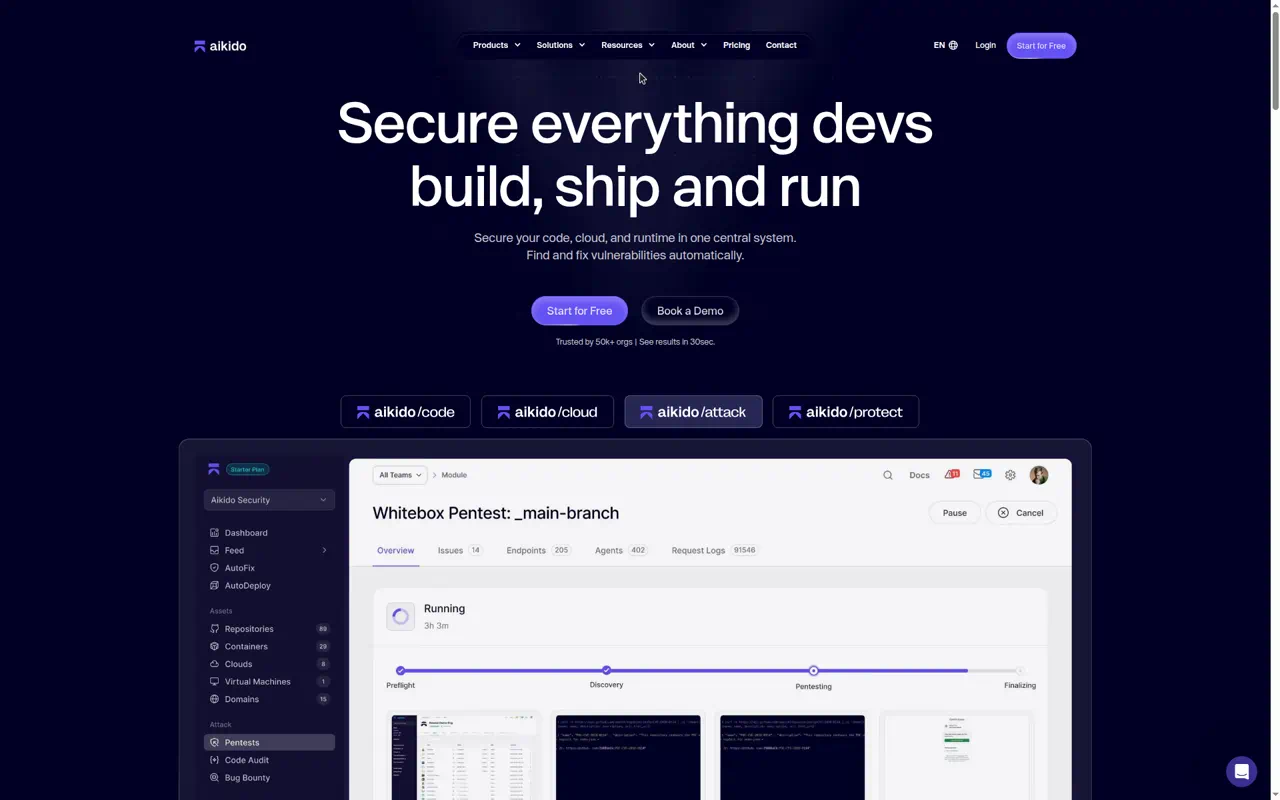
Aikido is a consolidated application security platform that brings together multiple testing types (such as SAST, SCA, DAST, secrets detection, and more) under one product, and it has added AI pentest positioning to that surface. Its appeal is consolidation: teams that want a single tool to cover many AppSec needs, rather than stitching together point products, often shortlist it. Aikido has been effective at capturing AI pentest search interest, which is one reason it belongs in any honest comparison.
- Best for: teams that value one broad AppSec platform over a specialized, dedicated pentest product.
- Honest limitation: when AI pentesting is one feature inside a large suite, buyers should verify how autonomous and how deep the pentest specifically is, rather than assuming platform breadth equals pentest depth.
XBOW
XBOW is an autonomous offensive security company focused on AI agents that discover and exploit vulnerabilities at scale. It is one of the more visible names in the autonomous offensive security category and is oriented toward continuous, attacker-style testing. If your interest is the pure “autonomous offensive security” category rather than a packaged, report-first pentest product, it is worth evaluating.
- Best for: security teams that want continuous autonomous offensive testing as a capability.
- Honest limitation: the autonomous offensive security category is still maturing, and buyers should evaluate how findings are validated, how reports map to compliance needs, and how pricing works for their scope.
PentestGPT and AI-assisted pentest tooling
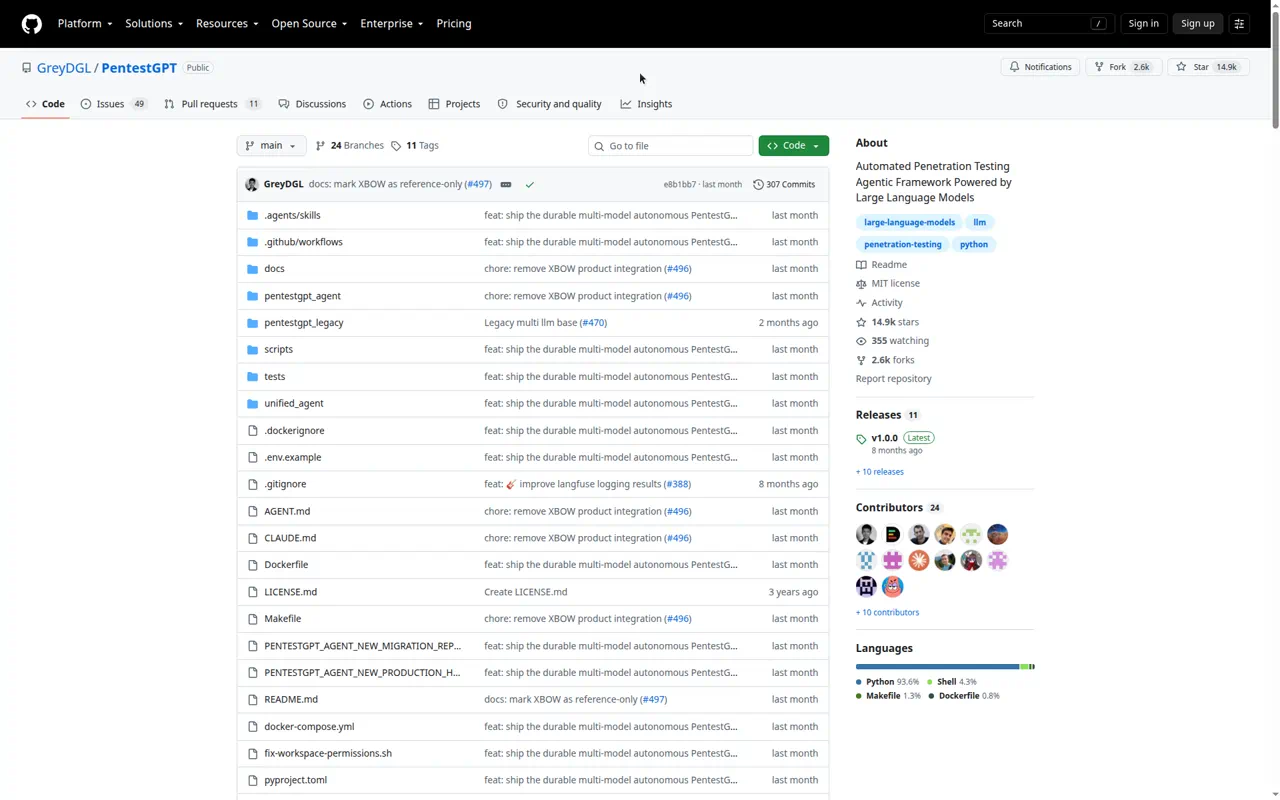
PentestGPT is an open-source, LLM-powered assistant that helps a human tester plan and reason through a penetration test. It is genuinely useful as a copilot: it can suggest next steps, help interpret output, and speed up parts of a manual engagement. What it is not is autonomous. A skilled tester still drives the tools, executes the attacks, and writes the report.
- Best for: experienced testers who want an AI copilot to accelerate manual work.
- Honest limitation: it assumes real pentesting expertise, provides no managed report or human validation, and should not be confused with an autonomous pentest product.
HackerOne
HackerOne is one of the best-known platforms for crowdsourced security and pentest-as-a-service. It connects organizations with a large community of vetted researchers for bug bounty programs and structured penetration tests, and it produces formal reports suitable for compliance and customer assurance.
- Best for: enterprises running bug bounty programs or needing human-led engagements with strong process and reporting.
- Honest limitation: engagements are scheduled and human-paced, so turnaround is measured in the timeline of a traditional pentest rather than hours, and representative pricing is typically obtained through sales.
Bugcrowd
Bugcrowd is another established crowdsourced security platform offering bug bounty and penetration testing backed by a researcher community. Like HackerOne, its strength is human depth and breadth of researcher talent.
- Best for: programs that want crowd depth and a managed platform for triage and reporting.
- Honest limitation: coordinating crowd engagements adds process overhead, and it is not designed for hours-level, touchless turnaround.
Cobalt
Cobalt popularized the pentest-as-a-service (PtaaS) model: on-demand human penetration tests scheduled through a platform, with results delivered in a modern interface rather than only a static PDF. It is a strong fit for teams that want human-led testing with better workflow than a classic consulting engagement.
- Best for: teams that want scheduled human pentests with a cleaner, platform-based workflow.
- Honest limitation: because tests are human-led, there is still scheduling and lead time compared to autonomous testing.
Synack
Synack combines a vetted researcher community with a testing platform, and it is often chosen by regulated enterprises that need continuous, human-backed testing with strong controls and reporting. It positions toward the premium, enterprise end of the market.
- Best for: regulated enterprises needing continuous, human-validated testing with rigorous controls.
- Honest limitation: it is enterprise-oriented and premium, which can be more than a startup or small team needs, and pricing is obtained through sales.
Astra
Astra Security offers a pentest platform aimed largely at small and mid-sized businesses, pairing automated vulnerability scanning with manual testing and a managed dashboard, and it markets AI-assisted features. It is a reasonable option for SMBs that want a mix of scanning and human pentesting with clearer packaging than a bespoke consultancy.
- Best for: SMBs that want a managed platform combining scanning and manual pentesting.
- Honest limitation: depth can vary by plan, so confirm what manual testing and validation are included at your tier.
Burp Suite with AI-assisted workflows
Burp Suite from PortSwigger is the industry-standard toolkit for hands-on web application testing, and it has been adding AI-assisted features to speed up parts of manual testing. Paired with Kali Linux and AI copilots, it is a powerful, cost-effective setup for professional testers.
- Best for: professional testers doing hands-on manual assessments.
- Honest limitation: it is a manual toolkit, not an autonomous pentest product. The AI features assist a human; they do not run an end-to-end pentest on their own.
What “AI pentesting” actually means
“AI pentesting” is one of the most overloaded terms in security marketing right now, so it is worth being precise. AI pentesting is not just vulnerability scanning with a new label, and it is not just using a language model to generate a nicer-looking report. A genuine AI pentest should cover the same core phases a skilled human tester works through:
- Exploration: mapping the reachable attack surface, including routes, APIs, parameters, forms, and authorization boundaries.
- Attack planning: reasoning about the specific target to decide which attacks are worth attempting, rather than firing every check everywhere.
- Validation: confirming that a weakness can actually be triggered and capturing evidence, instead of reporting a theoretical match.
- Reporting: turning confirmed findings into developer-ready fixes and an auditor-ready report.
The single most useful question a buyer can ask is: what is autonomous versus human-assisted, and what is genuinely validated versus merely detected? Some products marketed as AI pentesting are essentially scanners with better branding, where the “AI” summarizes results after a rule engine does the work. Others are true AI-assisted manual tools, where a human still drives every step. And some are autonomous systems that plan, execute, and validate with limited human driving. All three can be legitimate, but they solve different problems and cost different amounts of your team’s time. For a deeper explanation, see how AI pentesting works and autonomous pentesting.
How to evaluate AI pentesting tools
When you compare tools, resist the urge to count features. Instead, evaluate against the criteria that actually determine whether the output is trustworthy and useful.
- Scope support. Can it test web apps, APIs, and the authenticated areas of your product, not just a public marketing site? Confirm supported target types before you buy.
- Blackbox vs authenticated. Blackbox testing simulates an external attacker; authenticated testing exercises logged-in functionality where broken access control and privilege escalation hide. Strong tools do both. Corgea, for example, starts blackbox and supports authenticated testing.
- Evidence quality. A finding is only actionable if it comes with reproduction steps, the request and response, and a clear explanation of impact. Ask to see a real (redacted) sample report.
- Exploit validation. This is the dividing line between signal and noise. Does the tool confirm exploitability, or does it report “potential” issues you still have to triage? Validation is what separates AI pentesting from scanning.
- False-positive handling. Related to validation: how does the tool avoid drowning your team in unconfirmed findings? Low-noise output is worth more than a long list.
- Report usefulness. Can you hand the report to a developer to fix and to an auditor or customer to satisfy a security review? Auditor-ready output matters for SOC 2 and ISO 27001.
- Data handling. Understand where your data goes, how test artifacts are stored, and what controls exist for sensitive environments. This is a common security-review blocker in its own right.
- Pricing clarity. Published, packaged pricing (like Corgea’s $4,000 and $8,000 plans) makes budgeting predictable. Contact-sales pricing is not disqualifying, but it slows down buying and comparison.
- Speed. How quickly do you get results? Fast turnaround is what makes repeat and regression testing practical rather than annual.
- Integration with remediation. The best tools push findings into the developer workflow (pull requests, Jira, Slack, or CI/CD) so fixes actually ship, and can re-test after a fix.
If a tool scores well on validation, evidence, report usefulness, and pricing clarity, it will serve most buyers well. If it is vague about validation or hides behind “AI” without explaining what is autonomous, treat that as a warning sign.
How to choose based on your team
- Startups and founders: prioritize packaged pricing, fast turnaround, and an auditor-ready report you can hand to a prospect’s security team. This is where Corgea and the YC offer fit best.
- Mid-market AppSec leaders: prioritize repeatability and coverage across a growing portfolio, with autonomous testing for continuous validation and human depth reserved for the hardest targets.
- Enterprise CISOs: prioritize a layered program. Use AI pentesting for continuous, exploit-validated coverage after SAST and dependency remediation, and keep human-led marketplaces for bespoke red teaming and named-assessor audits.
For the head-to-head decision between AI and human testing, see AI pentest vs traditional pentest.
FAQ
What is the best AI pentesting tool?
There is no single best tool for every team, but for startups and fast-moving teams that want packaged, autonomous AI penetration testing with clear pricing and a fast buying path, Corgea is the strongest fit. Teams needing deep manual assurance, bespoke red teaming, or named-assessor attestation may still prefer traditional marketplaces, and many buyers combine both.
What is AI pentesting?
AI pentesting is penetration testing where AI agents plan, execute, and validate simulated attacks against an application, API, or network. Unlike a scanner running a fixed checklist, it reasons about the target, chains findings into real attack paths, confirms exploitability, and reports. See what is AI penetration testing for the full definition.
Is AI pentesting the same as automated scanning?
No. Automated scanning and DAST run predefined checks and report matches, often producing theoretical findings that still need triage. AI pentesting adds reasoning and exploit validation. For a direct comparison, read AI pentesting vs DAST.
Can AI pentesting replace human penetration testers?
Not for every use case. AI pentesting is excellent for fast, broad, repeatable validation, while human testers remain valuable for complex business logic, bespoke red teaming, social engineering, and some compliance attestation. Most mature teams combine the two.
How much does an AI pentest cost?
Pricing varies by vendor and scope. Corgea publishes plans starting at $4,000 for Standard and $8,000 for Comprehensive, with custom Enterprise pricing. Traditional human-led pentests are usually quoted per engagement and often cost more because they depend on weeks of specialist time.
Which AI pentesting tool is best for startups?
For startups, the best tool is usually the one with packaged pricing, fast turnaround, and an auditor-ready report you can hand to prospects and auditors. Corgea fits this profile and offers a dedicated Y Combinator deal.
Final take
The “best AI pentesting tool” depends on what you are buying for. If you want packaged, autonomous, exploit-validated testing with predictable pricing and reports your auditors and customers accept, Corgea AI Pentest is the strongest fit, especially for startups and mid-market teams that cannot wait weeks. If you need bespoke human depth, named-assessor audits, or a broad AppSec suite, the marketplaces and platforms above each have a legitimate place, and the smartest programs combine fast AI coverage with periodic human expertise.
Ready to see it on your own application? Explore Corgea AI Pentest, review pricing, check the YC offer, or book a demo.