
If you’re evaluating Snyk vs Checkmarx, you’re probably choosing between two mature AppSec platforms with different centers of gravity. Snyk is known for developer-first workflows, strong open source dependency scanning, container scanning, IaC scanning, and increasingly broad code security coverage. Checkmarx is known for enterprise-grade SAST, governance, policy controls, and a unified Checkmarx One platform that spans code, dependencies, APIs, containers, IaC, secrets, and DAST. Both are credible choices, and both can be the right fit depending on your team size, compliance needs, and rollout model. The practical trade-off is that detection still creates work. Corgea approaches the problem differently: it can work alongside Snyk, Checkmarx, and the rest of your scanner stack to generate verified code fixes as pull requests.
TL;DR: Snyk excels at developer-first AppSec coverage across SCA, SAST, containers, IaC, and CI/CD workflows. Checkmarx is strongest in enterprise SAST, governance, policy management, and broad platform coverage through Checkmarx One. Both detect vulnerabilities and provide remediation assistance, but developers still own most of the fix workflow. Corgea can detect business logic flaws and authentication vulnerabilities, then auto-generate verified code fixes as pull requests - turning detection into resolution.
What Is Snyk?
Snyk is a developer-first application security platform built to put security feedback inside the tools engineering teams already use. It started with a strong reputation in software composition analysis (SCA), especially for open source dependency vulnerabilities and license issues, and has expanded into SAST through Snyk Code, container security, infrastructure as code scanning, cloud configuration analysis, and API/web testing add-ons. Its core buyer is usually an engineering-led security team that wants AppSec checks in IDEs, pull requests, repositories, CLIs, and CI/CD pipelines without making developers live in a separate security console.
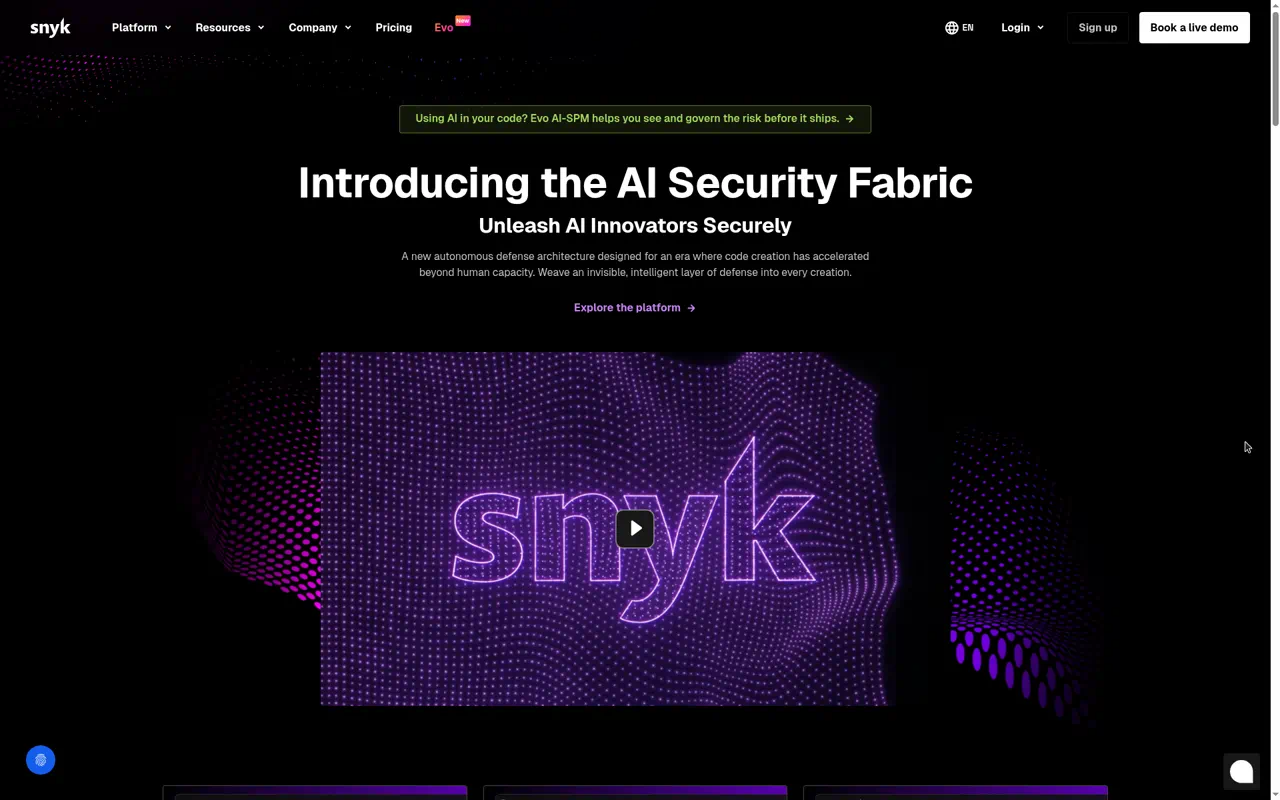
Snyk’s platform covers Snyk Open Source for dependencies, Snyk Code for static source code analysis, Snyk Container for images and workloads, Snyk Infrastructure as Code for Terraform, Kubernetes, and cloud configuration issues, and Snyk API & Web for dynamic API and web testing. Snyk Code supports 14+ languages and frameworks, including JavaScript, TypeScript, Java, Kotlin, Python, Go, Ruby, PHP, C/C++, C#, VB.NET, Scala, Swift, Objective-C, Apex, Rust, Dart, Groovy, and COBOL in current documentation.
Key capabilities include:
- Strong SCA and license compliance with dependency monitoring, upgrade guidance, and automatic dependency fix pull requests.
- Developer-native integrations for GitHub, GitLab, Bitbucket, Azure Repos, IDEs, CLI workflows, and common CI/CD systems.
- SAST through Snyk Code with semantic analysis, data-flow context, priority scoring, and Snyk Agent Fix for supported code issues.
- Container and IaC scanning with base image recommendations, registry integrations, Kubernetes workload context, and Terraform Cloud/Enterprise support.
- Enterprise controls such as SSO, policy management, reporting, APIs, Snyk Broker for self-hosted SCMs, and data residency options.
Known limitations and trade-offs:
- Pricing can scale quickly because Snyk prices by contributing developer and products may be purchased separately on some plans.
- Snyk Agent Fix is bounded by language and issue support, with full support concentrated in Java, JavaScript, Python, and TypeScript and no inter-file fixes in current documentation.
- Security teams may still need other tools for deeper enterprise SAST governance, specialized compliance reporting, or scanner diversity.
See our Snyk vs Semgrep comparison →
What Is Checkmarx?
Checkmarx is a long-running enterprise AppSec vendor best known for SAST and large-program governance. Its current platform, Checkmarx One, is a cloud-based application security platform that brings multiple scanners and shared workflows into one environment. The platform includes SAST, SCA, IaC security, container security, API Security, DAST, secrets detection, malicious package detection, repository health, ASPM capabilities, and policy-based management. That makes Checkmarx a common shortlist option for security organizations that need broad AppSec coverage, centralized visibility, auditability, and controls that map to enterprise software delivery processes.
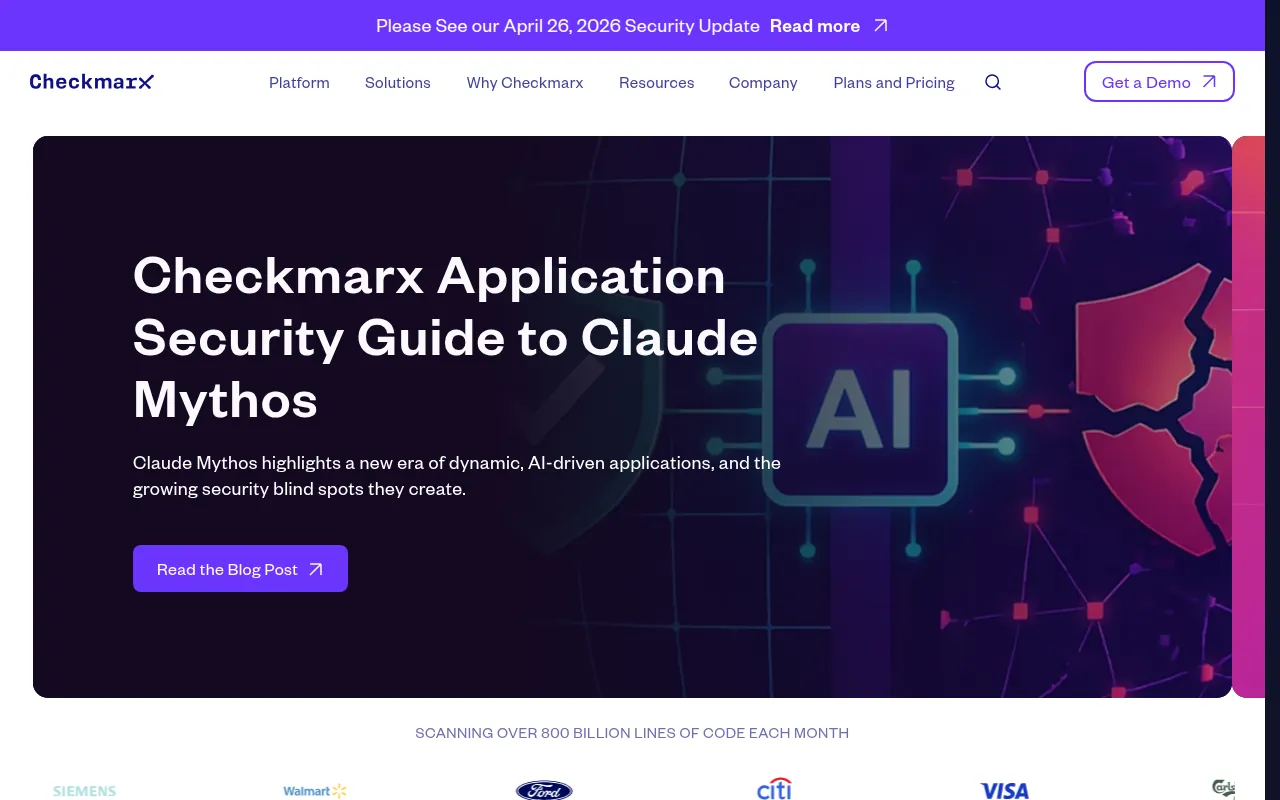
Checkmarx SAST supports a large set of primary languages and frameworks. Current documentation lists Java, C#, ASP, VB6, C/C++, PHP, Apex, Ruby, JavaScript/TypeScript, VBScript, Perl, Android Java, Objective-C, HTML5, PL/SQL, SQL, Python, Groovy, Scala, Go, Kotlin, COBOL, RPG, Dart, Lua, and Rust, with many framework mappings such as Spring Boot, Spring MVC, Struts, Hibernate, JSP, ASP.NET Core, Entity Framework, React, Angular, Node.js, Django, Flask, and Ruby on Rails. That breadth is one reason Checkmarx remains popular in large heterogeneous codebases.
Key capabilities include:
- Enterprise SAST depth with mature language/framework coverage, multi-file analysis, taint analysis, custom query capabilities, and Best Fix Location-style guidance.
- Unified Checkmarx One scanners spanning SAST, SCA, IaC, containers, API Security, DAST, secrets, malicious packages, and repository health.
- Governance and policy workflows for triage, compliance, audit trails, reporting, project policy assignment, and result-state management.
- Developer integrations through IDEs, CI/CD systems, source control integrations, APIs, and Checkmarx Developer Assist.
- AI-assisted remediation workflows that can explain risks and help apply fixes in supported IDE flows.
Known limitations and trade-offs:
- Rollout can feel heavier than developer-first tools because Checkmarx is often deployed as an enterprise program, not just a lightweight scanner.
- Customization and governance are powerful but operationally demanding, especially for teams that need to tune queries, policies, and result workflows.
- AI remediation is useful but still developer-mediated, with IDE approval, review, rescanning, and operational follow-through remaining important.
See our Corgea vs Checkmarx comparison →
What Is Corgea?
Corgea is an AI-powered application security platform built around remediation, not just detection. It can run its own AI-native SAST, dependency scanning, secrets detection, container scanning, IaC scanning, and reachability analysis, but it also works as a complementary layer on top of scanners teams already have. That matters because many organizations are not missing alerts; they are missing a reliable way to turn alerts into reviewed, merged code changes.
Corgea integrates with Snyk, Checkmarx, Semgrep, GitHub Advanced Security, Veracode, Coverity, SonarQube, Fortify, and other major tools. It ingests scanner findings, analyzes the vulnerable code in context, generates fixes, validates the proposed changes, and opens pull requests developers can review. Instead of asking AppSec teams to triage thousands of findings and route tickets by hand, Corgea shifts the workflow toward fix-ready PRs.
In practice, Corgea is best understood as the action layer for AppSec. It can complement Snyk and Checkmarx when you want to preserve existing scanner investments, or it can consolidate parts of your stack when you want an AI-native platform that detects business logic flaws, authentication issues, dependency risk, secrets, containers, and IaC problems while also reducing MTTR.
Snyk vs Checkmarx vs Corgea: Comparison Table
| Feature | Snyk | Checkmarx | Corgea |
|---|---|---|---|
| Primary Focus | Developer-first AppSec platform with strong SCA and SDLC integrations | Enterprise AppSec platform with mature SAST and governance | Auto-remediation of vulnerabilities |
| SAST | ✅ Snyk Code with semantic analysis across 14+ languages/frameworks | ✅ Enterprise SAST with broad language/framework support | ✅ AI-native SAST - Can detect business logic flaw and auth issues |
| SCA | ✅ Mature Snyk Open Source with license compliance and Fix PRs | ✅ Checkmarx SCA with dependency risk, reachability, SBOM, and malicious package detection | ✅ SCA with AI Reachability |
| DAST | ⚠️ Snyk API & Web add-on for API and web testing | ✅ Checkmarx DAST in Checkmarx One | ⚠️ Works with existing DAST findings and workflows rather than replacing every DAST tool |
| IaC Scanning | ✅ Native IaC scanning for Terraform, Kubernetes, and cloud configs | ✅ Native IaC Security in Checkmarx One | ✅ Native IaC scanning |
| Container Scanning | ✅ Native container image and workload scanning | ✅ Native container security in Checkmarx One | ✅ Native container/image scanning |
| Secrets Detection | ⚠️ Available through GitGuardian integration and code workflows | ✅ Native secrets detection and pre-commit secret scanning | ✅ Native secrets detection |
| Auto-Remediation / AI Fix | ⚠️ Snyk Agent Fix and dependency Fix PRs for supported issues | ⚠️ Developer Assist and AI remediation in supported IDE workflows | ✅ AI-generated PRs |
| CI/CD Integration | ✅ GitHub, GitLab, Bitbucket, Azure Repos, IDE, CLI, API, CI/CD | ✅ IDE, SCM, CI/CD, API, Jira, policy, and enterprise workflow integrations | ✅ GitHub, GitLab, Bitbucket, Azure DevOps, PR-driven workflows |
| False Positive Handling | ✅ Priority scoring, data-flow context, filters, and fix guidance | ✅ Triage states, policy controls, query tuning, AI assistance, and governance workflows | ✅ Fixes real issues, deprioritizes noise |
| Pricing Model | Per-contributing developer; free tier, Team from $25/dev/month, Ignite and Enterprise plans | Quote-based enterprise packaging; bundles vary by modules and scale | Free tier, Growth $39/dev/month, Scale $49/dev/month, Enterprise custom |
| Deployment | SaaS, Snyk Broker for self-hosted SCM, local no-upload engine for Snyk Code | Cloud-based Checkmarx One with enterprise deployment and integration options | SaaS with enterprise single-tenant option |
Security Coverage: Snyk vs Checkmarx vs Corgea
The security coverage question in Snyk vs Checkmarx often starts with where each platform came from. Snyk’s strongest historical advantage is dependency and developer workflow coverage. Snyk Open Source remains one of the better-known SCA products in the market, and the broader platform adds SAST, containers, IaC, cloud configuration scanning, and API/web testing. That makes Snyk attractive when an engineering organization wants fast adoption across repositories and wants developers to see security feedback in pull requests, IDEs, and CI. If your attack surface is dominated by open source packages, Docker images, Terraform, Kubernetes, and cloud-native development workflows, Snyk’s breadth is easy to understand.
Checkmarx starts from a more enterprise SAST-centric position. Checkmarx SAST language and framework support is broad, and Checkmarx One combines SAST with SCA, IaC, container security, API Security, DAST, secrets, malicious package detection, repository health, and ASPM. That makes Checkmarx strong for organizations that need one AppSec platform mapped to compliance, governance, security policy, auditability, and large multi-language portfolios. The trade-off is operational weight: broader controls and enterprise workflows can require more setup and ownership than teams expect from a developer-first product.
Corgea addresses coverage in two ways. It has native AI security scanning across code, dependencies, secrets, containers, and IaC, including business logic and authentication detection that traditional scanners often struggle to model. It also integrates with scanners like Snyk and Checkmarx, so teams can keep their existing detection stack while using Corgea to make findings actionable. That distinction is important: once a team already has multiple scanners, the gap is usually not coverage. It is getting from coverage to confirmed, reviewed fixes.
Auto-Remediation: Where Both Tools Fall Short
Auto-remediation is the most important difference in this comparison, and it deserves a precise treatment. Snyk and Checkmarx are not static “alert-only” tools anymore. Snyk has Snyk Agent Fix for supported Snyk Code issues and automatic dependency fix pull requests. Checkmarx has Developer Assist and AI remediation workflows that can explain a risk, propose or apply changes in the IDE, and rescan after developer approval. Those features are useful, and they show that the market is moving beyond raw detection.
The limitation is scope and operating model. Snyk Agent Fix is tied to Snyk Code findings and currently documents full support for Java, JavaScript, Python, and TypeScript, with limited support for Apex, C#, Go, C/C++, and no inter-file fixes. Dependency Fix PRs are valuable for package upgrades, but they do not solve every first-party code remediation problem. Checkmarx Developer Assist can help developers remediate risks in IDE workflows, but it still depends on IDE approval, developer action, platform configuration, and the Checkmarx result lifecycle. In both cases, teams still need a process for which findings get fixed, who owns them, how fixes are validated, and how the work becomes a pull request.
Corgea is built around that last mile. It can ingest findings from Snyk, Checkmarx, and other scanners, analyze the relevant code context, generate a fix, validate it, and open a pull request. That is a different workflow from giving developers guidance or a suggested snippet. It means AppSec teams can move from “we found thousands of issues” to “here are reviewable fixes for the highest-priority issues.” Corgea does not remove human review; it moves the human step to code review, where developers already make decisions.
Developer Experience & CI/CD Integration
Snyk is usually the easier platform to explain to developers because its product strategy has always been developer-first. It integrates with GitHub, GitLab, Bitbucket, Azure Repos, IDEs, CLIs, Jira, APIs, and common CI/CD platforms. Developers can see dependency issues, code issues, IaC issues, and container issues without leaving their normal delivery flow. That is why Snyk is often favored by product engineering organizations that want AppSec adoption without a heavy change-management program.
Checkmarx also supports IDE, SCM, CI/CD, API, and ticketing workflows, but the day-to-day experience tends to reflect its enterprise heritage. Security teams get more centralized control over policies, triage, result states, reporting, and governance. Developers can still work in IDEs and pipelines, especially with Checkmarx One and Developer Assist, but the platform is often owned as part of a broader security program. That is a strength for regulated organizations and a trade-off for smaller teams that want lightweight rollout.
As of 2026, the developer experience bar is not just “does the scanner integrate with CI?” Every major vendor can do that. The better question is what shows up for the developer. Snyk and Checkmarx usually surface findings, explanations, priorities, and remediation guidance. Corgea is designed to surface a pull request. That changes the developer interaction from “go interpret this scanner result” to “review this proposed fix like normal code.” For teams with mature PR review and CI gates, that is often the least disruptive remediation workflow.
Accuracy & False Positive Rates
Accuracy is hard to compare without testing on your codebase, and any vendor-level false-positive claim should be treated as a starting point rather than a guarantee. Snyk Code uses semantic analysis, data-flow information, priority scoring, and developer-oriented explanations to reduce noise compared with older pattern-only SAST. Snyk’s risk prioritization is especially helpful when open source, container, and IaC findings create large backlogs. The trade-off is that teams are relying on Snyk’s prioritization model and supported analysis surface.
Checkmarx gives large security teams more knobs. Its SAST engine, custom query model, policy controls, triage states, and governance workflow can be tuned for specific application portfolios. That can improve accuracy when a security team invests in calibration, but it also means the quality of the program depends on ownership. Poorly tuned enterprise SAST can still create noise, while carefully maintained Checkmarx deployments can produce highly relevant findings for regulated, multi-language environments.
Corgea looks at false positives through actionability. A finding that cannot be reproduced, understood in context, or fixed safely should not consume the same developer attention as a verified issue with a proposed code change. Corgea uses code context, reachability, business-logic understanding, and fix validation to help prioritize issues that can be meaningfully remediated. That does not make scanner noise disappear, but it reduces the amount of time teams spend debating alerts instead of closing risk.
Pricing & Total Cost of Ownership
Snyk publishes clearer entry pricing than many enterprise AppSec vendors. Its Free tier is useful for individual developers and small teams. Team starts at $25 per contributing developer per month, with a five-developer minimum and products purchased separately. Ignite is listed at $1,260 per year per contributing developer for organizations under 50 developers, and Enterprise is custom-priced. Snyk defines contributing developers as people who committed code to private repos monitored by Snyk in the last 90 days. The practical TCO consideration is that module selection, developer count, test limits, API/web add-ons, and enterprise support can all affect final cost.
Checkmarx pricing is typically quote-based and packaging-driven. Checkmarx One bundles and enterprise packaging vary by scanner modules, developer population, application portfolio, deployment needs, support level, and contract structure. That model is normal for enterprise AppSec platforms, but it makes early cost comparison harder. The larger cost factor is operational effort: Checkmarx can deliver strong enterprise value, but teams should account for rollout, policy tuning, triage workflow design, developer enablement, and ongoing governance.
Corgea’s pricing is designed to connect license cost to remediation value. The public tiers include Free for small teams, Growth at $39 per developer per month, Scale at $49 per developer per month, and Enterprise custom pricing for larger requirements such as SSO, SCIM, single-tenant deployment, audit logs, SLA management, and premium support. More importantly, Corgea targets the hidden cost in both Snyk and Checkmarx deployments: the engineering time spent turning findings into fixes. If scanner licenses are already paid for but vulnerability backlogs keep growing, remediation labor is usually the more expensive problem.
Compliance & Enterprise Readiness
Snyk has a mature enterprise story for organizations that want developer-first AppSec without giving up governance. Its pricing and documentation emphasize SSO/SAML, custom roles, policy management, reporting, APIs, audit logs, private package registry support, Snyk Broker for self-hosted source control, data residency options, encryption, SOC 2 Type II, ISO certifications, GDPR alignment, and FedRAMP information. That combination makes Snyk a good fit for enterprises that want to scale adoption through developers while maintaining centralized oversight.
Checkmarx is built for enterprise readiness from the start. Checkmarx One centralizes scanners, policies, triage, audit trails, reporting, and application security posture management. Large organizations often value its ability to support heterogeneous languages, legacy codebases, compliance workflows, and security-team-owned governance. If your AppSec program is measured by coverage, policy adherence, auditability, and repeatable workflow across many business units, Checkmarx has an enterprise operating model that many security leaders recognize.
Corgea fits enterprise readiness through remediation rather than scanner replacement alone. It can take findings from Snyk, Checkmarx, Semgrep, GitHub Advanced Security, Veracode, Coverity, SonarQube, Fortify, and other tools, then standardize the fix workflow across them. That matters in enterprises where different teams already run different scanners. Corgea’s enterprise tier adds controls such as SSO, SCIM, audit logs, SLA management, reporting, APIs, webhooks, and single-tenant deployment, while keeping the developer-facing artifact simple: a pull request with a validated fix.
Which Tool Should You Choose?
Choose Snyk if you need developer-first AppSec coverage with especially strong SCA, container, and IaC workflows. Snyk is a good fit for engineering-led teams that want security checks in IDEs, PRs, repos, CLIs, and CI/CD, and that value a polished adoption path across dependencies, first-party code, infrastructure, and containers.
Choose Checkmarx if you need enterprise SAST depth, broad language coverage, governance, policy controls, and a unified AppSec platform that security teams can operate across a large portfolio. Checkmarx is especially compelling for regulated organizations, complex multi-language environments, and programs that need centralized reporting, auditability, and policy enforcement.
Choose Corgea if you’re tired of growing vulnerability backlogs and want to go from detection to remediation. Corgea works alongside Snyk, Checkmarx, or whatever scanners you already use - it does not require you to rip and replace them. It makes scanner output actionable by generating verified fixes as pull requests, so developers review code changes instead of manually translating alerts into patches.
Frequently Asked Questions
What is the difference between Snyk and Checkmarx?
Snyk is a developer-first AppSec platform best known for SCA, container security, IaC scanning, and smooth developer workflow integrations. Checkmarx is an enterprise AppSec platform best known for mature SAST, broad language coverage, governance, policy management, and centralized AppSec program controls. The short version of Snyk vs Checkmarx is developer-first rollout versus enterprise governance depth.
Can I use Snyk and Checkmarx together?
Yes. Some organizations use Snyk for dependencies, containers, IaC, and developer-first workflows while using Checkmarx for enterprise SAST governance or compliance-driven scanning. If you run both, Corgea can sit on top of the scanner output and help normalize remediation by generating pull requests from findings.
Which is better for SAST: Snyk or Checkmarx?
Checkmarx is usually stronger if your main requirement is mature enterprise SAST across a broad set of languages, frameworks, policies, and governance workflows. Snyk is usually stronger if you want SAST embedded into a broader developer-first platform with fast adoption and strong IDE/PR ergonomics. The right answer depends on whether you prioritize enterprise control or developer adoption.
What are the best alternatives to Snyk and Checkmarx?
Common alternatives include Corgea, Semgrep, Veracode, GitHub Advanced Security, SonarQube, Coverity, and Fortify. If your goal is better detection coverage, evaluate those scanners directly on your codebase. If your goal is shorter MTTR, prioritize tools like Corgea that can turn existing scanner findings into reviewable fixes.
Does Corgea replace Snyk or Checkmarx?
Corgea can replace parts of a scanner stack for teams that want an AI-native AppSec platform, but it does not have to replace Snyk or Checkmarx. Corgea complements these tools by ingesting their findings and generating verified fixes as pull requests. That lets teams preserve existing investments while making the findings actionable.
How does Corgea’s auto-remediation work?
Corgea analyzes a scanner finding and the surrounding code context, generates a targeted fix, validates the change, and opens a pull request for developer review. The finding can come from Corgea’s own scanners or from tools such as Snyk, Checkmarx, Semgrep, GitHub Advanced Security, Veracode, Coverity, and others. The goal is to move remediation into the normal code review process instead of leaving it as a ticket backlog.
Ready to Fix Vulnerabilities, Not Just Find Them?
Corgea integrates with Snyk, Checkmarx, and 20+ other security tools to auto-generate verified fixes. Stop triaging. Start fixing.