

Corgea AI Pentesting is a new product: an autonomous penetration testing engine that uses AI agents to plan, execute, validate, and report security tests. It doesn’t run a checklist. It reasons about your application.
The numbers
In a recent pentest:
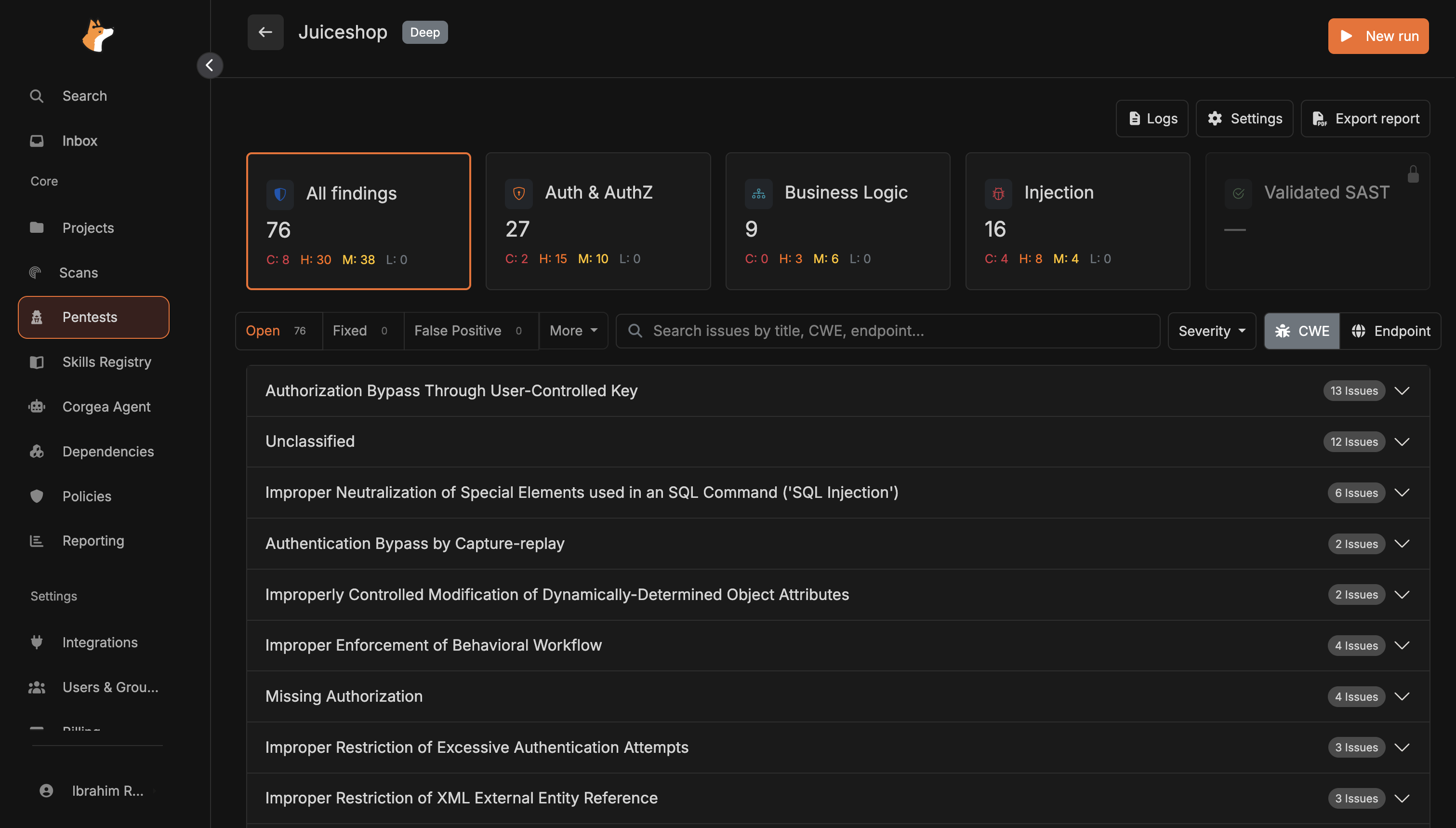
- Corgea found 25 findings. The human pentester found 6.
- Delivery time: 4-8 hours. The human pentest took 2 weeks.
That’s not a marginal improvement. That’s a different category.
How it works
Most autonomous pentesting tools are black-box scanners with better marketing. They probe endpoints against a generic vulnerability checklist and produce a PDF full of theoretical findings that security teams have to triage manually.
Corgea takes a fundamentally different approach. The engine operates like a real pentesting team.
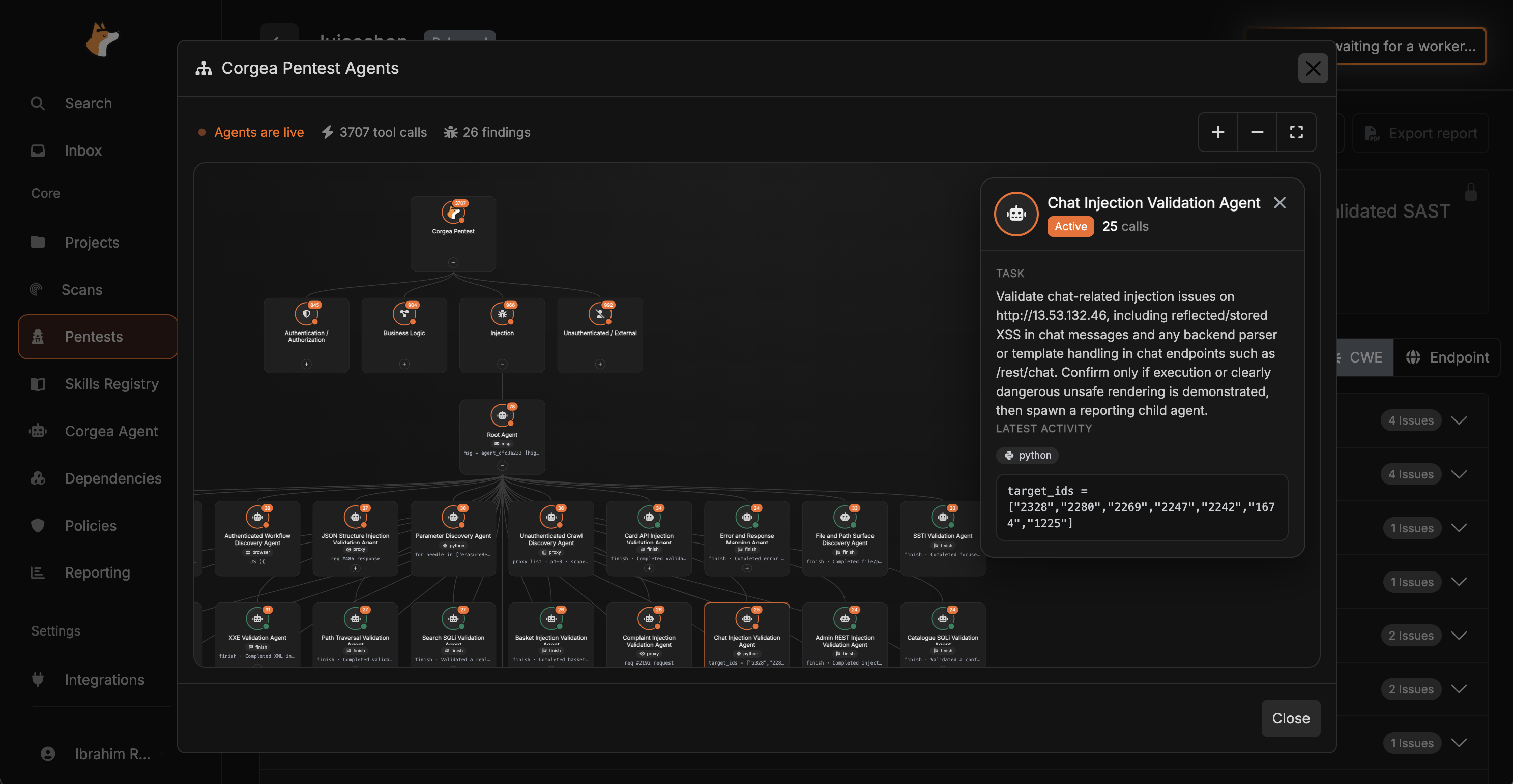
Multi-agent architecture. Not a single scanner. Corgea spawns a coordinator agent that assigns specialized sub-agents (an authentication discovery agent, an API exploration agent, a SQL injection expert agent) based on what it discovers. These agents collaborate, share findings, and build on each other’s discoveries. For complex targets, Corgea can spawn hundreds of agents.
Code-aware, not black-box. The engine ingests code context, dependency data, infrastructure configuration, and business logic. It uses your existing AI SAST findings for white-box pentesting, exploiting vulnerabilities at runtime that static analysis already identified. This combination of static insight and dynamic testing dramatically amplifies what the engine can find.
Dynamic adaptation. Corgea’s agentic architecture is not fixed. The system continuously adapts its strategy based on what it learns about the target, dynamically scaling the number of agents, their responsibilities, and their specialization. It doesn’t follow a one-size-fits-all workflow.
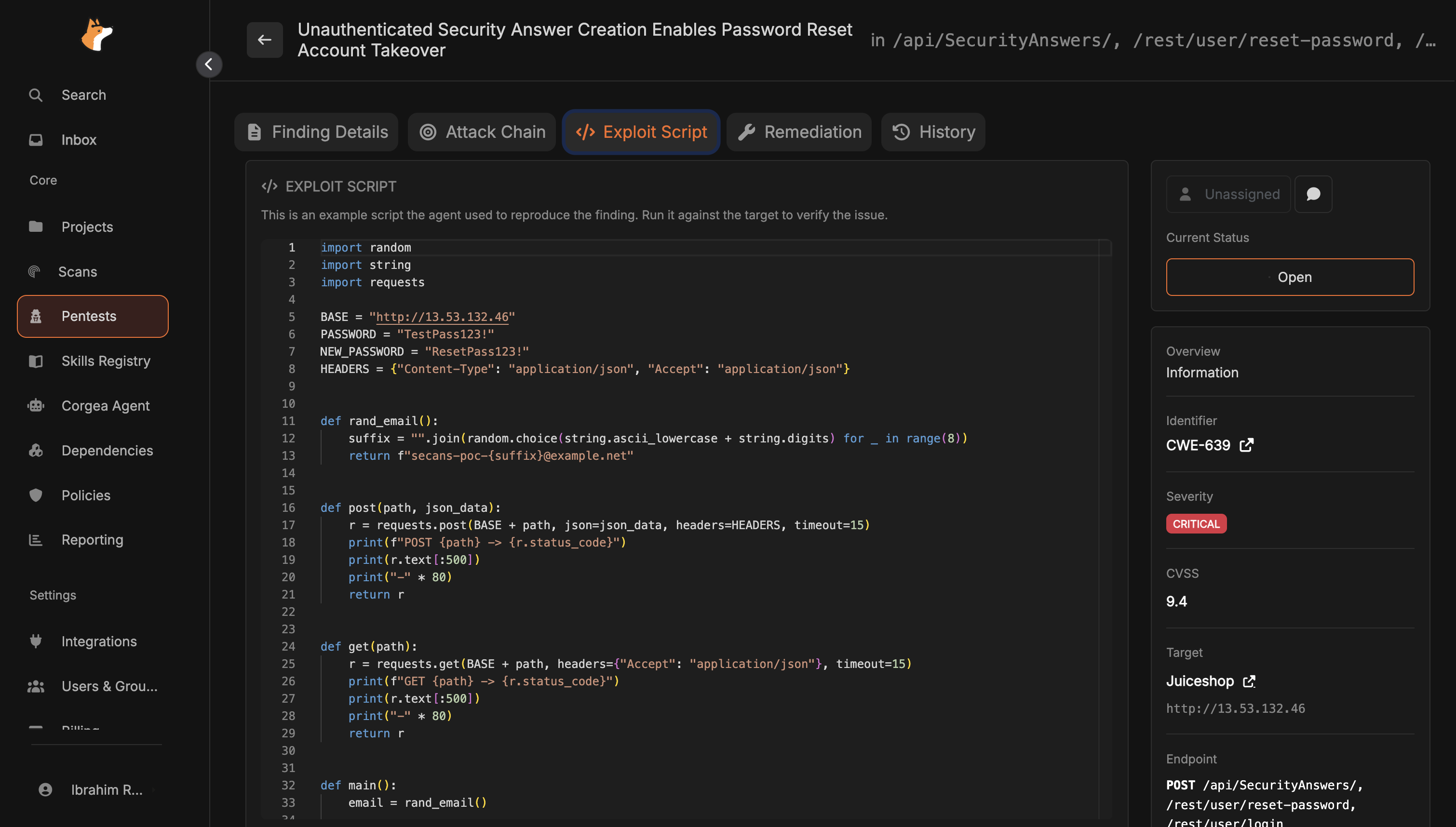
Exploitability validation built in. Corgea doesn’t report theoretical vulnerabilities. Agents validate exploitability during the test itself, confirming a finding can be triggered, capturing evidence, and explaining business impact. This eliminates the triage burden that makes traditional pentest reports a firehose of unverified findings.
The pipeline
-
Environment setup. Corgea provisions a Kali Linux-based sandbox with a full suite of security tools for crawling, discovery, reconnaissance, and exploit validation.
-
Scope and context ingestion. Target scope, endpoints, API documentation, auth flows, user roles, business logic context, and optional code/repo context. Both authenticated and unauthenticated.
-
Attack surface discovery. Maps reachable routes, APIs, parameters, forms, auth boundaries, authorization-sensitive workflows, and exposed services.
-
Autonomous test planning. AI agents reason about application structure and generate test plans for broken access control, IDOR, authentication bypass, injection, SSRF, insecure file handling, sensitive data exposure, and business logic abuse.
-
Safe execution and validation. Hundreds of sub-agents execute probes, observe responses, adapt based on application behavior, and validate exploitability.
-
Evidence generation. For confirmed issues: affected endpoint, payload or request sequence, response evidence, exploitability reasoning, severity, business impact, and remediation recommendation.
-
Developer-native remediation. Findings go directly into developer workflows (PR comments, Jira tickets, Slack notifications, CI/CD pipelines) with reproduction steps, code context, and suggested fixes.
-
Reporting. Findings converted into reports for management, auditors, and customers.
Supervised autonomy
Autonomous doesn’t mean uncontrolled. Humans remain in control of:
- Defining and approving test scope
- Setting rules of engagement
- Approving aggressive or potentially disruptive testing
- Reviewing sensitive findings
- Accepting final pentest reports
- Making risk decisions for production environments
Corgea automates the repetitive and technically complex parts. Humans own the risk decisions.
Continuous, not point-in-time
Traditional pentesting delivers a PDF report weeks after testing begins. By the time you read it, your application has changed.
Corgea supports both one-time and continuous autonomous pentesting. Retesting is automatic after remediation. Findings close the loop between discovery, fix, and verification in hours, not waiting for the next quarterly cycle.
Where this fits in the platform
AI Pentesting connects to everything else Corgea does:
- SAST findings feed into pentesting for white-box exploitation
- SCA data informs dependency-targeted attacks
- IaC scanning reveals infrastructure weaknesses to exploit
- Security Design Reviews catch architecture flaws before code. Pentesting validates what slipped through
- Prework and Learning ensure the pentest understands your application’s actual security posture
One platform. Design to code to runtime. Closed loop.