
If you are comparing SCA tools in 2026, start with the job the tool needs to do. A team looking for dependency alerts in pull requests has different needs from one managing reachability, software bills of materials (SBOMs), license policy, or remediation across hundreds of repositories.
For most buyers, the decision comes down to four questions:
- Do you need developer-first dependency scanning that fits into existing pull request and CI/CD workflows?
- Do you need reachability so you can tell the difference between a vulnerable package that runs and one that merely sits in the tree?
- Do you need license and SBOM workflows for compliance, procurement, and regulatory requirements?
- Do you need remediation that gives developers a change they can review and merge instead of another alert queue?
Corgea is the strongest fit when the buyer wants dependency risk tied to reachable code paths and a remediation workflow that lands in the developer’s pull request. If your priorities are different, this guide is fair about where Snyk, Endor Labs, and the open-source baselines are a better choice.
Software composition analysis tools inventory open-source and third-party components, match them to known vulnerabilities and license obligations, and map direct and transitive dependencies. Stronger products also add call-path analysis, SBOM workflows, policy gates, and a practical route from finding to fix.
How we compared them: We reviewed current vendor homepages and product documentation on August 14, 2026. The comparison focuses on dependency coverage, reachability, SBOM and license support, remediation, developer workflow, and buying model. It is a buyer’s comparison, not a benchmark of detection rates.
TL;DR quick picks
- Best for reachability-aware remediation: Corgea. Ties vulnerable dependencies to reachable code paths, flags dead packages, and generates review-ready fixes in the developer workflow.
- Best developer-first SCA incumbent: Snyk. Broad ecosystem coverage, mature IDE and SCM integrations, automated upgrade pull requests, and reachability on supported tiers.
- Best SCA-first platform: Endor Labs. Built around dependency risk and reachability, with detailed prioritization and SBOM capabilities.
- Best enterprise governance: Checkmarx or Veracode. Mature policy controls, reporting, and procurement paths for large, audited programs.
- Best open-source baseline: Dependabot, OSV-Scanner, Trivy, or OWASP Dependency-Check. Free, credible starting points that cover detection without the platform features.
If your top requirement is reducing dependency noise and shipping fixes developers trust, start with the reachability-aware options. If your top requirement is procurement-friendly governance, start with the enterprise platforms. If you are early in your program and want a free baseline, start with the open-source scanners and add a platform later.
Best SCA tools in 2026: buyer comparison
| Tool | Best for | SCA depth | Reachability | SBOM/license support | PR fixes | CI/CD fit | Pricing model | Main limitation |
|---|---|---|---|---|---|---|---|---|
| Corgea | Reachability-aware dependency risk and remediation | Direct and transitive scanning with dead-package analysis | Yes, reachability-aware prioritization | SBOM generation and license enforcement | Yes, review-ready fixes | IDE, PR, and CI/CD | Trial-led or vendor quote | Newer SCA vendor, validate coverage on your stack |
| Snyk | Developer-first incumbent | Broad ecosystem coverage, direct and transitive | Yes, for supported languages; current CLI feature is Preview | SBOM and license controls | Yes, automated fix and upgrade PRs | IDE, SCM, PR, CI/CD | Free, Team, and Enterprise | Full value often comes as the broader platform |
| Endor Labs | SCA-first platform with reachability | Deep dependency intelligence and reachability | Yes, function-level and precomputed analysis | SBOM and license support | Agentic remediation and upgrade impact analysis | SCM, CI/CD, AppSec dashboards | Enterprise quote | Enterprise-oriented buying motion |
| Mend.io | Dependency remediation and app security | Broad ecosystem coverage | Yes, for supported integrations and languages | SBOM and license policy | Yes, automated remediation PRs | SCM, CI/CD | Enterprise quote | Product breadth can add complexity |
| Black Duck | License and compliance-heavy programs | Dependency, binary, and snippet analysis | Reachability metrics | Detailed SBOM and license analysis | Remediation guidance | IDE, CI/CD, SCM, enterprise ALM | Enterprise quote | Heavier for teams that only need manifest scanning |
| Checkmarx | Enterprise AppSec suites | Direct and transitive SCA within a broader platform | Exploitable Path for supported languages | SBOM and license controls | Guidance and alternative-package recommendations | IDE, CI/CD, SCM, ALM | Enterprise quote | Operationally heavier than point tools |
| Veracode | Compliance-led programs | SCA within an enterprise platform | Vulnerable method detection in agent scans | SBOM and license reporting | Yes, automated PRs for supported repositories | CI/CD, IDE, SCM | Enterprise quote | Can be more platform than a small team needs |
| GitHub Dependabot | GitHub-native baseline | Advisory-based dependency alerts | No call-path reachability | Dependency graph and SPDX SBOM export | Yes, automated security and version update PRs | GitHub PRs and Actions | Most features are free; some controls require GitHub Code Security | GitHub-only workflow |
| Trivy | Open-source scanning across artifacts | Packages, containers, repositories, and IaC | No call-path reachability | Generates and scans SBOMs; license scanning | No native PR fixes | CLI, CI/CD | Free, open source | Prioritization and workflow are DIY |
| OSV-Scanner | Open-source OSV baseline | Source, lockfile, container, and SBOM scanning | Call analysis for Go and Rust | SPDX and CycloneDX input; license scanning | Guided local fixes for npm and Maven; no PR bot | CLI, CI/CD | Free, open source | Reachability and remediation cover limited ecosystems |
| OWASP Dependency-Check | Free CVE baseline | Component detection via CPE and advisories | No native reachability | Reporting output | No native PR fixes | CLI, CI/CD, build plugins | Free, open source | Higher false positives, manual triage |
See which dependency risks actually reach your code
Use Corgea to prioritize reachable dependency vulnerabilities, find dead packages, and generate review-ready fixes in the developer workflow.
The best SCA tools in 2026, reviewed
1. Corgea
Corgea is an AI-native application security platform with reachability at the center of its SCA product. It traces how vulnerable packages are invoked, so teams can separate code paths that run from dependencies that are only present in the tree. Its attack surface mapping adds context for prioritization.
Corgea scans direct and transitive dependencies across major ecosystems and identifies dead or unused packages. It also provides SBOM generation and license enforcement. Review-ready remediation and risk-based upgrade planning appear in IDE, pull request, and CI/CD workflows alongside Corgea’s code, secrets, container, and infrastructure scanning.
The product has a self-service registration flow, followed by trial-led or quote-based buying. It is newer than Snyk, Black Duck, Checkmarx, and Veracode, so buyers with strict procurement requirements should test it on representative repositories.
Best for: Teams that want reachable dependency risk, dead-package cleanup, and proposed fixes in the developer workflow.
Watch for: Teams that only need a free scanner may not need the broader platform.
2. Snyk
Snyk Open Source is one of the most widely adopted developer-first SCA tools, and for many teams it is the default incumbent.
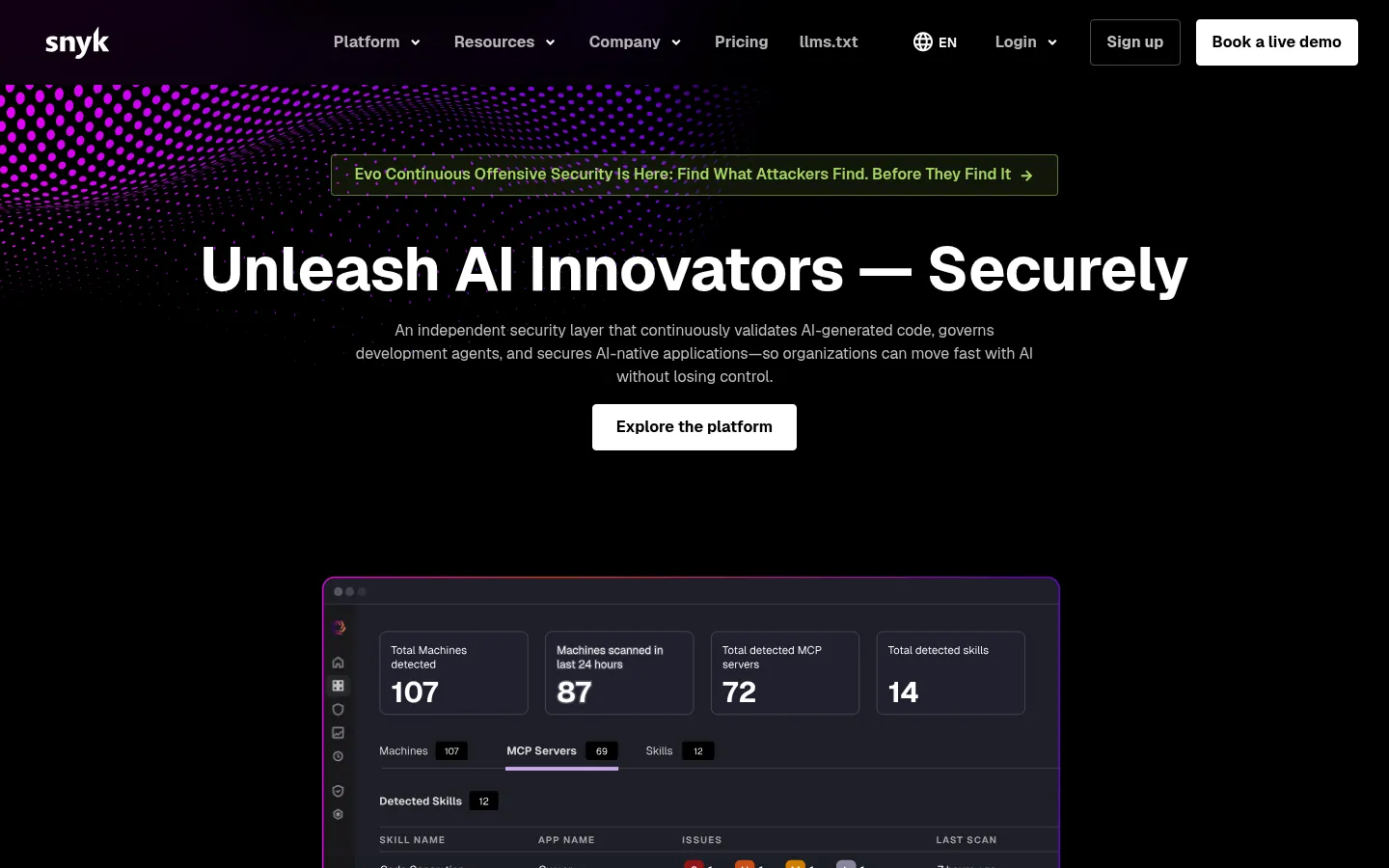
Snyk Open Source scans direct and transitive dependencies for vulnerabilities and license issues. Developers can run it from an IDE, the CLI, source control, or CI/CD. Snyk also supports SBOMs and license policies, and its wider platform includes SAST, container, and infrastructure-as-code security.
Snyk reachability analysis compares application and dependency call graphs to find paths to vulnerable code elements. Its current CLI option is marked Preview, with support dependent on language and integration. For remediation, Snyk creates automatic or manual fix and upgrade pull requests for supported ecosystems.
The product page lists Free, Team, and Enterprise options. Plan limits matter because reachability, reports, and automated fixes do not have identical availability.
Best for: Engineering-led teams that want an established developer workflow and may also adopt other Snyk scanners.
Watch for: A team buying SCA alone may end up paying for or operating more platform than it needs.
3. Endor Labs
Endor Labs now presents a broader agentic application security platform, but dependency security and reachability remain core capabilities.
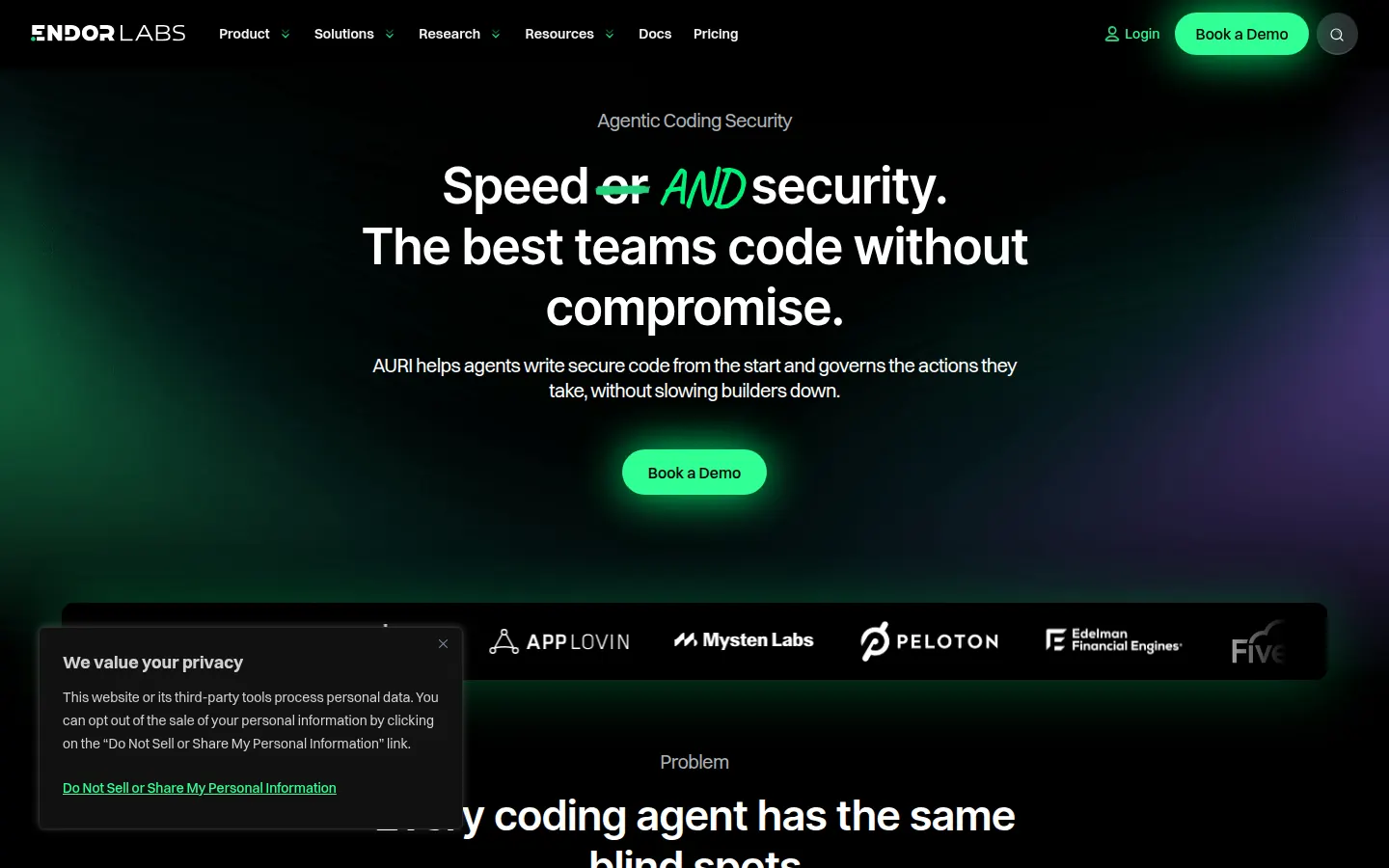
Endor analyzes direct and transitive dependencies and supports SBOM generation and license analysis. Its reachability documentation describes function-level analysis, plus precomputed reachability when a complete call graph is unavailable.
SCM, CI/CD, and AppSec dashboard integrations feed findings into remediation. Endor pairs call-path context with upgrade impact analysis and agentic fixes. Buyers should test the approval flow, build requirements, and language coverage in their own repositories.
Endor does not publish SCA prices on its site. The sales-led buying process may feel heavy to a small team looking for a quick self-service start.
Best for: Teams that treat open-source dependency risk as a primary AppSec problem and require function-level reachability.
Watch for: The platform and buying process are aimed more at enterprise programs than lightweight baseline scanning.
4. Mend.io
Mend.io, formerly WhiteSource, is a long-running software composition analysis and application security vendor.
Mend scans direct and transitive dependencies across a broad set of ecosystems and supports SBOM generation and license policy enforcement. Mend SCA Reachability analyzes imports and class relationships to assess whether application source can reach a vulnerability. Its technical requirements and supported languages need to be checked during a pilot.
SCM and CI/CD integrations are the main path into the product. When a supported fix exists, Mend Remediate can open a pull request to update the dependency. An organization-level strategy controls the version it recommends.
Mend does not publish SCA prices. Its wider AppSec and AI security portfolio can add operational complexity if dependency scanning is the only requirement.
Best for: Teams that want established SCA coverage and automated dependency remediation.
Watch for: Confirm reachability coverage and decide whether the broader platform is useful before buying.
5. Black Duck
Black Duck is best known for deep open-source license and compliance analysis.
Black Duck SCA combines dependency, binary, and snippet analysis. It can find components that do not appear in package manifests or when source is unavailable. The platform imports and exports SPDX and CycloneDX SBOMs, applies license policies, and monitors identified components for new vulnerabilities.
Current plans list reachability metrics alongside severity and prioritization, though the public product page gives less call-path detail than reachability-focused vendors. Remediation is guidance-oriented. CI/CD, SCM, IDE, and enterprise lifecycle integrations support policy enforcement throughout development.
Pricing is quote-based. The breadth that makes Black Duck useful for audits, M&A due diligence, firmware, and license compliance can feel heavy when a team only wants manifest scanning and update pull requests.
Best for: Organizations that put license compliance, audit evidence, and component discovery ahead of a lightweight developer experience.
Watch for: Ask for a language-specific reachability demonstration and account for the platform’s operational footprint.
6. Checkmarx
Checkmarx is a long-running enterprise AppSec vendor whose platform includes SCA alongside SAST, IaC, and API security.
Checkmarx SCA covers direct and transitive packages, malicious packages, license risk, SBOMs, and policy gates. Checkmarx Exploitable Path combines SAST and SCA to show whether project code can reach a vulnerable method and which lines form the path.
Its remediation output includes expected fix effort and impact, plus recommendations for alternative packages. The public SCA page focuses on guidance and policy automation, rather than promising a dedicated SCA pull request bot. IDE, SCM, CI/CD, and application lifecycle integrations feed a central enterprise reporting model.
Checkmarx uses quote-based pricing. Running the full platform generally requires more setup and ownership than a dependency-only product.
Best for: Large security programs that want SCA, SAST, policy, and reporting from one established vendor.
Watch for: Teams seeking a small, reachability-first point tool may find the suite too broad.
7. Veracode
Veracode is an enterprise application security platform with a long-standing SCA offering and compliance-oriented workflows.
Veracode SCA covers direct and transitive dependencies with policy, license, and SBOM reporting. Its agent-based scan adds vulnerable method detection and dependency graphs. The same platform includes IDE, SCM, CI/CD, and enterprise dashboard integrations.
For supported GitHub and GitLab repositories, Veracode can open automatic pull requests that update dependency files to the closest safe version suggested by its update advisor. Teams can configure vulnerable method calls as the trigger.
Pricing is quote-based. The platform and sales process are built for centralized programs, which may be more than a small engineering team needs.
Best for: Security leaders managing large application portfolios, compliance reporting, and centralized policy.
Watch for: Validate vulnerable method and automatic pull request support for each language and package manager in scope.
8. GitHub Dependabot
GitHub Dependabot is GitHub’s native dependency security feature, and it is often the first SCA control teams turn on.
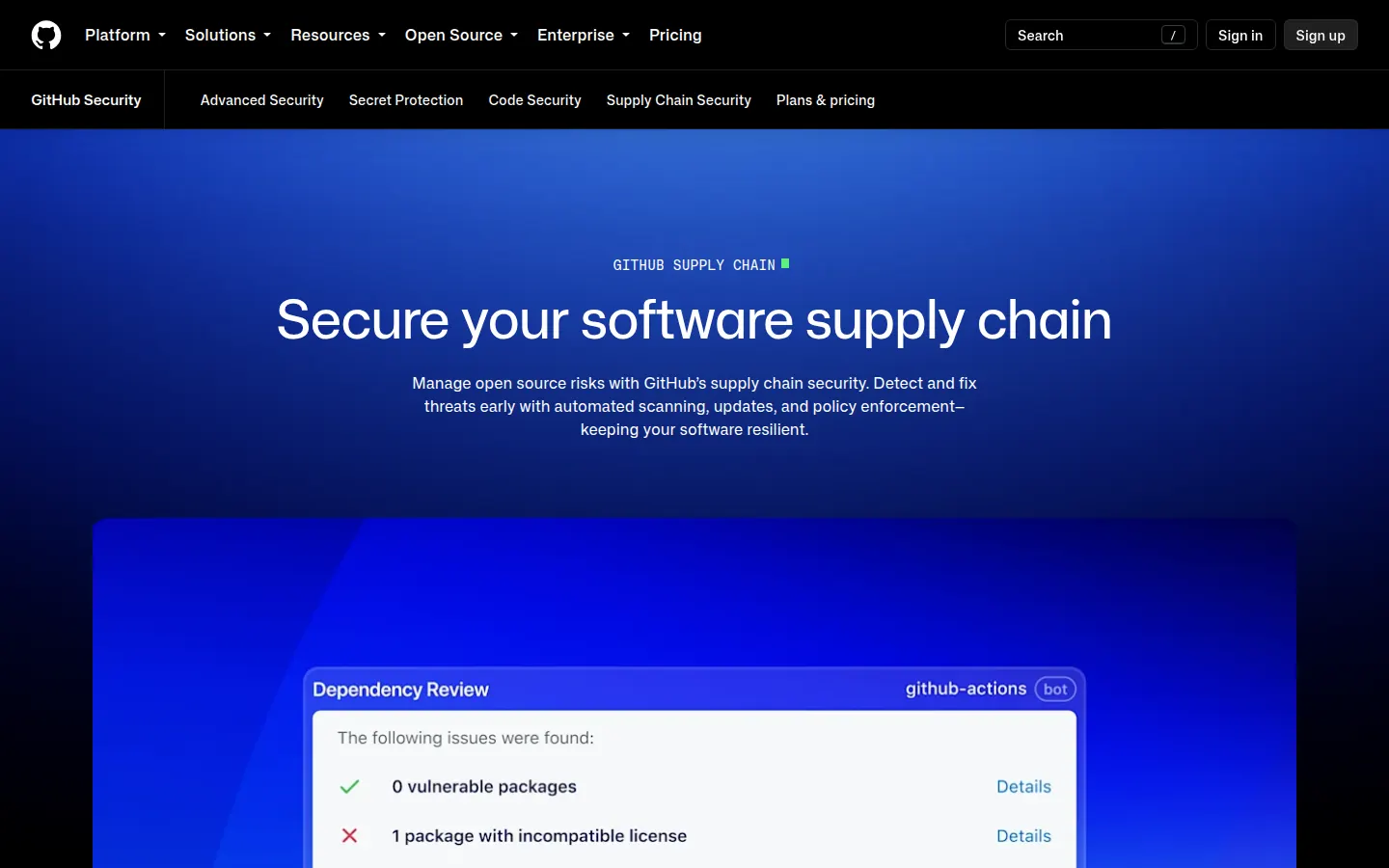
Dependabot alerts use the GitHub Advisory Database and repository dependency graph to find vulnerable dependencies on the default branch. Alerts rely on affected version ranges rather than call-path reachability.
Dependabot security updates try to update a vulnerable dependency to the minimum patched version without disrupting the dependency graph. Separate version updates keep packages current. GitHub can also export the dependency graph as an SPDX SBOM, while pull request license policy belongs to Dependency Review and GitHub Code Security.
Most supply chain features are free, though advanced controls for private repositories may require GitHub Code Security. Everything stays in GitHub pull requests and Actions, but there is no cross-SCM option and update pull requests can accumulate on large repositories.
Best for: GitHub teams that want a low-setup baseline with automated security and version updates.
Watch for: It does not offer call-path reachability, and policy features span several GitHub products.
9. Trivy
Trivy from Aqua Security is a popular open-source scanner that covers dependencies, containers, and infrastructure as code.
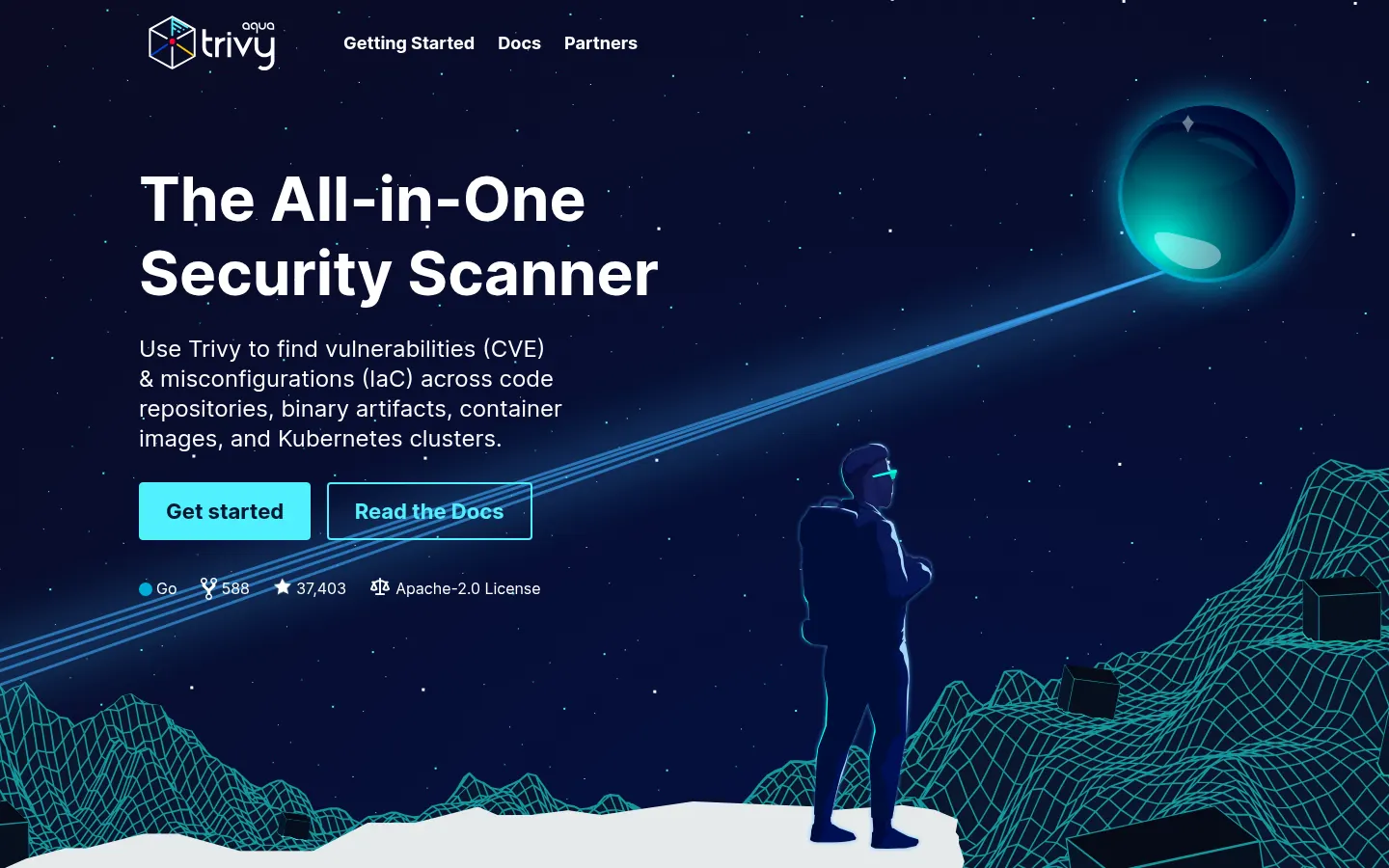
Trivy scans repositories, binary artifacts, container images, and Kubernetes clusters for vulnerabilities and misconfigurations. It generates SBOMs and can scan CycloneDX and SPDX SBOMs for vulnerabilities and licenses.
The Apache-2.0 licensed CLI fits easily into CI/CD and covers more artifact types than a dependency-only scanner. It does not provide call-path reachability, ownership workflows, or native fix pull requests. Teams must build prioritization and remediation around its output.
Best for: Teams that want one free scanner for packages, containers, repositories, and infrastructure as code.
Watch for: The scan engine is capable, but the surrounding triage and fix workflow is yours to operate.
10. OSV-Scanner
OSV-Scanner is Google’s open-source scanner built on the OSV (Open Source Vulnerabilities) database.
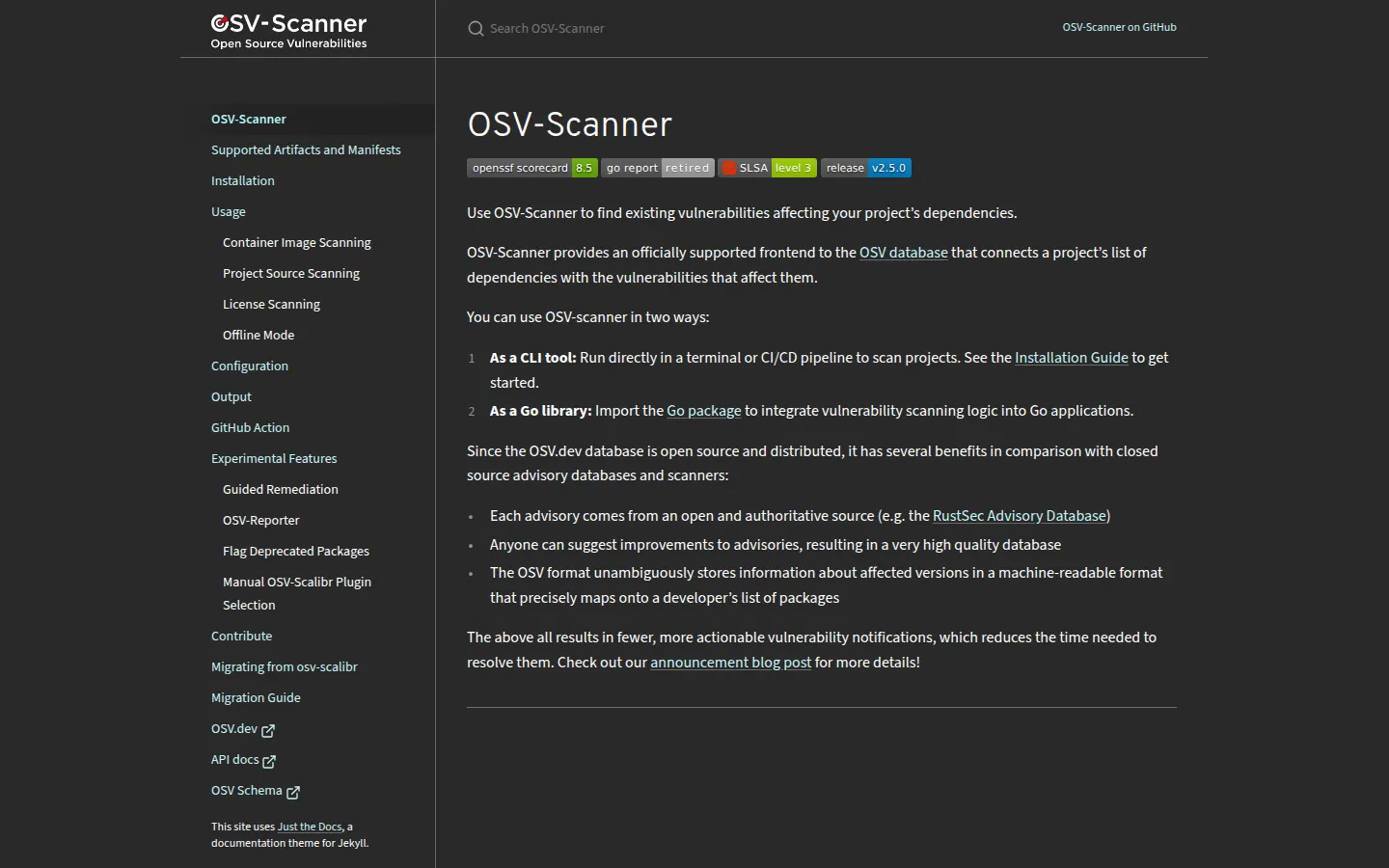
OSV-Scanner is a free CLI and Go library that connects project dependencies to the OSV database. Project source scanning finds supported lockfiles, SPDX or CycloneDX SBOMs, and Git repositories. A separate command scans container images, and the CLI can report license data.
Unlike many free scanners, OSV-Scanner has call analysis for Go and Rust. Go analysis is on by default. Rust analysis can be enabled with --call-analysis=rust, but it compiles dependency code and may execute build scripts. Its guided remediation can modify supported npm and Maven files locally.
There is no hosted governance platform or pull request bot. Basic vulnerability coverage spans more ecosystems than call analysis and remediation do.
Best for: Teams that want an OSV-aligned scanner, especially for Go or Rust projects that benefit from call analysis.
Watch for: Read the Rust execution warning and confirm that the narrower remediation support covers your package files.
11. OWASP Dependency-Check
OWASP Dependency-Check is a long-standing free tool that flags dependencies with known vulnerabilities.
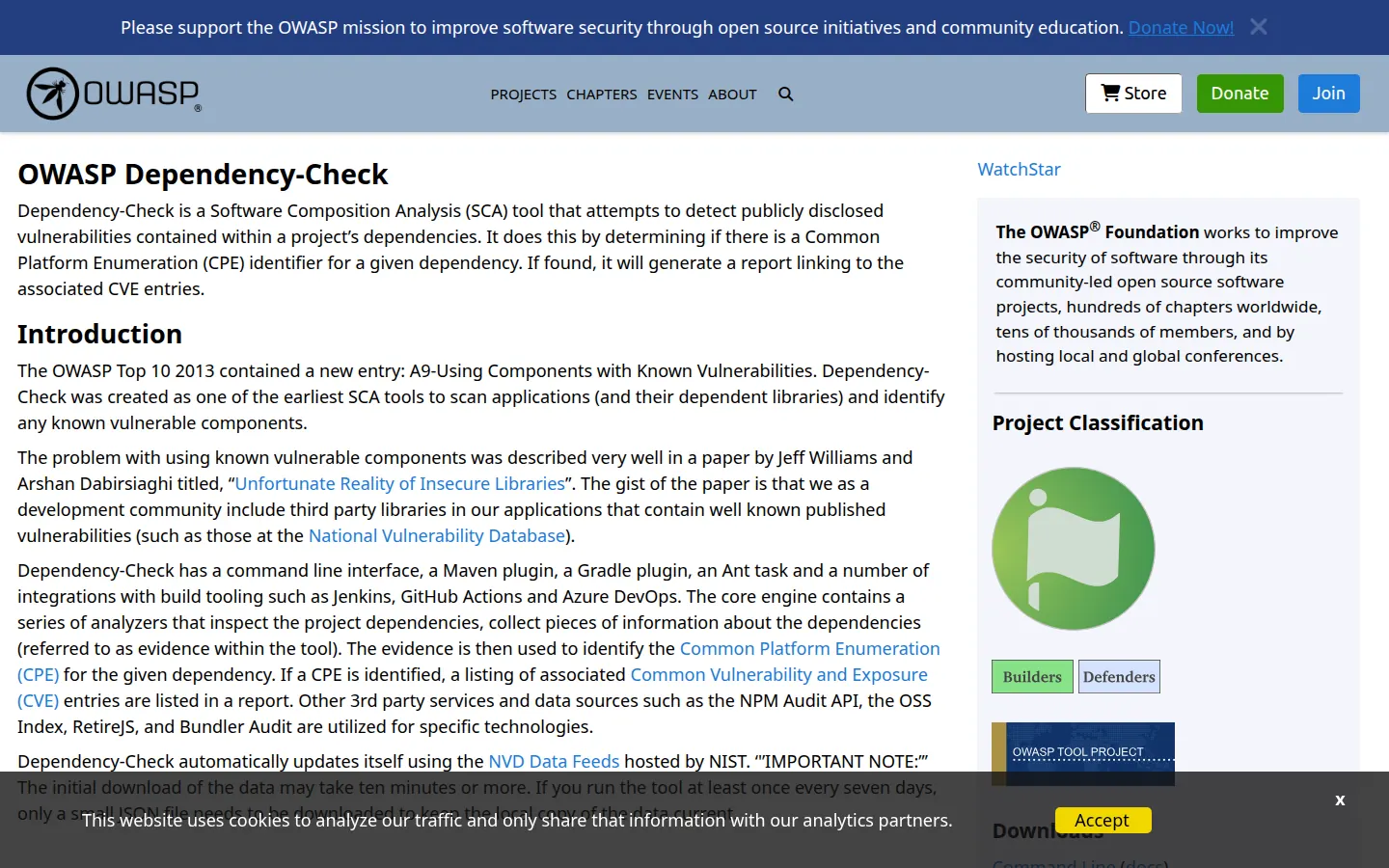
OWASP Dependency-Check maps identified components to Common Platform Enumeration (CPE) identifiers, then links them to public CVE records. It runs as a CLI, Maven or Gradle plugin, Ant task, and through CI integrations including Jenkins, GitHub Actions, and Azure DevOps.
The tool produces vulnerability reports but does not offer call-path reachability, a full license governance workflow, or fix pull requests. CPE matching can produce false positives. The project documents XML suppression rules for incorrect CPE and CVE matches, but teams must maintain those rules.
Best for: Teams that need a familiar, free CVE gate in a build process.
Watch for: Expect manual triage and suppression work, especially outside the ecosystems its analyzers identify cleanly.
How to choose an SCA tool
Start with the operational outcome you need, then use these criteria to structure the evaluation.
1. Reachability and exploitability context
The most useful difference between a basic dependency scanner and a modern SCA platform is whether it can tell you if vulnerable code is reachable. A CVE in a package that the application never calls poses a different risk from one on an exposed execution path. Corgea, Endor Labs, Snyk, Mend.io, Checkmarx, and Veracode provide forms of reachability or vulnerable-method analysis. OSV-Scanner also provides call analysis for Go and Rust. Ask every vendor to show the call path on your own code, because the meaning and coverage of “reachability” differ sharply.
2. Developer workflow fit
SCA only works when developers act on it. Evaluate whether findings and fixes appear in IDEs, pull requests, and CI/CD, and whether developers can understand why a dependency is flagged. A tool that lives in a separate dashboard tends to create a backlog nobody clears.
3. Dependency update automation
Transitive dependencies and frequent releases make manual updates hard to sustain. Check how a tool chooses an upgrade, whether it opens pull requests, how it handles breaking changes, and whether it batches or floods updates. Dependabot, Snyk, Mend.io, and Veracode can automate pull requests for supported ecosystems. OSV-Scanner offers local guided remediation for a smaller set of package files.
4. SBOM and license policy
If you have compliance, procurement, or regulatory requirements, SBOM generation and license enforcement move from nice-to-have to mandatory. Check for supported SBOM formats such as CycloneDX and SPDX, license policy controls, and how the tool handles restricted or copyleft licenses. Corgea covers this through SBOM generation and license enforcement, and Black Duck is a specialist in this area.
5. Noise reduction
Alert volume is the reason most SCA programs stall. Reachability, deduplication, dead-package analysis, and clear suppression workflows all reduce noise. Measure the size of the triage queue after tuning, not the raw count of findings.
6. Enterprise reporting
Security leaders need SLAs, ownership mapping, trend reporting, and audit evidence. Enterprise platforms like Checkmarx and Veracode are built for this. Confirm the reporting matches your governance and audit needs.
7. Pricing and scale
SCA pricing models vary and are often not publicly listed. Common models include per developer, per repository, per project, and platform bundles. Operating the tool also costs money through triage, unreachable CVEs, and update fatigue. During a pilot, record that time so the comparison reflects total cost rather than the quoted price alone.
For a deeper view of how dependency risk fits into a full program, see software composition analysis tools and the differences across scanner types in SAST vs SCA vs DAST.
Where SCA fits in a modern AppSec stack
Software composition analysis covers open-source and third-party dependency risk. SAST examines custom code, while DAST and AI pentesting test the running application. A complete AppSec program usually combines these methods and uses reachability and prioritization to control the resulting alert volume.
If you are building out the full picture, these guides help:
- Best SAST tools in 2026 for custom-code vulnerability detection.
- Software composition analysis tools: complete buyer guide for a deeper SCA overview.
- SAST vs SCA vs DAST to understand what each testing type finds.
- Top 10 DAST tools for dynamic testing options.
How to run an SCA evaluation
A credible SCA bake-off uses your repositories, your ecosystems, and your real dependency history.
Step 1: Pick representative repositories
Choose repositories that include your primary languages, a service with heavy transitive dependencies, a legacy service with an outdated dependency tree, and a security-sensitive service. If reachability matters, include a repo where you know which packages are actually used.
Step 2: Define what “good” looks like
Decide the outcomes you care about before you start: reachable vulnerabilities found, non-reachable noise filtered, license violations detected, SBOM accuracy, and remediation acceptance. Write these down so vendors cannot redefine success mid-pilot.
Step 3: Run tools under equal conditions
Use the same repositories, the same branch and commit, and the same integrations. Do not let one vendor tune while others run defaults.
Step 4: Score outcomes, not alert volume
More findings are not better. Score confirmed reachable vulnerabilities, confirmed noise, missed known issues, duplicate rate, time to a clean triaged list, fix acceptance rate, and reporting usefulness for leadership.
Common SCA buying mistakes
- Treating every CVE as equally urgent. Without reachability, teams burn sprints on vulnerabilities that never execute.
- Ignoring transitive dependencies. Most dependency risk lives in transitive packages you did not choose directly.
- Buying on raw finding count. A tool that reports 5,000 issues is not better than one that reports 500 reachable ones.
- Skipping license and SBOM needs. Compliance requirements surface late and are painful to retrofit.
- Forgetting remediation. Detection without a fix path just moves work to an overloaded backlog.
- Overlooking dead packages. Unused dependencies grow attack surface and maintenance cost quietly.
Frequently asked questions
What is the best SCA tool?
There is no universal best SCA tool. Corgea suits teams that want dependency risk tied to reachable code paths and review-ready remediation. Snyk is the established developer-first option, while Endor Labs centers its product on dependency risk and reachability. Checkmarx and Veracode suit enterprise governance. Dependabot, OSV-Scanner, Trivy, and OWASP Dependency-Check provide useful open-source baselines.
What is software composition analysis?
Software composition analysis, or SCA, identifies open-source and third-party components in an application, maps them to known vulnerabilities and licenses, and helps teams remediate risk. It reads manifests, lockfiles, and sometimes binaries to build an inventory of direct and transitive dependencies.
What is the difference between SCA and dependency scanning?
Dependency scanning is the core detection step inside SCA that enumerates packages and matches them to known vulnerabilities. Software composition analysis is the broader discipline that also covers license compliance, SBOM generation, transitive mapping, policy enforcement, and remediation. In practice the terms overlap and are often used interchangeably.
Is Snyk an SCA tool?
Yes. Snyk Open Source is a software composition analysis product and one of the most widely adopted developer-first SCA tools. Snyk also sells SAST, container, and IaC products, so SCA is one part of a broader platform.
Which SCA tools support reachability analysis?
Corgea and Endor Labs center their dependency analysis on reachability. Snyk, Mend.io, Checkmarx, and Veracode also document reachability or vulnerable-method analysis for supported languages and workflows. OSV-Scanner provides call analysis for Go and Rust. Validate every tool against your own languages and frameworks because coverage and evidence differ.
Which SCA tool is best for remediation?
The best SCA tool for remediation ties each vulnerable dependency to a specific upgrade or fix path and delivers it as a review-ready change in the developer workflow. Corgea focuses on reachability-aware prioritization and review-ready remediation, Snyk and Dependabot offer automated upgrade pull requests, and enterprise platforms provide remediation guidance with policy controls.
Sources and vendor references
- Corgea: dependency scanning, SBOMs and license enforcement, attack surface mapping
- Snyk: Snyk Open Source, reachability analysis, pull requests
- Endor Labs: homepage, reachability analysis, upgrade impact analysis
- Mend.io: homepage, SCA Reachability, GitHub remediation results
- Black Duck: Black Duck SCA, Binary Analysis
- Checkmarx: Checkmarx SCA, Exploitable Path
- Veracode: SCA documentation, automatic pull requests, SBOMs
- GitHub Dependabot: alerts, security updates, SBOM export
- Trivy: homepage, SBOM scanning
- OSV-Scanner: homepage, source and call analysis, guided remediation
- OWASP Dependency-Check: project homepage, false-positive suppression
Ready to focus on reachable dependency risk? Try Corgea or book a demo.