
Choosing among IaC security tools in 2026 starts with the files and workflows you need to protect. A Terraform-only CLI, a multi-framework policy scanner, and a code-to-cloud security platform solve different problems even when all three claim to scan infrastructure as code.
Compare tools on supported formats, pull request feedback, custom policy options, suppression controls, and the amount of context attached to each finding. A useful scanner should catch risky Terraform, Kubernetes, and cloud template changes before deployment without turning every policy mismatch into a release blocker.
Quick picks
- Choose Corgea when you want IaC findings in the same AppSec workflow as code, dependency, and secret findings.
- Start with Checkov for broad open-source policy scanning, or KICS when support for more IaC formats matters.
- Add Snyk IaC to an existing Snyk program instead of introducing a separate scanner and reporting layer.
- Compare Prisma Cloud and Wiz when code-to-cloud context is part of the requirement.
- Keep tfsec for an existing Terraform workflow, but plan the migration to Trivy that Aqua recommends.
Bridgecrew is not a separate product to shortlist today. Palo Alto Networks acquired it and integrated its IaC capabilities into Prisma Cloud.
IaC security tools compared
| Tool | Best for | IaC coverage | Policy model | Developer workflow | Runtime context | Pricing | Main tradeoff |
|---|---|---|---|---|---|---|---|
| Corgea | Unified AppSec scanning | Terraform, Kubernetes, Helm, and cloud templates | Contextual guardrails | Pull request feedback | AppSec finding context | Trial or vendor quote | Validate coverage on your modules |
| Checkov | Broad open-source scanning | Terraform and plans, CloudFormation, Kubernetes, Helm, ARM, Serverless, and more | Python and YAML policies, including graph checks | CLI, CI, and VCS integrations | Available through Prisma Cloud | Free, open source | Teams own tuning and triage |
| tfsec | Maintaining an existing Terraform scanner | Terraform only | Embedded checks with custom policy support | Local CLI and CI | No | Free, open source | Aqua directs new work to Trivy |
| Snyk IaC | Existing Snyk users | Terraform, CloudFormation, Kubernetes, Helm, and ARM | Built-in rules plus OPA custom policies | IDE, CLI, SCM, and CI/CD | Drift features available | Free and paid plans | Most useful inside the Snyk platform |
| Prisma Cloud | Centralized code-to-cloud governance | Terraform, CloudFormation, Kubernetes, Helm, ARM, and Serverless | Checkov-based policies and custom rules | IDE, CI, VCS, and pull request fixes | Yes | Vendor quote | More platform than small teams may need |
| Wiz | Cloud risk prioritization | Terraform, CloudFormation, ARM, Kubernetes, Docker, and more | Unified code and cloud policy | IDE, pull requests, and CI/CD | Yes, with code-to-cloud mapping | Vendor quote | Enterprise platform scope |
| Bridgecrew | Understanding a legacy product name | Capabilities now live in Prisma Cloud | Checkov and Prisma Cloud policies | Prisma Cloud workflows | Yes, through Prisma Cloud | Not sold separately | No longer a standalone option |
| KICS | Multi-framework open-source scanning | Terraform, CloudFormation, Kubernetes, Helm, Ansible, Docker, Pulumi, and more | Customizable query rules | CLI and CI integrations | No | Free, open source | Teams own prioritization and suppressions |
Evaluate IaC scanning on your own modules
Use Corgea to catch cloud misconfigurations before merge and give developers clearer remediation guidance than raw policy output.
The best IaC security tools, reviewed
1. Corgea
Corgea IaC scanning focuses on catching cloud misconfigurations before they become production incidents. It is designed for merge-time policy enforcement with explanations developers can act on, inside the same workflow as AI SAST, dependency scanning, and secrets scanning.
Corgea fits platform, DevOps, and cloud security teams that want pull request guardrails without sending engineers to a separate cloud security console. Findings share triage and remediation workflows with other AppSec results.
Corgea is newer than the established CNAPP vendors in this list. Validate its rule coverage against your Terraform modules, Helm charts, and internal cloud standards during a proof of concept.
2. Checkov
Checkov is an open-source static analysis tool maintained by Prisma Cloud. Its official framework list includes Terraform source and plan files, CloudFormation, Kubernetes, Helm, ARM templates, Serverless, Docker, and several CI configuration formats. Teams can use built-in checks or write custom policies in Python and YAML.
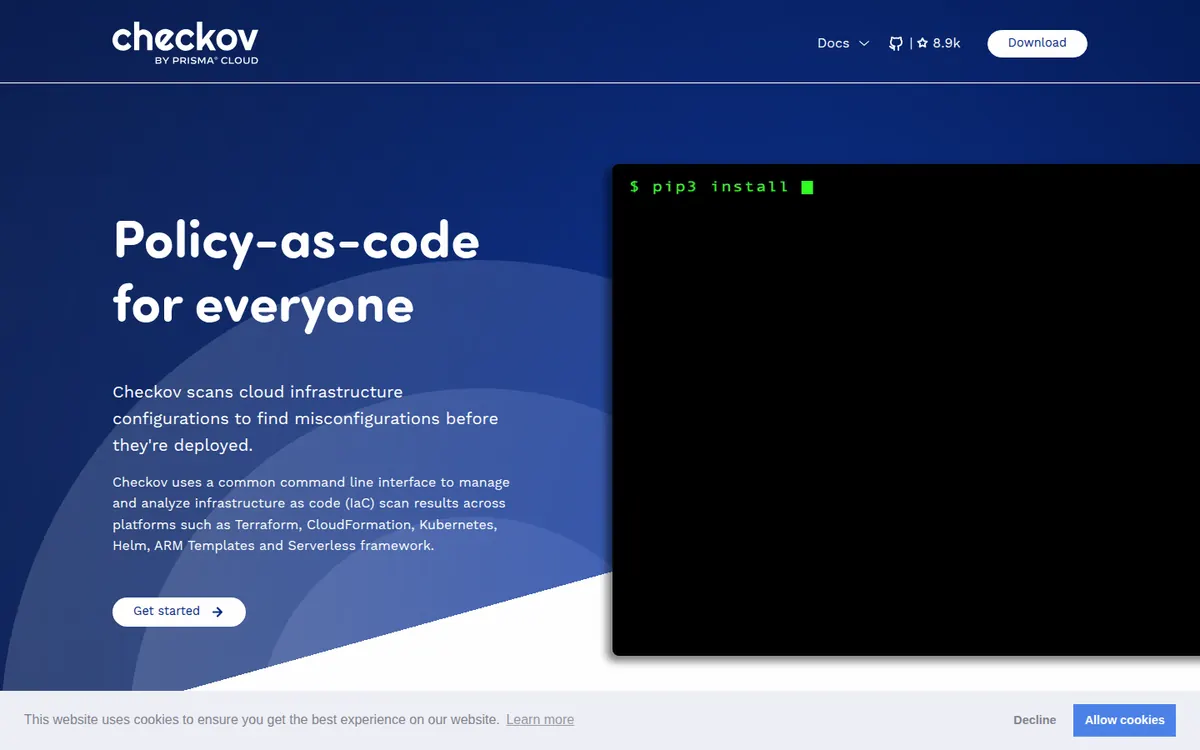
Checkov is a practical starting point when you want one local and CI scanner across several IaC frameworks. Its graph checks can evaluate relationships between resources, not just one attribute at a time.
The tradeoff is operational ownership. Your team must decide which checks matter, manage suppressions, and route results to the right service owners. Prisma Cloud adds hosted reporting and code-to-cloud features around the same open-source foundation.
3. tfsec
tfsec is an open-source static analysis scanner for Terraform. It runs locally or in CI and uses the official HCL parser to inspect configuration before infrastructure changes take effect.
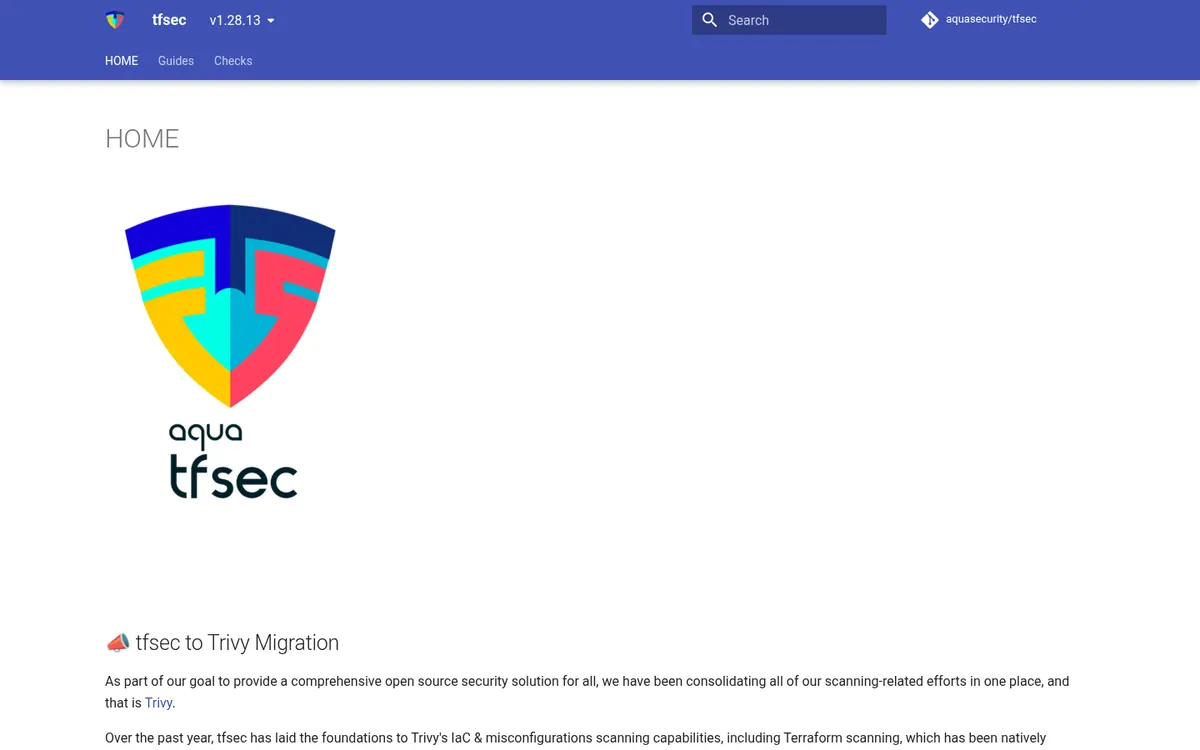
Its current status matters more than its feature list. Aqua’s official migration guide says tfsec remains available, but engineering attention has moved to Trivy. Trivy uses the same Terraform scanning engine and also scans formats such as Dockerfile, JSON, YAML, and CloudFormation.
Keep tfsec on a shortlist only when you already run it and value a narrow Terraform workflow. For a new rollout, compare Trivy with Checkov and KICS instead.
4. Snyk IaC
Snyk Infrastructure as Code scans Terraform, CloudFormation, Kubernetes, Helm charts, and ARM templates in IDE, CLI, source control, and CI/CD workflows. Its official product page also documents built-in rules and custom policies powered by Open Policy Agent.
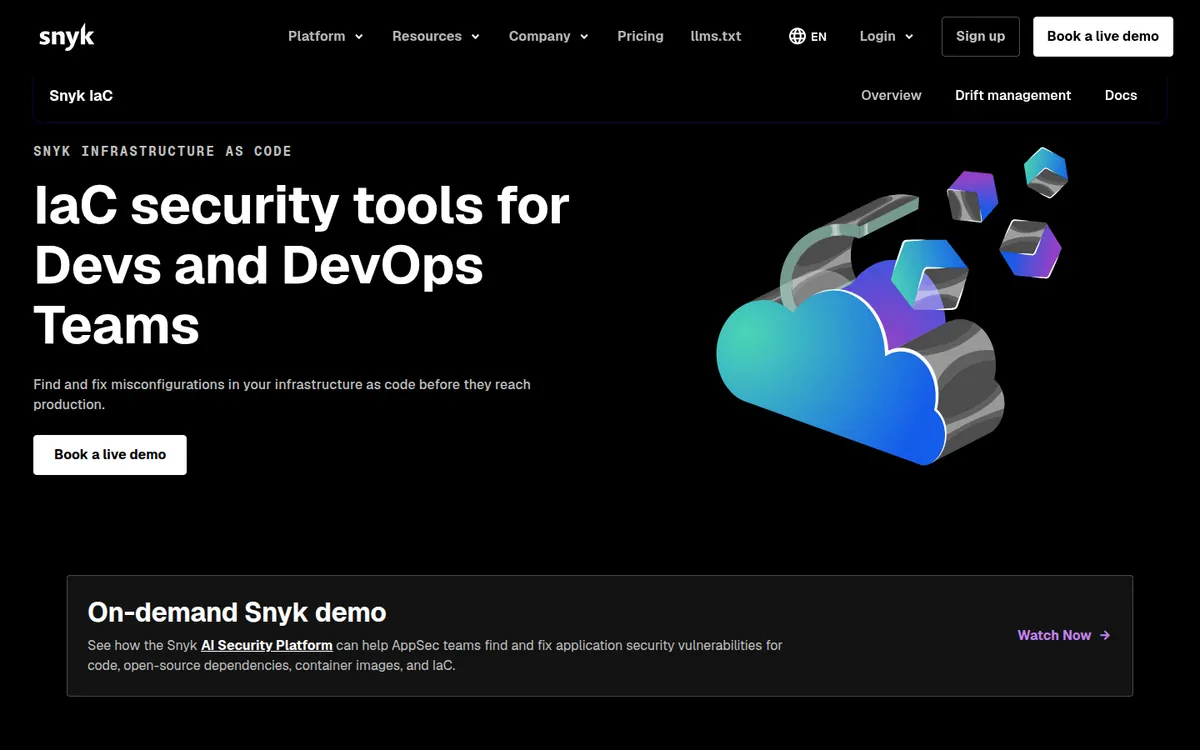
Snyk IaC makes the most sense when developers already use Snyk for open-source packages, containers, or application code. IaC findings then use familiar integrations, reporting, and ownership workflows. Snyk also offers Terraform drift management for resources changed outside the expected IaC state.
Teams evaluating Snyk should verify which policy, reporting, and custom rule features are included in the plan they intend to buy.
5. Prisma Cloud
Prisma Cloud IaC Security builds on Checkov and adds repository integrations, scan history, centralized policy management, automated fixes, and links from deployed resources back to IaC. It scans templates for misconfigurations and exposed secrets in IDEs, CI tools, repositories, and runtime environments.
Prisma Cloud fits organizations that want the same controls across build and runtime. Pull request comments, configurable build failures, and custom policies give security teams central guardrails while developers receive feedback in their existing tools.
That breadth adds implementation work. Test repository onboarding, policy exceptions, ownership mapping, and developer feedback on a real service before committing to a wider rollout.
6. Wiz
Wiz Code scans Terraform, CloudFormation, ARM, Kubernetes, Docker, and other configuration formats. Its main distinction is code-to-cloud mapping: Wiz traces deployed cloud risks back to source code and adds runtime context to remediation.
Wiz is a strong fit when cloud security teams already use its risk graph and want IaC findings prioritized alongside live exposure. The product surfaces results in IDEs, pull requests, and CI/CD rather than limiting scans to the cloud console.
During evaluation, check whether code-to-cloud mapping covers your repositories, deployment paths, and IaC modules. That connection is the reason to choose Wiz over a standalone open-source scanner.
7. Bridgecrew status
Bridgecrew belongs in this comparison because buyers still encounter the name in older IaC security articles and Checkov references. It is not a separate current product. Palo Alto Networks completed its acquisition of Bridgecrew in 2021, then integrated its IaC security capabilities into Prisma Cloud.
If an evaluation list includes Bridgecrew, compare the current Prisma Cloud IaC product instead. Checkov remains the open-source scanner associated with the original Bridgecrew team.
8. KICS
KICS is Checkmarx’s open-source static analysis scanner for IaC. Its supported platform documentation covers Terraform, CloudFormation, Kubernetes, Helm, Ansible, Docker, Pulumi, and other formats. Helm charts are rendered and then checked with Kubernetes queries.
KICS suits teams that need broad format coverage and want the scanner and query rules to remain open and customizable. Checkmarx publishes integration guidance for common CI systems, pre-commit hooks, Terraform Cloud, and Visual Studio Code.
Results still need an owner. Before blocking merges, run KICS against representative repositories, remove irrelevant queries, and document how engineers suppress accepted findings.
How to evaluate IaC security tools
Run a proof of concept on your own modules rather than comparing rule counts. Give every tool the same Terraform plan, Kubernetes or Helm deployment, and cloud template. Seed a few known issues, record what each scanner catches, and note how much work it takes to explain or suppress each result.
- It scans the source files, rendered templates, and plan output you use.
- Pull request scans show the changed resource, policy, impact, and a usable fix.
- Teams can write custom policies without maintaining a separate rules service.
- Suppressions require a reason, stay close to the code, and can be reviewed later.
- High-confidence public exposure, IAM, encryption, and secret findings can block a merge.
- Repository ownership or ticketing sends findings to the team that can fix them.
- Incremental scan time fits the CI budget for monorepos and shared modules.
- Hosted platforms connect code findings to deployed cloud resources where that context matters.
Start in advisory mode. Once developers have reviewed the results and false positives are under control, gate a small set of policies with clear security impact. Public storage, unrestricted administrative access, and committed secrets are better first blockers than a large compliance pack.
For implementation depth, read Terraform security best practices, the Kubernetes security checklist, and the CI/CD security guide.
Related IaC and AppSec guides
- Terraform security best practices for state, secrets, and module hygiene.
- Kubernetes security checklist for manifest and cluster controls.
- CI/CD security guide for pipeline scanning and OIDC.
- Container security tools for image risk alongside infrastructure changes.
- Secrets detection tools for credentials in Terraform and manifests.
- Best SAST tools when custom application code is part of the same buying decision.
Ready to enforce cloud guardrails before merge? Try Corgea IaC scanning or book a demo.