
Buying an all-in-one AppSec platform is less about finding a vendor that claims the longest feature list. It is about deciding which controls should share an operating model: findings, policies, ownership, remediation, reporting, and developer integrations.
The six vendors in this guide have different centers of gravity. Corgea focuses on contextual code security and remediation in developer workflows. Checkmarx, Fortify, and Veracode fit large programs that need centralized governance. Snyk is a developer-first suite across common shift-left controls. Semgrep is strongest where AppSec teams want fast feedback and direct control of detection logic.
Quick recommendations
| Buyer goal | Start with | Why |
|---|---|---|
| Contextual, developer-review remediation across shift-left controls | Corgea | Connects code, dependencies, secrets, IaC, and container findings to developer workflows. |
| Broad enterprise AppSec suite and centralized controls | Checkmarx, Fortify, or Veracode | Established enterprise platforms with governance, reporting, and procurement familiarity. |
| Developer-first scanner suite | Snyk | Brings code, open-source, container, and IaC scanning into familiar developer integrations. |
| Custom rules and fast code-security feedback | Semgrep | Gives AppSec teams transparent rules, fast scans, and strong CLI, IDE, and pull request workflows. |
| Dynamic testing as a required native control | Checkmarx, Fortify, or Veracode | Each has a DAST offering. Verify authenticated coverage, API support, and deployment model in a pilot. |
Platform comparison
Coverage in a product family is not the same as coverage in one license or one workflow. “Available” means the vendor markets a product or capability in that area. Confirm the edition, language, deployment model, and integration that apply to your environment.
| Platform | SAST | SCA | DAST | IaC | Secrets | Container | Best fit | Pricing model |
|---|---|---|---|---|---|---|---|---|
| Corgea | Yes | Yes | Pair with AI pentesting or a DAST tool | Yes | Yes | Yes | Teams that want contextual shift-left coverage and review-ready remediation | Trial-led or vendor quote |
| Checkmarx | Yes | Yes | Yes | Yes | Yes | Available in the platform portfolio | Enterprise programs consolidating testing and governance | Enterprise quote |
| Snyk | Yes | Yes | No native DAST product | Yes | Yes | Yes | Developer-led teams consolidating common shift-left scanners | Free tier plus paid tiers |
| Semgrep | Yes | Yes | No native DAST product | Yes | Yes | Source and supply-chain checks, not image scanning as a primary product | Teams that want rule control and code-security speed | Free OSS plus paid tiers |
| Fortify | Yes | Yes | Yes | Verify current product coverage | Verify current product coverage | Verify current product coverage | Regulated enterprises with mature audit and testing processes | Enterprise quote |
| Veracode | Yes | Yes | Yes | Verify current product coverage | Verify current product coverage | Verify current product coverage | Centralized enterprise AppSec and compliance programs | Enterprise quote |
Test unified AppSec on your own delivery workflow
Use Corgea to prioritize code and supply-chain risk, surface findings in developer workflows, and review remediation before merge.
The platforms, reviewed
1. Corgea
Corgea is an AI-native application security platform for teams that want to consolidate shift-left security work around the developer review path. Its product coverage includes AI SAST, dependency scanning, secrets scanning, infrastructure-as-code scanning, container scanning, SBOM and license enforcement, and cloud posture capabilities.
Best fit: Teams whose main problem is low-trust findings, slow triage, or remediation that leaves developers to interpret a separate dashboard.
Coverage and workflow: Corgea brings code, dependency, secret, IaC, and container signals into IDE, pull request, and CI/CD workflows. It uses code and project context to prioritize findings and generate remediation that developers can review. For dynamic validation, teams should assess Corgea’s AI pentesting capabilities alongside any conventional DAST requirements.
Enterprise fit: A good fit for enterprises that want platform coverage without making centralized triage the only way work gets done. Buyers with strict requirements for long vendor tenure, on-premises deployment, or analyst-report procurement should validate those requirements early.
Pricing and operating cost: Corgea uses a trial-led and vendor-quote motion. Evaluate the time saved in triage and remediation, not only the platform quote. A useful proof of value measures how many findings become developer-reviewed fixes and how much duplicate or non-actionable work disappears.
Choose Corgea if: you want contextual detection and remediation in the same workflow as dependencies, secrets, IaC, and containers.
Avoid Corgea if: you require a traditional DAST product as a single-vendor contractual requirement or need a long-standing legacy platform without running a hands-on evaluation.
2. Checkmarx
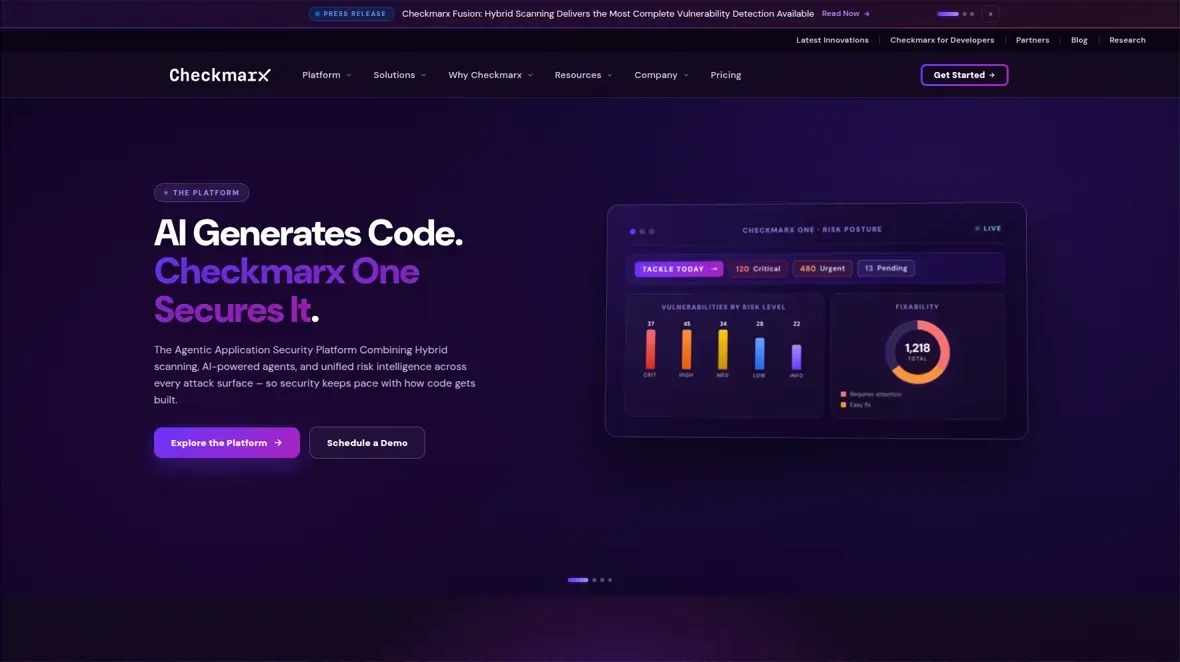
Checkmarx is an enterprise application security vendor with SAST, software composition analysis, DAST, IaC security, secrets detection, API security, and related platform capabilities.
Best fit: Large AppSec organizations that need scanner breadth, governance controls, and a familiar enterprise procurement path.
Coverage and workflow: Checkmarx brings multiple testing disciplines into an enterprise suite with IDE, SCM, CI/CD, and application-lifecycle integrations. Its strength is the breadth of the platform and the ability to manage policies and findings centrally. Teams should test whether the individual scanner experiences meet their expectations, because buying a suite does not remove the need to tune each control.
Enterprise fit: Strong for centralized programs with compliance reporting, audit requirements, defined exception flows, and a dedicated AppSec team.
Pricing and operating cost: Pricing is quote-based. The operating cost can include onboarding, policy design, query customization, integrations, and ongoing triage. During a pilot, track the effort to get each required control into production rather than evaluating only the first SAST scan.
Choose Checkmarx if: you need broad AppSec testing and centralized controls from an established enterprise vendor.
Avoid Checkmarx if: the immediate goal is a lightweight, developer-led rollout with little platform administration.
3. Snyk
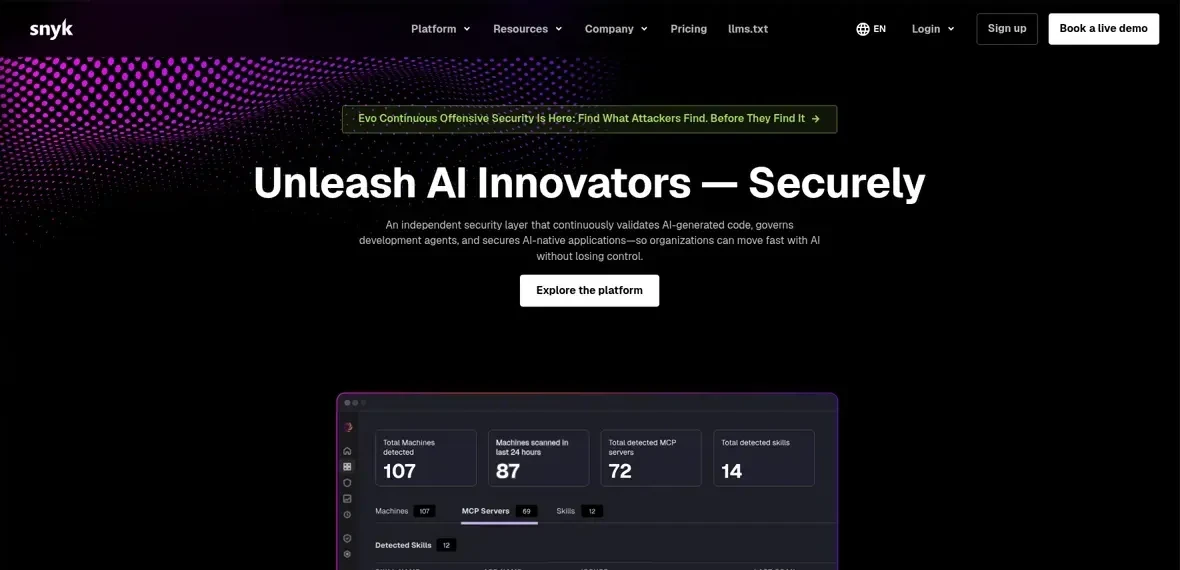
Snyk is a developer-first application security platform with Snyk Code for SAST, Snyk Open Source for SCA, Snyk Container, Snyk Infrastructure as Code, and secrets scanning capabilities.
Best fit: Engineering-led organizations that want broad shift-left coverage in IDEs, source control, pull requests, CLI workflows, and CI/CD.
Coverage and workflow: Snyk has strong coverage for code, dependencies, containers, and IaC. Its product family is particularly natural for teams already using developer-centric dependency scanning. It does not offer a native DAST product, so a team that needs dynamic scanning must keep or add a separate control.
Enterprise fit: Suitable for enterprise developer security programs, especially when SCA is a major buying driver. Buyers should confirm how product tiers, usage limits, and integrations apply across the controls they want.
Pricing and operating cost: Snyk offers a free tier and paid tiers, commonly structured around users, products, or usage. Budget for the platform bundle that matches your rollout, plus time to maintain policies, ignore decisions, and integrations. Compare the cost of one platform against the overhead of continuing to operate separate SAST, SCA, container, and IaC tools.
Choose Snyk if: developers need broad shift-left scanning from a vendor with mature developer integrations.
Avoid Snyk if: native DAST is mandatory or you want custom rule ownership to be the center of your security program.
4. Semgrep
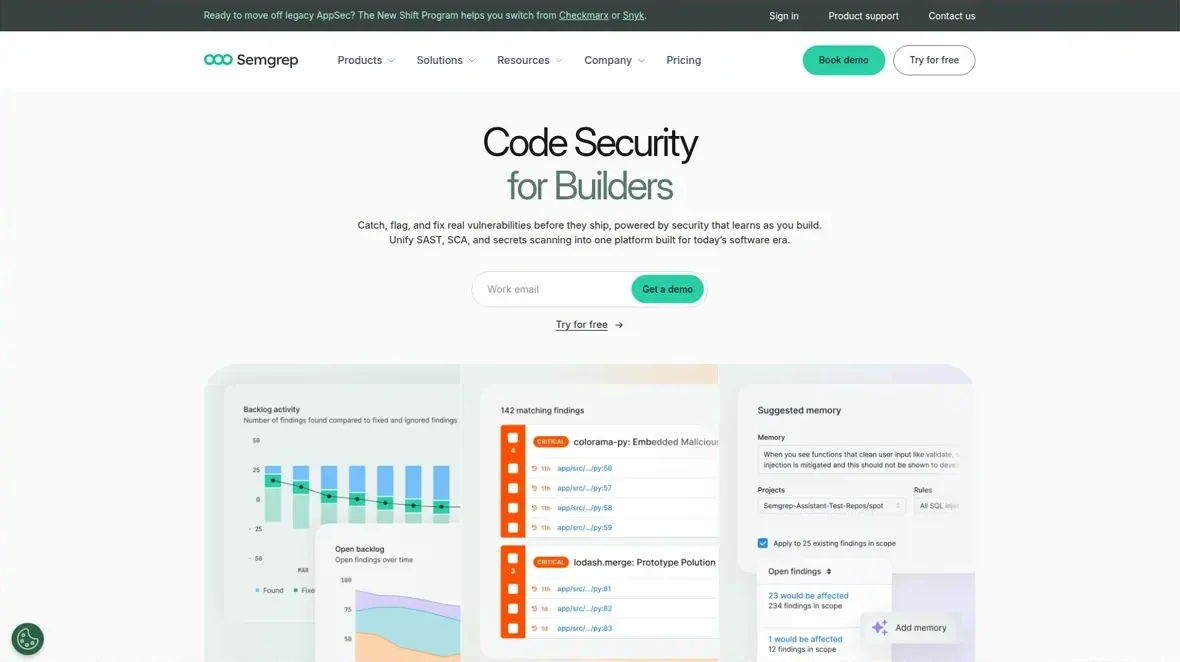
Semgrep is a developer-focused code security platform with an open-source rule engine and commercial capabilities for SAST, secrets, software supply-chain analysis, and infrastructure-as-code scanning.
Best fit: AppSec teams that want direct control over the rules they run and fast results in local development, pull requests, and CI.
Coverage and workflow: Semgrep’s core strength is its pattern, semantic, and taint analysis, plus custom YAML rules. Semgrep Supply Chain adds dependency analysis, and Semgrep Secrets identifies exposed credentials. The platform is not a native DAST product, and it should not be evaluated as a container image scanner or runtime cloud security platform.
Enterprise fit: Strong when an organization has security engineers who will own rules, tuning, and policy content. That ownership can be an advantage for companies with internal frameworks and specific secure-coding requirements.
Pricing and operating cost: Semgrep has free open-source tooling and paid commercial tiers. License cost is only part of the comparison. Include the engineering time required to author, test, tune, and maintain rules. A rule program can be cost-effective when it prevents recurring issues, but it needs a named owner.
Choose Semgrep if: transparency, fast feedback, and security-owned rules matter more than one broad testing suite.
Avoid Semgrep if: you need native DAST, full container image scanning, or a platform that can replace every AppSec control without an internal rule-maintenance program.
5. Fortify
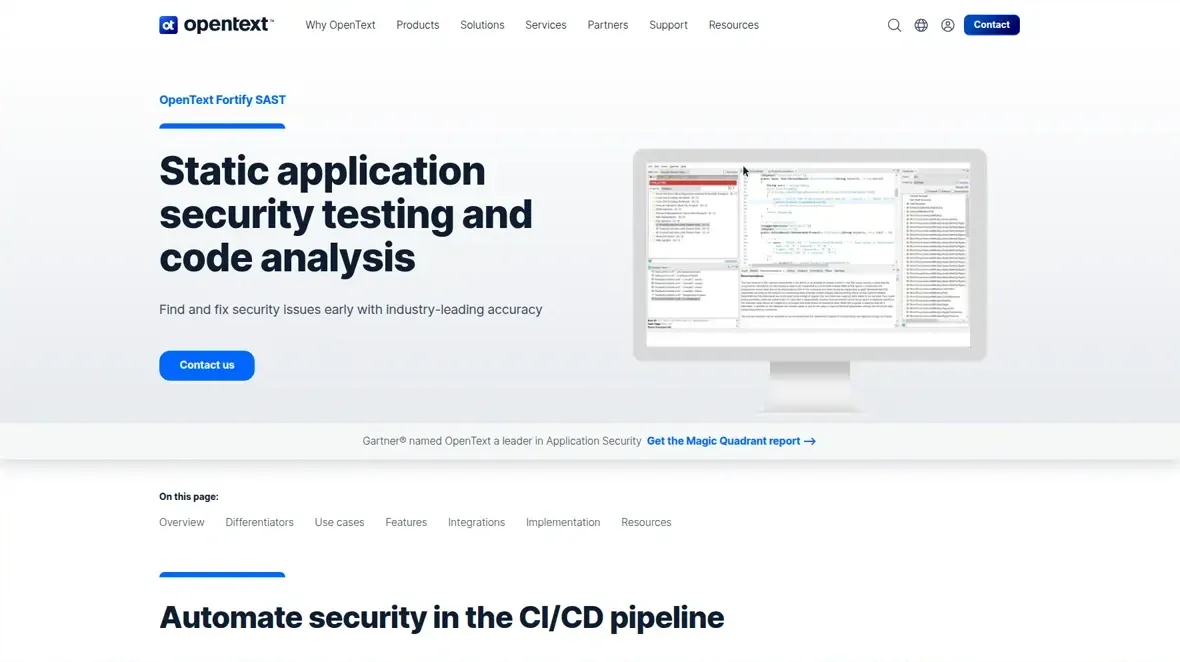
OpenText Fortify is a mature enterprise application security portfolio with SAST, DAST through WebInspect, software composition analysis, and governance workflows.
Best fit: Large and regulated organizations that already run formal application testing, audit workflows, and centralized security governance.
Coverage and workflow: Fortify’s static analysis and dynamic testing products are established parts of enterprise AppSec programs. The portfolio can support cloud, on-premises, and managed-service deployment models. Confirm exact coverage for IaC, secrets, containers, language support, and deployment constraints before treating the portfolio as a replacement for specialized tools.
Enterprise fit: Strong for organizations with formal audit, policy, and application-portfolio management requirements. It is also a sensible shortlist item for existing Fortify customers that want to modernize integrations rather than replace their program.
Pricing and operating cost: Pricing is quote-based. The main operating cost question is whether your program has the people and process to tune, audit, and manage the platform. Measure time to onboard a representative application, close a finding through the audit process, and produce the evidence an auditor or executive review requires.
Choose Fortify if: you need mature SAST and DAST with enterprise deployment flexibility and formal audit workflows.
Avoid Fortify if: a fast self-serve rollout and minimal security-tool administration are the primary requirements.
6. Veracode
Veracode is an enterprise application security platform with static analysis, dynamic analysis, software composition analysis, pipeline scanning, and centralized policy and reporting workflows.
Best fit: Security leaders managing a large application portfolio, compliance commitments, and organization-wide risk reporting.
Coverage and workflow: Veracode combines several application testing methods in a cloud-delivered platform with IDE, CI/CD, SCM, API, and dashboard workflows. Dynamic analysis is a native part of the portfolio. Ask the vendor to demonstrate the current depth of IaC, secrets, and container coverage for your specific toolchain rather than assuming all product-family capabilities are included.
Enterprise fit: Strong for centralized governance, policy enforcement, and compliance-led programs. It can be more platform than a small engineering organization needs.
Pricing and operating cost: Pricing is quote-based. Consider application counts, developer access, scan types, onboarding support, and the process required to manage policy exceptions. A lower apparent price can cost more if finding ownership, remediation, and reporting still require manual work across separate systems.
Choose Veracode if: centralized governance, broad application testing, and established enterprise process are the priority.
Avoid Veracode if: you are optimizing primarily for a lightweight developer-led rollout or a highly customizable rule program.
What “all-in-one” should mean
Platform consolidation helps only when it removes real work. A unified AppSec platform should give you a shared way to:
- connect repositories, build pipelines, applications, and owners;
- set policy and exception rules;
- prioritize duplicate or related findings;
- deliver results in pull requests, IDEs, CI, tickets, or dashboards;
- report on risk, remediation, and service-level objectives; and
- manage access, audit history, and data retention.
Do not require one vendor to own every security control. Runtime cloud security, external attack-surface management, API gateways, identity security, security operations, and human penetration testing may remain separate systems. The goal is fewer disconnected queues, not an unrealistic single tool.
How the testing layers work together
| Control | What it examines | Common blind spot | What to test in a pilot |
|---|---|---|---|
| SAST | Custom source code and data flow | Runtime configuration and deployed behavior | Known code vulnerabilities, framework behavior, and false-positive rate |
| SCA | Third-party packages and licenses | Whether vulnerable code is reachable | Transitive dependencies, reachability, SBOM, and upgrade workflows |
| DAST | Running web applications and APIs | Code paths that are not exposed to the scanner | Authentication, API coverage, scan safety, and CI integration |
| IaC scanning | Terraform, Kubernetes, Helm, and cloud templates | Drift after deployment | Your modules, custom policies, and merge-time feedback |
| Secrets scanning | Repositories, commits, and sometimes build artifacts | Credentials stored outside scanned systems | Historical scans, validation, revocation workflow, and false positives |
| Container scanning | Image layers, OS packages, and application packages | Runtime behavior and cloud exposure | Private registries, base-image noise, SBOM, and release gates |
For implementation detail, see the guides for SAST, SCA, container security, IaC security, secrets detection, and SAST vs. SCA vs. DAST.
Security workflow integration checklist
A scanner is only useful when the right person can act on its output. During a platform evaluation, ask each vendor to demonstrate the following on your own projects:
- Repository and monorepo onboarding with the source control systems you use.
- IDE, pull request, CLI, and CI/CD feedback without duplicate alerts.
- A finding routed to the correct service owner.
- One policy that starts in advisory mode and later blocks a merge.
- An exception with an owner, reason, expiry date, and audit history.
- A ticket or issue created only for a finding that needs work outside the pull request.
- Dependency, container, or IaC risk connected to the application change that introduced it.
- A remediation proposal reviewed and validated through the normal engineering process.
- A leadership report that shows open risk, trend, ownership, and service-level objective performance.
The vendor demo should include a failed case. Ask to see an irrelevant or duplicate finding suppressed correctly, a scan that cannot complete because of build context, and an integration failure. Those details reveal operating cost better than a clean dashboard tour.
Pricing and total operating cost
Most enterprise AppSec platform pricing is not public. Common commercial models include per developer, committer, application, repository, line of code, scan volume, platform bundle, or enterprise agreement. The quote matters, but it is not the whole budget.
Use this model when comparing platforms:
| Cost area | Questions to ask |
|---|---|
| License and consumption | What metric drives cost? What happens when repositories, developers, or scan volume grow? Which controls and integrations require a higher tier? |
| Onboarding | How many hours does it take to connect a representative repository, build, application, registry, and ticket system? |
| Tuning | Who writes policies, custom rules, suppressions, and exception workflows? How much maintenance do they require? |
| Triage | How many findings are confirmed, duplicated, suppressed, or escalated? How long does that take? |
| Remediation | Does the developer receive enough context to fix the issue in the usual workflow? Are generated fixes reviewed, tested, and accepted? |
| Reporting | Can security leaders and auditors get the necessary evidence without spreadsheets or manual exports? |
| Overlap | Which existing tools, integrations, contracts, and queues can you actually retire? |
The platform with the lower subscription price is not automatically the lower-cost option. A tool that creates more false positives, requires more custom-rule work, or leaves findings disconnected from ownership can cost more than a higher-priced platform.
Run a credible AppSec platform evaluation
1. Define the consolidation target
List the tools and workflows you want to retire, keep, or integrate. Separate required controls from desirable capabilities. For example, “native authenticated DAST” is different from “one dashboard for DAST results.”
2. Use representative applications
Include a modern service, a legacy application, a repository with dependency debt, an infrastructure-heavy project, and a containerized workload. If DAST is required, include an authenticated staging application or API that the scanner can safely test.
3. Give every vendor the same test
Use the same commit, build context, integrations, and pilot window. Let vendors tune only if each participant receives comparable time and access. Capture setup friction because it is part of total operating cost.
4. Score outcomes
Score confirmed findings, missed known issues, duplicate findings, time to useful result, time to triage, remediation acceptance, policy administration, workflow adoption, and reporting quality. Do not score raw alert volume as a success metric.
5. Decide what remains separate
Document the controls the platform will not replace. A clear integration boundary is better than forcing an incomplete replacement and creating coverage gaps.
Frequently asked questions
What is the best all-in-one AppSec platform?
There is no universal best platform. Corgea is a strong fit for contextual code security and remediation across common shift-left controls. Checkmarx, Fortify, and Veracode are strong for enterprise governance and testing breadth. Snyk is a strong developer-first suite. Semgrep is a strong choice for teams that want transparent rules and focused code-security workflows.
Which AppSec platform has SAST, SCA, DAST, IaC, secrets, and container scanning?
Checkmarx markets broad coverage across these categories. Other platforms cover many of them but may use separate products, editions, or integrations. Snyk does not have a native DAST product. Semgrep does not position itself as a native DAST or container-image scanning platform. For Fortify and Veracode, verify current IaC, secrets, and container coverage for your required deployment model.
Is tool consolidation always a good idea?
No. Consolidation is useful when it reduces duplicate alerts, integration maintenance, and manual reporting without weakening detection or remediation. Keep specialized tools where they provide coverage the platform cannot match, such as runtime cloud protection or a required dynamic-testing workflow.
How do I compare AppSec platform pricing?
Get a quote for the controls and scale you will actually use, then measure onboarding, tuning, triage, remediation, reporting, and tool-retirement costs during a pilot. Compare total operating cost over the expected rollout, not a single license metric.
What is the difference between a unified AppSec platform and ASPM?
A unified AppSec platform usually provides scanners and developer workflows for application security controls. Application security posture management, or ASPM, usually aggregates, prioritizes, and governs findings from multiple security tools. Some products combine parts of both models, but the distinction matters when you decide whether you need detection, orchestration, or both.
Sources and vendor references
- Corgea: AI SAST, dependency scanning, secrets scanning, IaC scanning, container scanning, and AI pentesting
- Checkmarx: Checkmarx
- Snyk: Snyk platform
- Semgrep: Semgrep
- Fortify: OpenText Fortify
- Veracode: Veracode
Ready to test a consolidated AppSec workflow on your own repositories? Try Corgea or book a demo.