
If you are looking for a Checkmarx alternative, Corgea is strongest when your priority is AI-native detection, faster setup, lower-noise prioritization, and review-ready fixes without heavy enterprise operational overhead. Checkmarx may still be a good fit if you already run a governance-heavy AppSec program and need its established policy, reporting, and procurement story. This guide compares the 9 best Checkmarx alternatives in 2026 so an AppSec buyer can shortlist quickly, then validate on real repositories. If you have already decided to leave, skip straight to how to migrate from Checkmarx to Corgea in under 2 weeks.
Checkmarx is a capable enterprise SAST platform, and it remains a common standard in large security programs. Teams start searching for Checkmarx alternatives for specific reasons: enterprise complexity, slower setup and tuning, legacy SAST workflows, pricing opacity, and developer friction that erodes trust in findings. The tools below address different versions of that problem.
What changed (August 2026): we added the tool count to the title, rebuilt the comparison table around SAST depth, secrets/IaC, AI triage, auto-fix, and free-tier columns, added a “Migrating from Checkmarx to Corgea” section that summarizes the five-phase, 14-day migration guide, updated GitHub’s pricing after Advanced Security was split into Code Security and Secret Protection, noted SonarQube’s Community Build rename, and added FAQs on migration time and porting CxQL queries.
TL;DR: quick picks for Checkmarx alternatives
- Best AI-native alternative to Checkmarx: Corgea
- Best developer-first SCA plus SAST option: Snyk
- Best open or custom-rule SAST option: Semgrep or OpenGrep
- Best peer enterprise SAST option: Veracode or Fortify
- Best GitHub-native option: GitHub Advanced Security
- Best code quality plus security option: SonarQube
- Best all-in-one coverage option: Aikido
If enterprise setup time and false positives are your pain, start a Corgea demo and measure time to first useful result on a real service, or read the Corgea vs Checkmarx comparison page for a feature-by-feature view.
Why teams look for Checkmarx alternatives
Checkmarx is a strong enterprise SAST product, but the reasons teams evaluate alternatives are usually about speed, cost clarity, and developer experience.
- Enterprise complexity. A full Checkmarx deployment can involve significant configuration, policy design, and operational ownership, including scan engines, CxFlow, and per-pipeline scan jobs.
- Slower setup. Time to first useful result can be longer than developer-first or AI-native tools, which slows pilots and rollout.
- Legacy SAST workflows. Some teams find the operating model heavier than modern pull-request-centric workflows.
- Pricing opacity. Checkmarx pricing is not publicly listed, so buyers cannot easily estimate cost before engaging sales.
- Developer friction. As with any scanner, adoption depends on trust. If developers do not trust findings or cannot fix them quickly, security debt grows.
The how to reduce false positives in SAST guide and the how to evaluate AI-native SAST tools guide help structure a fair comparison. New to the category? Start with what is SAST and AI SAST explained.
Checkmarx alternatives compared: features and pricing at a glance
The table below compares Checkmarx alternatives across the AppSec capabilities most buyers evaluate. Entries reflect public positioning as of August 2026 and should be validated during a pilot on your own repositories. Where a vendor does not publish list prices, the table says so rather than guessing.
Table: Checkmarx alternatives compared across SAST depth, SCA, secrets and IaC, AI triage, auto-fix, and pricing model or free tier.
| Tool | Best for | SAST depth | SCA | Secrets / IaC | AI triage | Auto-fix | Pricing model / free tier |
|---|---|---|---|---|---|---|---|
| Corgea | AI-native detection and fast setup | AI-native; business-logic, auth, and reachability-aware | Yes, with reachability | Yes / Yes (plus containers) | Yes | Verified fix PRs, incl. multi-file | Free plan (2 members, 10 repos); per-developer Growth and Scale plans |
| Checkmarx (baseline) | Enterprise governance | Deep data-flow with custom CxQL queries | Yes | Yes / Yes | Yes | Guided remediation, partial | Enterprise quote, no public pricing |
| Snyk | Developer-first SCA plus SAST | Snyk Code (semantic, AI-assisted) | Best-in-class | Limited / Yes (plus containers) | Yes | Dependency Fix PRs + Agent Fix | Free tier; published Team pricing per product; Enterprise via sales |
| Semgrep | Open-source rule control | Pattern + dataflow; cross-file taint in paid tiers | Yes (paid) | Yes (paid) / Partial | Semgrep Assistant (paid) | Rule-level autofix | Free Community Edition; paid per contributor; Enterprise quote |
| Veracode | Compliance programs | Binary and source SAST, policy-driven | Yes | Partial / Yes | Yes | Veracode Fix suggestions | Enterprise quote, no public pricing |
| GitHub Advanced Security | GitHub-native teams | CodeQL semantic analysis | Dependency review | Secret Protection add-on / Partial | Partial | Copilot Autofix suggestions | Free for public repos; published per-active-committer add-ons |
| SonarQube | Code quality plus security | Quality-first rules; taint analysis in paid editions | Paid editions | Yes / Yes | Partial (AI CodeFix) | Suggestions in dashboard | Community Build free; paid editions priced by lines of code |
| Endor Labs | Reachability-led SCA | Newer than its SCA | Yes, reachability-first | Yes / Partial | Yes | Partial | Enterprise quote, no public pricing |
| Aikido | All-in-one coverage | AI-assisted SAST on open engines | Yes | Yes / Yes (plus CSPM) | Yes | AutoFix suggestions and PRs | Free tier; published per-user tiers; Enterprise quote |
| Fortify | Legacy regulated enterprises | Deep SAST with Aviator AI | Yes | Partial / Partial | Yes (Aviator) | Aviator suggestions | Enterprise quote, no public pricing |
Compare Corgea against Checkmarx on your own code
Upload your latest Checkmarx report, scan the same commit with Corgea, and compare true positives, false positives, and fixes side by side.
The best Checkmarx alternatives in 2026, reviewed
Corgea is listed first because it targets the exact pain that drives Checkmarx evaluations: enterprise-grade detection with faster setup, lower noise, and better developer workflow. The rest of the list is honest about where each tool wins.
1. Corgea
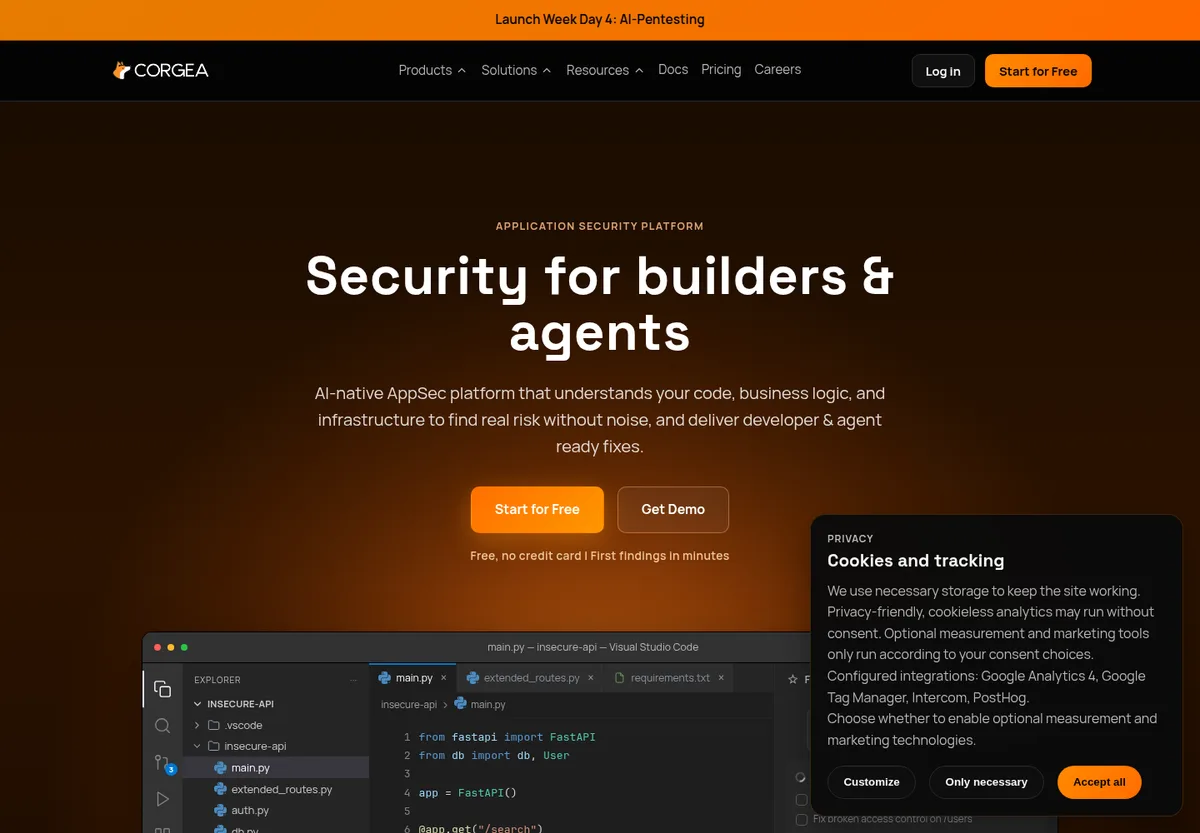
Corgea is an AI-native application security platform that finds exploitable vulnerabilities and helps fix them. It is built for teams that want strong detection without a heavy enterprise deployment.
What it is: AI-native SAST for custom code, with broader AppSec coverage across dependencies, secrets, containers, and IaC, plus autonomous AI pentesting.
Why teams choose it over Checkmarx: Where Checkmarx centers on policy configuration and query customization, Corgea uses static analysis, code context, framework understanding, reachability, and LLM-based reasoning to explain why a finding is exploitable and to propose a review-ready fix. That usually means faster time to first useful result and less operational overhead: Corgea connects to GitHub, GitLab, Azure DevOps, Bitbucket, and Harness Code through API-native integrations, so there are no scan engines to host, no CxFlow to run, and no per-pipeline scan jobs. Reachability-aware prioritization reduces the queue of low-value findings that erode developer trust. Out of the box, Corgea surfaces roughly 2x the true positives and 3x fewer false positives than legacy SAST, and Latio Tech’s Actually Useful Product Guide ranked it first of seven SAST auto-fix tools tested.
Migration proof: the Checkmarx-to-Corgea migration guide lays out a five-phase, 14-day cutover, starting with uploading your latest Checkmarx JSON report into Corgea so both result sets sit side by side on the same commit. Auto-Discovery generates project-specific policies from your code, so presets, custom CxQL queries, and false positive suppressions do not need to be ported.
Where it falls short: Corgea is a newer vendor than Checkmarx. If your procurement depends on a specific analyst placement or decades of enterprise tenure, plan a structured proof of value with your own repositories and internal evidence.
Best fit: Teams that want enterprise-quality detection with faster setup, lower noise, reachability-aware prioritization, and fixes developers can review in pull requests.
Pricing note: Corgea has a free plan for up to 2 team members and 10 repositories, with per-developer Growth and Scale plans. See the pricing page and the Corgea vs Checkmarx comparison.
2. Snyk
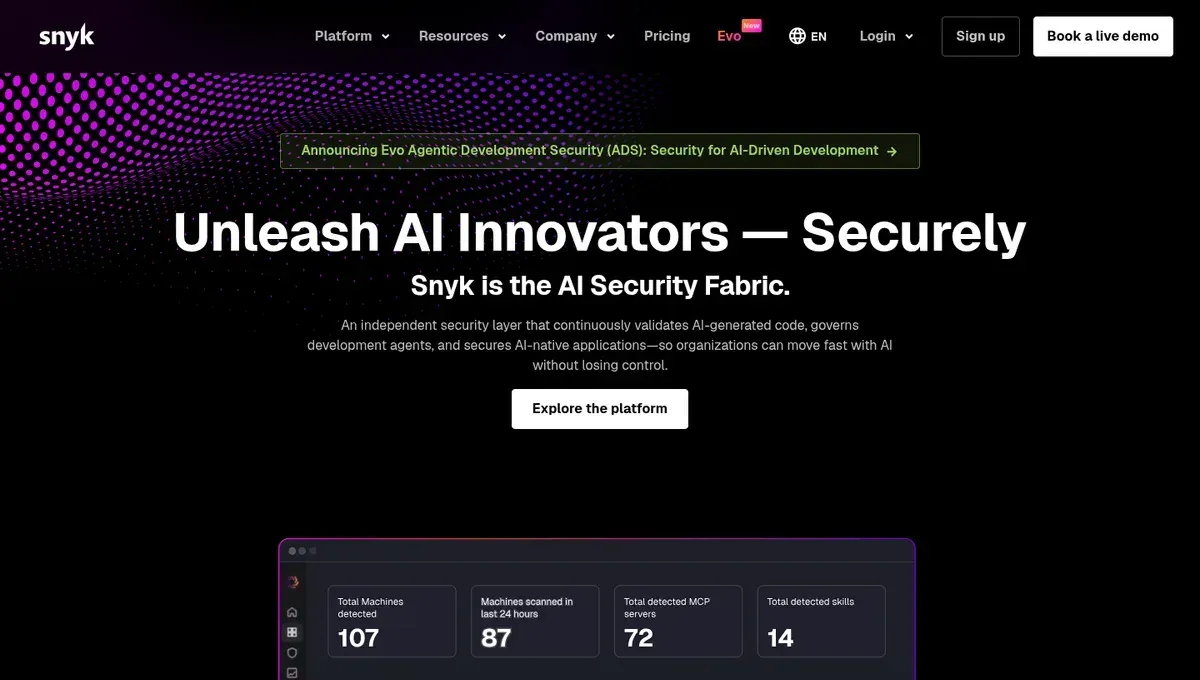
Snyk is a developer-first security platform with software composition analysis and Snyk Code for SAST.
What it is: A developer-oriented platform spanning SCA, SAST, container, and IaC security.
Why teams choose it over Checkmarx: Faster developer adoption and a lighter operating model appeal to teams moving away from heavy enterprise workflows. See Snyk vs Checkmarx and the Snyk alternatives guide for a deeper comparison.
Where it falls short: Snyk is SCA-led, and cost can grow with the platform. On a deliberately vulnerable benchmark repository, Snyk Code found 26 of 47 confirmed issues versus Corgea’s 42; see the Corgea vs. Snyk benchmark.
Best fit: Teams whose center of gravity is developer-first SCA plus SAST.
Pricing note: Free tier and published Team pricing per product, with enterprise pricing quote-based.
3. Semgrep
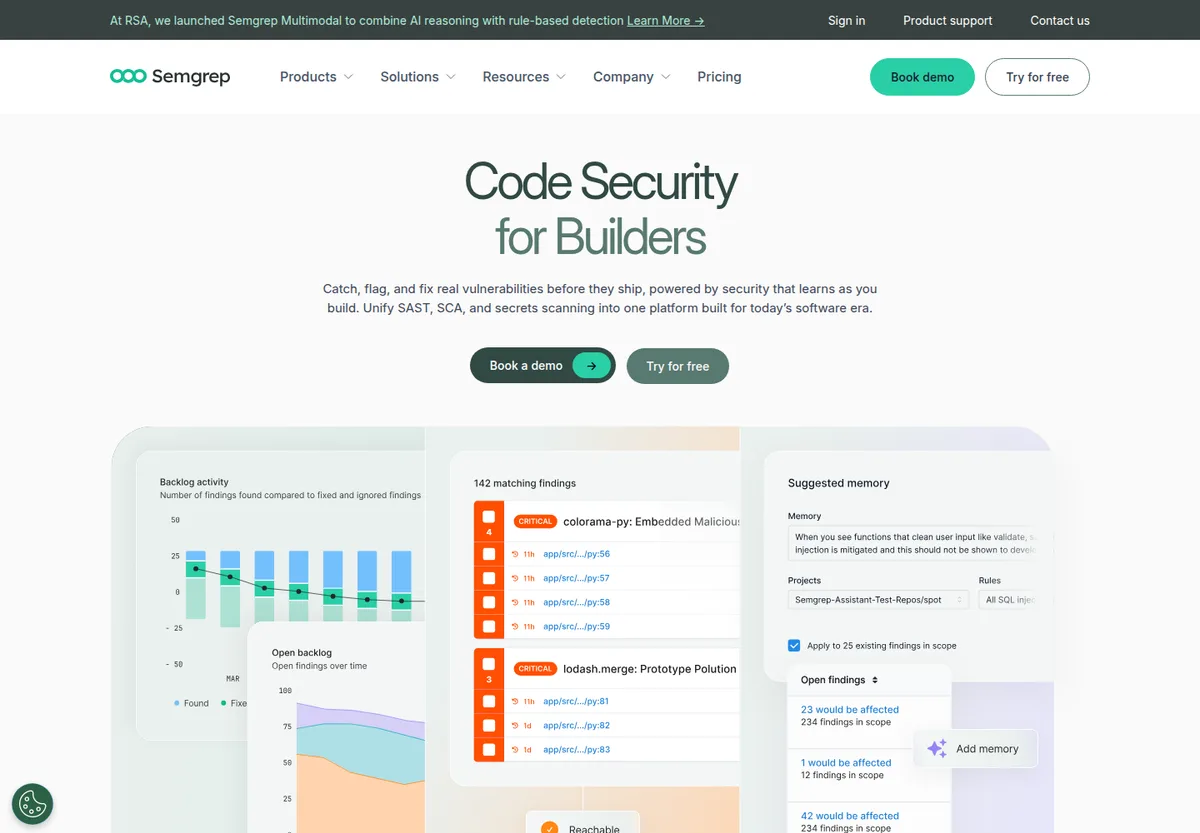
Semgrep is a developer-friendly static analysis platform with open-source rule control. Its January 2025 fork, OpenGrep, is maintained by a consortium of security vendors under the same LGPL-2.1 license.
What it is: A fast SAST platform with strong rule authoring and a large rule ecosystem.
Why teams choose it over Checkmarx: Transparent, customizable detection and fast CI scans appeal to teams that want to own detection logic. See the Semgrep alternatives guide and Corgea vs Semgrep.
Where it falls short: Pattern-first detection can miss business-logic flaws, and custom rules need maintenance. Cross-file taint analysis, SCA, secrets, and AI triage are paid features.
Best fit: Teams that value speed, transparency, and open-source control.
Pricing note: Free Community Edition plus paid tiers priced per contributor.
4. Veracode
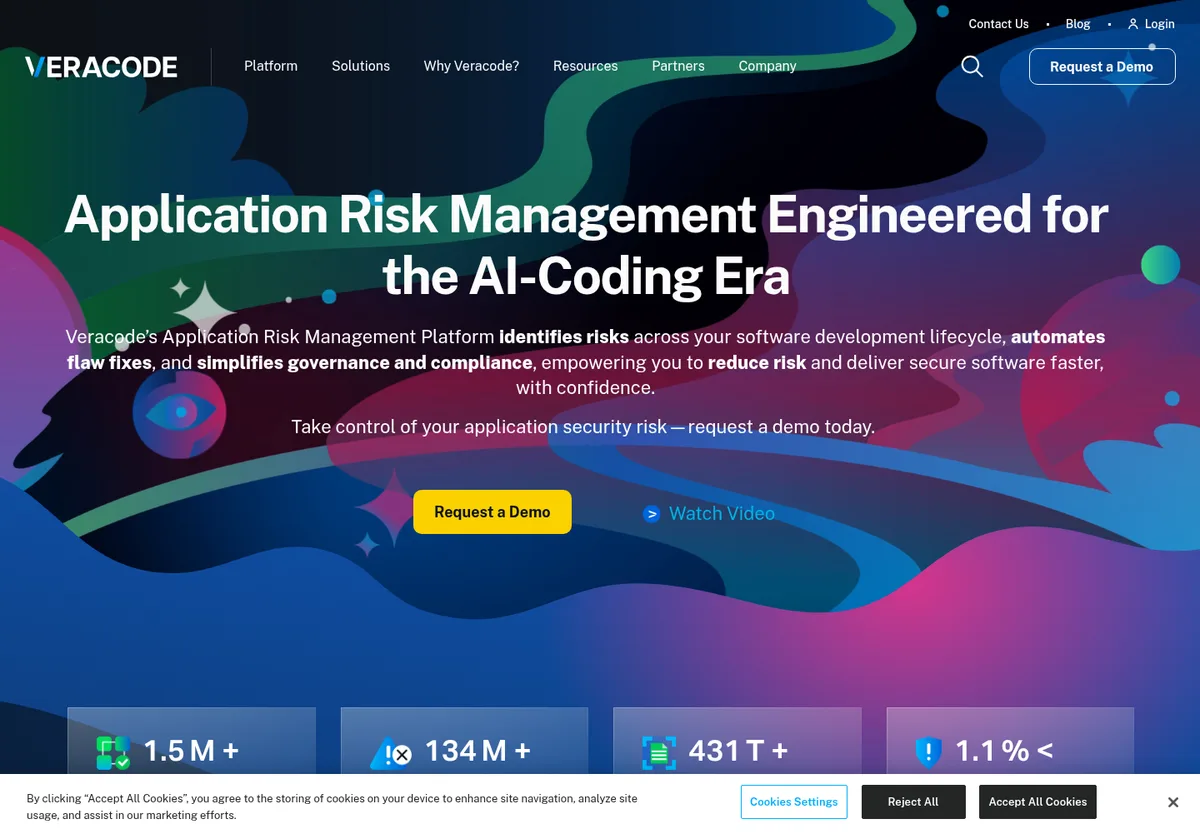
Veracode is a peer enterprise application security platform with policy-driven SAST.
What it is: Enterprise static analysis and application security testing for governance-led programs.
Why teams choose it over Checkmarx: Buyers who want an enterprise SAST alternative with strong compliance reporting and Veracode Fix often compare the two directly. See Checkmarx vs Veracode.
Where it falls short: Like Checkmarx, the platform can feel heavy for smaller teams.
Best fit: Compliance-led programs seeking an enterprise peer to Checkmarx.
Pricing note: Enterprise quote. Pricing is not publicly listed.
5. GitHub Advanced Security
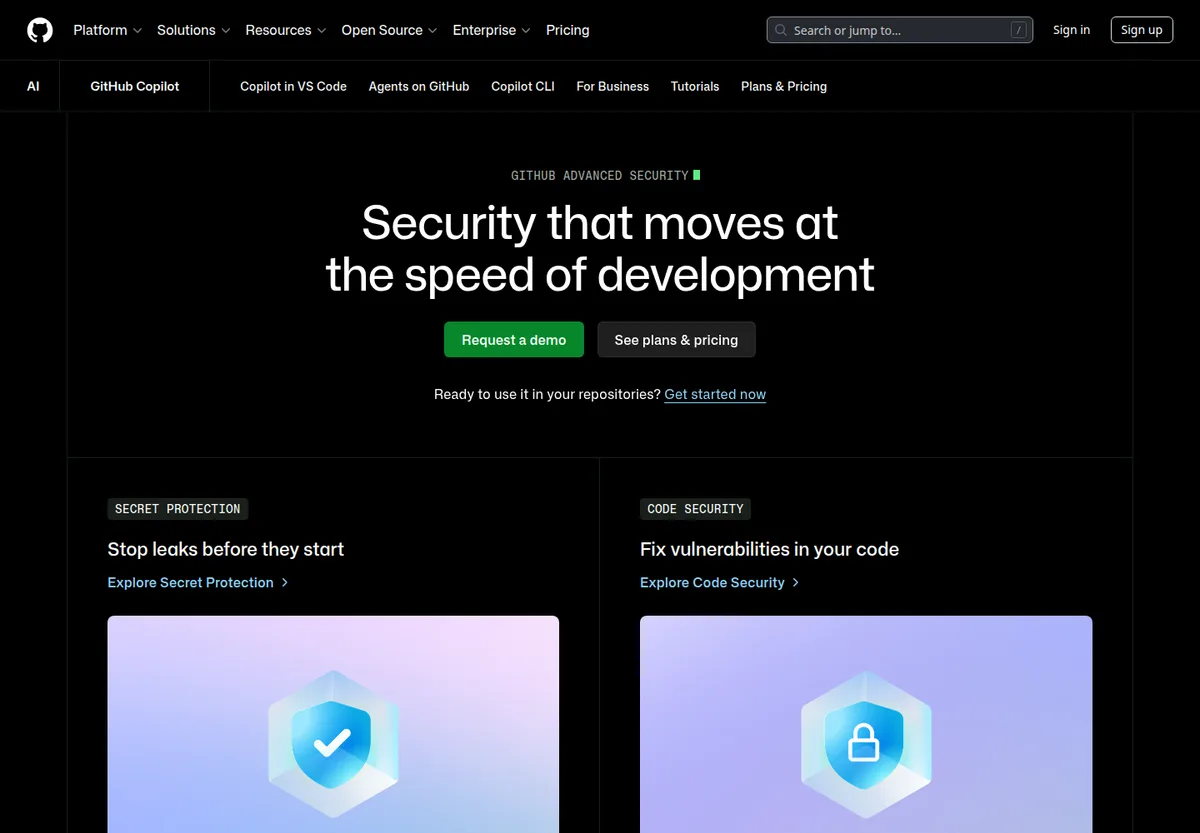
GitHub Advanced Security uses CodeQL for code scanning plus native secret scanning and Copilot Autofix. Since April 2025 it is sold as two add-ons: GitHub Code Security (CodeQL, Copilot Autofix, dependency review) and GitHub Secret Protection (secret scanning and push protection).
What it is: GitHub’s native application security suite.
Why teams choose it over Checkmarx: GitHub-native teams get SAST inside pull requests and Actions without a separate enterprise platform.
Where it falls short: It is less natural outside GitHub, and CodeQL authoring has a learning curve. See Corgea vs GitHub Advanced Security.
Best fit: Teams standardized on GitHub.
Pricing note: Published per-active-committer pricing for private repositories, free for public repositories.
6. SonarQube
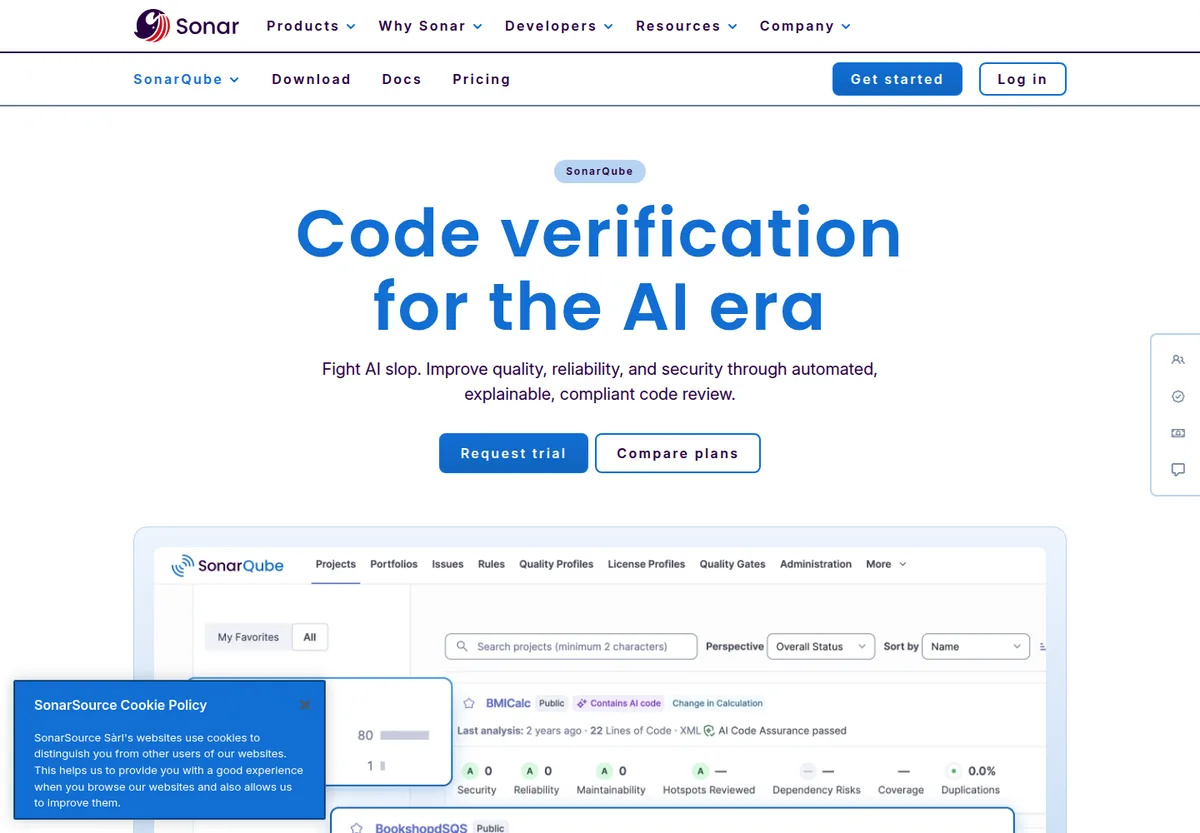
SonarQube is a widely adopted static analysis platform for code quality and security.
What it is: Code quality and security analysis with quality gates and broad language support.
Why teams choose it over Checkmarx: Teams already using SonarQube can add security checks without introducing a heavy enterprise SAST tool. See SonarQube vs Checkmarx.
Where it falls short: Security depth varies by language, taint analysis and SCA sit in paid editions, and it may miss logic-heavy issues. See the best SonarQube alternatives.
Best fit: Teams that want quality and baseline security together.
Pricing note: Free Community Build; Developer, Enterprise, and Data Center editions are priced by lines of code, plus SonarQube Cloud.
7. Endor Labs
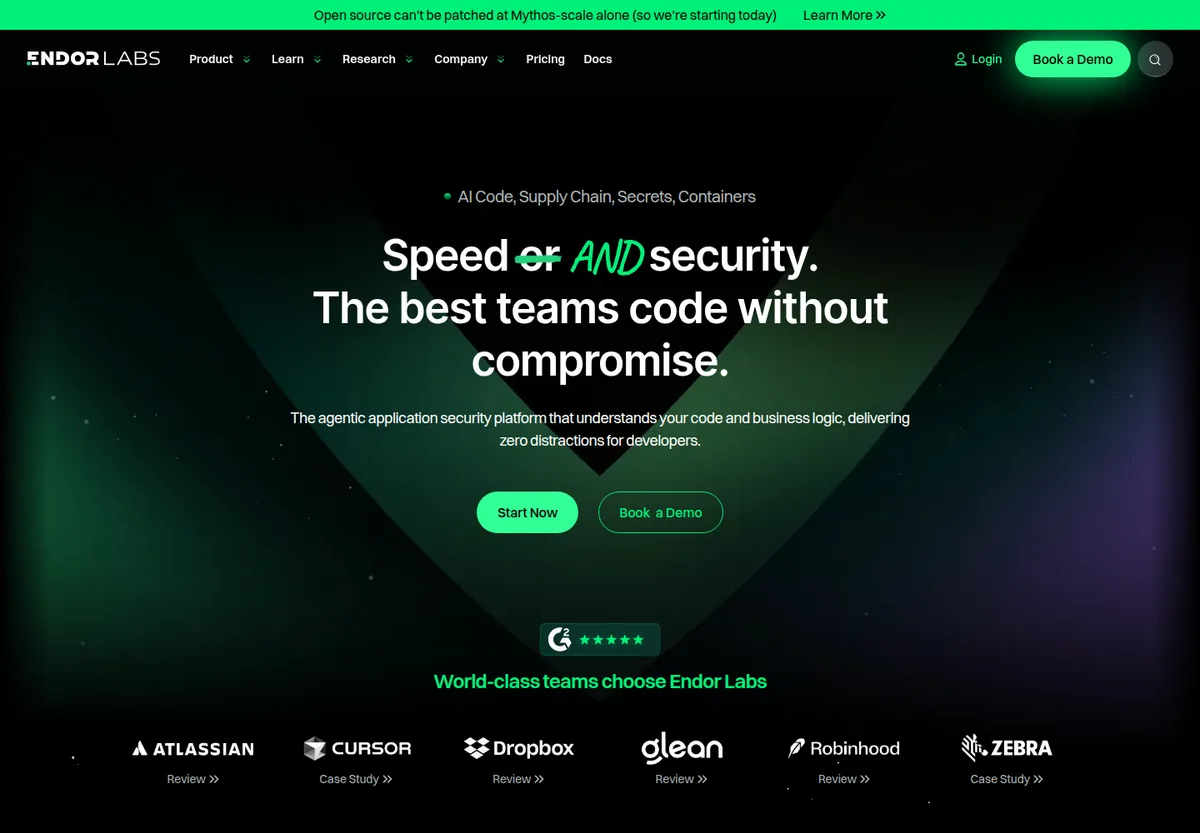
Endor Labs is best known for reachability-based software composition analysis with expanding code security.
What it is: An AppSec platform centered on dependency security, reachability, and prioritization.
Why teams choose it over Checkmarx: Teams whose SAST decision is tied to dependency risk and reachability find its prioritization compelling.
Where it falls short: Its SAST is newer than its SCA reputation.
Best fit: Teams focused on dependency risk and reachability.
Pricing note: Enterprise quote. Pricing is not publicly listed.
8. Aikido
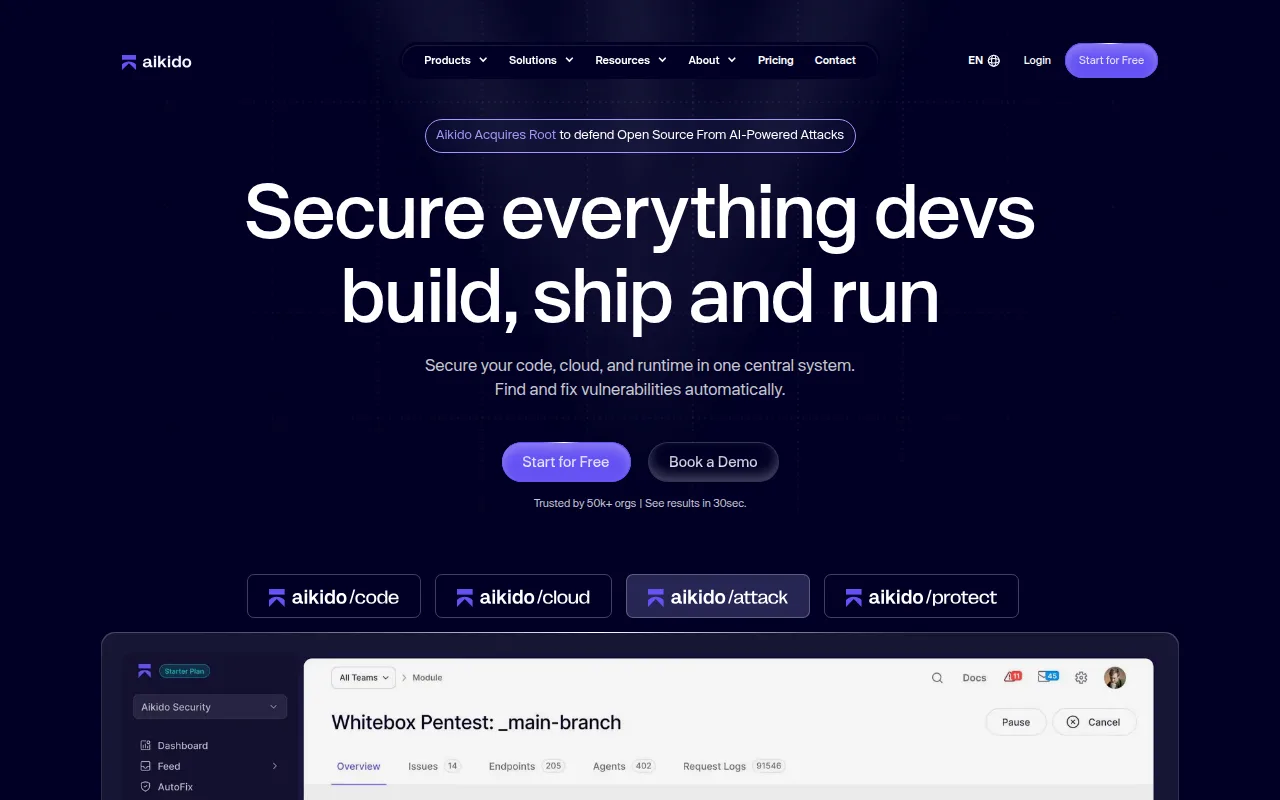
Aikido is an all-in-one security platform that secures code, cloud, and runtime with automated fixes.
What it is: A broad AppSec platform covering SAST, SCA, secrets, IaC, containers, and cloud posture.
Why teams choose it over Checkmarx: Teams that want consolidated coverage and public pricing instead of enterprise quotes shortlist Aikido. See the Aikido alternatives guide.
Where it falls short: All-in-one breadth can mean less depth in specific areas. On the same benchmark repository used for the Snyk comparison, Aikido’s SAST found 13 of 47 confirmed issues versus Corgea’s 42; see the Corgea vs. Aikido benchmark.
Best fit: Teams that want broad coverage with transparent pricing.
Pricing note: Public tiers including a free tier, with quotes for larger plans.
9. Fortify
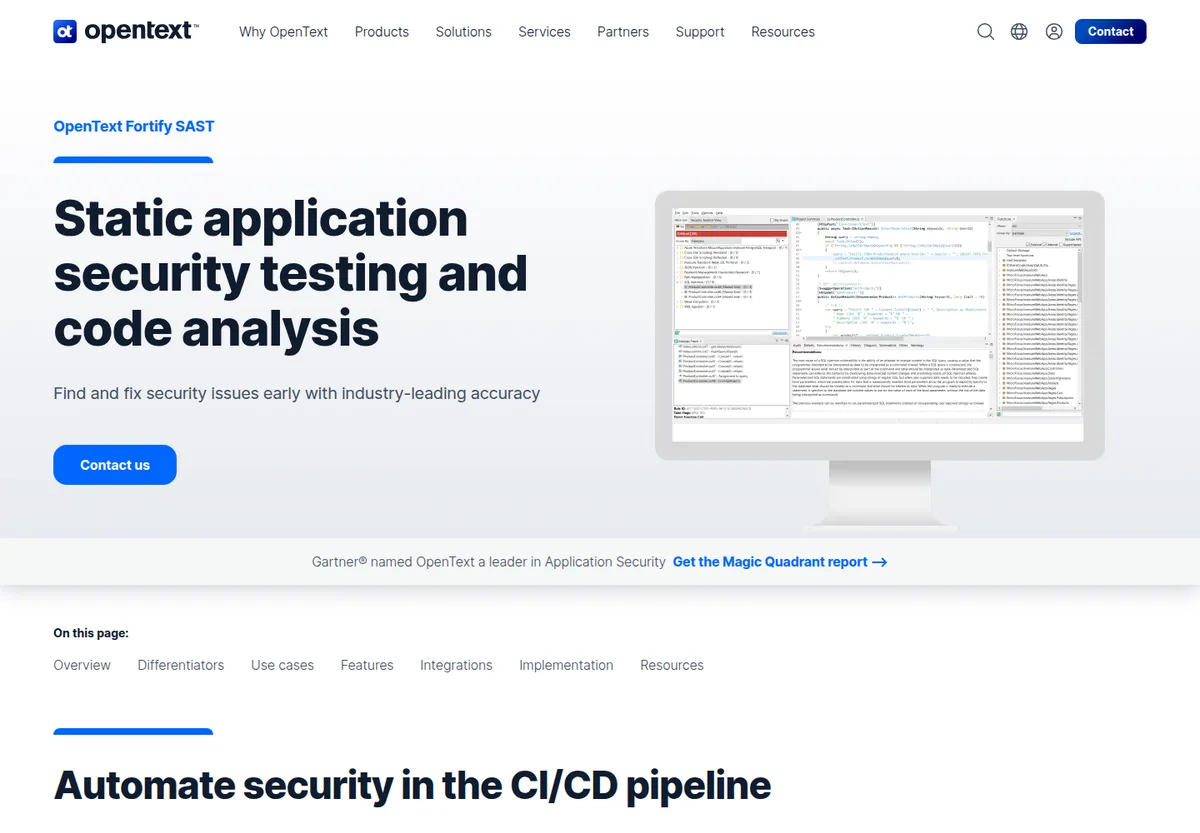
Fortify from OpenText is one of the longest-running enterprise SAST products, with Fortify Aviator for AI triage and remediation.
What it is: Mature enterprise SAST with cloud, on-premises, and managed service options.
Why teams choose it over Checkmarx: Regulated enterprises evaluating a peer legacy SAST platform often compare Fortify and Checkmarx directly.
Where it falls short: The platform can feel heavy compared with modern developer-first or AI-native tools.
Best fit: Large regulated enterprises, especially existing Fortify customers.
Pricing note: Enterprise quote. Pricing is not publicly listed.
When to stay with Checkmarx
A fair comparison acknowledges where Checkmarx remains a strong choice. Stay with Checkmarx if:
- You already run a governance-heavy AppSec program and rely on its policy, query, and reporting controls.
- Analyst recognition and legacy enterprise procurement precedent matter to your buying process.
- Your compliance program depends on established audit workflows and centralized controls.
- Your teams already invested in Checkmarx query customization and integrations.
- You have negotiated pricing and support that fit your organization.
If those points describe your program, the incremental value of switching may be small. Focus on tuning and developer trust instead.
How to choose a Checkmarx alternative
Use a decision framework rather than a feature checklist.
- Choose Corgea if you want AI-native AppSec, faster setup, better signal, reachability-aware prioritization, and review-ready fixes in the developer workflow.
- Choose Checkmarx (stay) if you already standardized on it and only need incremental improvement.
- Choose Semgrep or OpenGrep if custom rules and open-source control matter most.
- Choose Veracode or Fortify if analyst recognition and legacy enterprise procurement matter most.
- Choose Snyk if developer-first SCA is the center of gravity.
- Choose GitHub Advanced Security if your team lives inside GitHub.
Then run a real bake-off. The best SAST tools guide explains how to design one, and the application security testing complete guide covers where SAST fits alongside SCA, secrets, IaC, and container scanning. Score confirmed true positives, false positives, missed known issues, setup effort, triage time, fix acceptance, developer friction, and total cost.
Migrating from Checkmarx to Corgea
Replacing Checkmarx One, Checkmarx SAST, or CxSAST has a reputation for being a multi-quarter program. That reputation comes from the architecture, not the work: a traditional SAST migration means re-plumbing every pipeline, re-hosting scan engines, and re-creating years of tuning in a new query language. Corgea removes both workstreams, which is why the full Checkmarx-to-Corgea migration guide fits in under 14 days:
- Baseline bake-off (days 1-2). Upload your most recent Checkmarx JSON report into Corgea, run a Corgea scan on the same commit, and compare true positives, false positives, and misses side by side on your own code.
- Native source control connections (days 2-4). Connect GitHub, GitLab, Azure DevOps, Bitbucket, or Harness Code through API-native integrations. No scan jobs per pipeline, no CxFlow, no engines to host.
- Enforcement rules (days 4-6). Port break-build policy to Corgea blocking rules. Skip the tuning migration: Auto-Discovery generates project-specific policies, so presets, custom CxQL queries, and false positive suppressions do not need to be recreated.
- Developer and agent enablement (days 6-9). Roll out the IDE extensions, the Corgea Agent in pull requests, and the CLI skill for coding agents so triage happens in code review instead of a suppression database.
- Reporting, governance, decommission (days 9-14). Wire up Jira, SARIF/CSV/PDF export, webhooks, SAML SSO, and SLA management, then archive Checkmarx and let the license lapse at renewal.
Checkmarx keeps running non-blocking for the entire window, so there is no coverage gap and rollback is a configuration change. The guide also covers what to preserve (governance evidence, break-build policy) and what not to port.
How to run the Checkmarx-to-Corgea pilot
Structure the evaluation to protect your governance requirements while testing for speed and signal.
- Start with time to first useful result. One of the most common Checkmarx complaints is setup and tuning time. Measure how long each tool takes to produce a triaged, trustworthy finding on a real repository, not a demo project.
- Pick a representative repository set. Include your primary languages and frameworks, a high-change service, a legacy service with known scanner noise, and a security-sensitive service with auth, payments, or admin logic.
- Define ground truth. Use recently fixed vulnerabilities, pentest findings, seeded issues, and known Checkmarx false positives so you can score detection and noise on the same evidence.
- Score outcomes, not alert volume. Track confirmed true positives, false positives, missed known issues, and duplicate findings. A smaller, trusted queue usually beats a large, noisy one.
- Test fix quality. For each generated fix, verify it compiles, passes tests, preserves behavior, and resolves the root cause, then measure developer acceptance in pull requests.
Migration considerations when leaving Checkmarx
- Preserve governance evidence. Confirm the alternative can produce the SLA tracking, ownership, trend reporting, and audit evidence your compliance program depends on today.
- Map existing policies. Translate the Checkmarx policies you rely on into the new tool’s model, and note anything that cannot be reproduced. With Corgea, most query customizations and suppressions have no equivalent because Auto-Discovery replaces them; break-build policy is the part to port deliberately.
- Plan a parallel run. Run the new tool alongside Checkmarx for a defined window so you can compare findings on identical commits before cutting over.
- Account for integrations. Verify IDE, CI/CD, SCM, and ticketing integrations match your workflow so developers do not lose context during the switch.
- Model total cost of ownership. Include license cost, AppSec triage hours, developer time, CI build cost, and administration effort, because Checkmarx pricing is not publicly listed and TCO is often dominated by operating overhead.
The best SAST tools guide includes a reusable bake-off template, and the how to reduce false positives in SAST guide covers scoring noise consistently across tools.
Questions to ask Checkmarx alternatives before you switch
- How long does it take to onboard a real repository and produce a triaged, trusted finding?
- Which languages and frameworks are supported at production depth, and how are generated code, tests, and vendored code handled?
- Can the tool reproduce my existing Checkmarx policies, query customizations, and severity workflows, or does it make them unnecessary?
- What governance evidence does it produce, including SLA tracking, ownership, trend reporting, and audit trails?
- Are generated fixes validated, and can developers review and merge them without leaving their workflow?
- Since pricing is not publicly listed for many enterprise tools, what does total cost of ownership look like at my rollout scale?
Answering these on your own repositories, rather than from a feature page, is the fastest way to separate real capability from marketing.
Related AppSec tool comparisons
- How to migrate from Checkmarx to Corgea in under 2 weeks and the Corgea vs Checkmarx comparison page
- Best Snyk alternatives, Corgea vs Snyk, and the Corgea vs. Snyk benchmark
- Best SonarQube alternatives
- Best Semgrep alternatives and best Aikido alternatives
- Best depthfirst alternatives
- Best SAST tools in 2026, what is SAST, and AI SAST explained
Frequently asked questions about Checkmarx alternatives
What is the best Checkmarx alternative in 2026?
There is no single best Checkmarx alternative for every team. Corgea is a strong fit when you want AI-native detection, faster setup, lower-noise prioritization, and review-ready fixes without heavy enterprise operational overhead. Veracode and Fortify are peer enterprise SAST platforms, Semgrep suits open-source rule control, and GitHub Advanced Security fits GitHub-native teams. Validate on your own repositories first.
Is Corgea a Checkmarx alternative?
Yes. Corgea is an AI-native application security platform that competes with Checkmarx on SAST and adds dependency, secrets, IaC, and container coverage. Teams evaluate Corgea against Checkmarx when they want faster onboarding, lower false positives, reachability-aware prioritization, and fixes developers can review in pull requests.
How long does it take to migrate from Checkmarx to Corgea?
Under two weeks for a full cutover. The migration guide splits it into five phases: a baseline bake-off (days 1-2), native source control connections (days 2-4), enforcement rules (days 4-6), developer and agent enablement (days 6-9), and reporting, governance, and decommission (days 9-14). Checkmarx keeps running non-blocking for the whole window, so there is no coverage gap and rollback is a configuration change.
Do I need to port Checkmarx presets and custom CxQL queries?
Usually no. Corgea’s Auto-Discovery studies your repository before the first scan, detects frameworks and existing security controls, and generates project-specific policies. Presets, custom CxQL queries, and false positive suppressions mostly exist to compensate for a generic ruleset, so there is little to port. The exception is break-build policy, which maps to Corgea blocking rules and should be ported deliberately.
What is the difference between Checkmarx and Corgea?
Checkmarx is an established enterprise SAST platform built around policy controls, query customization, and governance. Corgea is AI-native from detection through remediation and prioritizes low noise, developer workflow, and review-ready fixes. Based on public positioning, Checkmarx emphasizes enterprise governance while Corgea emphasizes speed to value and autofix quality.
Which Checkmarx alternative has the fastest setup?
AI-native and developer-first tools generally onboard faster than a full enterprise SAST deployment. Corgea, Snyk, Semgrep, and GitHub Advanced Security are typically quicker to pilot than a governance-heavy platform. Corgea connects through API-native source control integrations with no scan engines to host, so first findings usually arrive within minutes. Measure time to first useful result on your own repositories during evaluation.
Are there enterprise Checkmarx alternatives with strong governance?
Yes. Veracode and Fortify are peer enterprise SAST platforms with mature policy, reporting, and compliance controls. If analyst recognition and legacy procurement are the priority, they are natural comparisons. If you want governance plus AI-native detection, evaluate Corgea alongside them; it supports SAML SSO, RBAC, SLA management, SARIF and PDF export, and webhooks for GRC pipelines.
Are there free Checkmarx alternatives?
Yes. Semgrep Community Edition has a free open-source engine, OpenGrep is fully open source, SonarQube Community Build is free, and GitHub code scanning is free for public repositories. Corgea also offers a free plan for up to 2 members and 10 repositories. Free tools reduce license cost but usually shift effort into tuning and triage; the free and open-source section of the SonarQube alternatives guide compares the options.
How should teams evaluate Checkmarx competitors?
Evaluate Checkmarx competitors on your own repositories. Upload your latest Checkmarx report next to a scan from the alternative on the same commit, then measure confirmed true positives, false positives, missed known issues, setup effort, time to triage, fix acceptance rate, developer workflow friction, reporting quality, and total cost of ownership rather than raw finding counts.
The bottom line on Checkmarx alternatives
Checkmarx is a capable enterprise SAST platform for governance-heavy programs. If your team is comparing Checkmarx alternatives because you need fewer false positives, faster remediation, and review-ready fixes, book a Corgea demo or follow the 14-day migration guide. You can also explore Corgea AI SAST, autonomous AI pentesting, the Corgea vs Checkmarx comparison, and current pricing.
Corgea is not affiliated with Checkmarx. This comparison is based on public information and product positioning.