

If you are looking for an Aikido alternative, Corgea is strongest when your priority is AI-native detection, reachability-aware prioritization, review-ready fixes, and autonomous AI pentesting rather than broad all-in-one coverage. Aikido may still be a good fit if you want consolidated code, cloud, and runtime security in one platform with transparent, self-serve pricing. This guide compares the best Aikido alternatives in 2026 so an AppSec buyer can shortlist quickly, then validate on real repositories.
Aikido positions itself as an all-in-one platform that secures code, cloud, and runtime, and it appeals to teams that want broad coverage and public pricing. Teams start searching for Aikido alternatives for specific reasons: questions about depth behind all-in-one breadth, startup versus enterprise fit, per-use AI audit economics, and the need for deeper AI-native remediation or an autonomous pentesting capability. The tools below address different versions of that gap.
TL;DR: quick picks for Aikido alternatives
- Best AI-native alternative to Aikido: Corgea
- Best benchmarked SAST depth: Corgea found 42 of 47 confirmed issues; Aikido found 13
- Best benchmarked auto-fix score: Corgea ranked #1 in Latio Tech’s auto-fix benchmark; Aikido ranked #6
- Why Aikido lagged on SAST: OpenGrep-based traditional static analysis is useful for known patterns, but it can miss context-heavy custom-code vulnerabilities
- Best developer-first SCA option: Snyk
- Best open or custom-rule SAST option: Semgrep or OpenGrep
- Best enterprise governance option: Checkmarx or Veracode
- Best cloud-to-code option: Wiz Code
- Best AppSec posture (ASPM) option: OX Security
- Best GitHub-native option: GitHub Advanced Security
- Aikido AI Code Audit pricing note: our benchmark account showed a 20-credit audit, $1 credits, and a 100-credit minimum purchase dialog
If you want deeper AI-native detection and autonomous AI pentesting, start a Corgea demo and compare on a security-sensitive service.
If you are already PoCing Aikido, test these before you buy
Teams evaluating Aikido often start with a PoC because the platform workflow looks modern and consolidated. That is a reasonable starting point, but a PoC that only checks UI fit or demo findings can miss the questions that matter at scale. Use this checklist before you sign:
- Seed known vulnerabilities and measure misses, not just false positives. A clean alert queue is useful, but missed known issues are the harder operational risk.
- Test business logic, authz, IDOR, SSRF, open redirect, secrets, and multi-file context. Pattern scanners and shallow demos often look good on injection samples and weak on authorization and context-heavy flaws.
- Compare default SAST and AI Code Audit separately. Do not assume one scan result represents the full analysis stack.
- Verify whether deeper AI analysis is included or credit-metered. Confirm what a normal CI scan includes versus what requires extra credits or manual runs.
- Test Autofix on business logic changes, not only simple SQL injection. Simple pattern fixes are not a proxy for safe remediation in real services.
- Require evidence that generated fixes preserve behavior, preferably tests or reviewable diffs. A patch that closes a finding but breaks a guardrail is not a win.
- Ask how fair-use limits apply to large microservice architectures, repo count, scan frequency, and Code Audit usage. Pricing that looks simple on one repo can change once scan volume and repo count grow.
Practitioners in a recent Reddit discussion about Aikido reported mixed PoC results depending on use case, which is exactly why buyer diligence should be structured rather than anecdotal.
Default SAST vs AI Code Audit
Aikido’s public positioning has evolved, and buyers should separate the layers instead of treating “Aikido SAST” as one product experience. In the Reddit thread, Aikido’s CEO said default SAST is OpenGrep-based and is strong for shell or SQL injection style patterns, while Code Audit is fully AI-based and aimed at complex vulnerabilities such as business logic issues or cross-tenant data leaks.
That distinction matters for evaluation design. If your PoC only exercises the default scan path, you may under-test the capability Aikido points to for harder classes of risk. If your PoC only exercises Code Audit, you may over-credit a workflow that is not what runs on every pull request. Run both paths explicitly, label which layer produced each finding, and score them against the same seeded ground truth.
Autofix buyer diligence
Autofix is often the feature that pulls teams into an Aikido PoC. In the Reddit thread, one practitioner reported that Autofix handled some simple SQL injection patterns but raised concern on a few business logic checks, while CI integration and support were viewed positively. Aikido’s CEO replied that Autofix has since been overhauled into a more agentic system, including writing its own unit tests.
Treat those notes as inputs to your own test plan, not as a universal verdict. During your PoC, score each proposed fix on:
- Did the fix close the vulnerability without weakening adjacent controls?
- Did tests pass, and were new tests generated where appropriate?
- Is the diff minimal, reviewable, and acceptable to your developers?
- Did the fix preserve business logic and authorization behavior?
Bring us the repo you are using for your Aikido PoC
We will benchmark Corgea on the same code and compare confirmed findings, missed known issues, false positives, and fix quality.
Why teams look for Aikido alternatives
Aikido is a capable all-in-one platform, but the reasons teams evaluate alternatives are usually about depth, fit, and specialized capability.
- Broad all-in-one positioning. Consolidation is attractive, but buyers sometimes want to confirm depth in the specific area that matters most, such as code SAST or remediation quality.
- SAST depth questions. In our July 2026 benchmark against a deliberately vulnerable repository, Aikido found 13 of 47 confirmed issues while Corgea found 42. The gap came from Aikido’s OpenGrep-based, traditional static analysis layer: strong for known patterns, weaker for contextual reasoning across custom application logic.
- Startup and enterprise fit questions. Teams growing from startup to enterprise may reassess whether an all-in-one tool scales with their governance and reporting needs, or whether it is right-sized for a lean team.
- Deeper AI-native remediation. Aikido promotes automated fixes, but buyers who want AI-native detection and review-ready remediation across many vulnerability classes may want to compare capability by capability.
- Per-use AI audit costs. Aikido’s AI Code Audit was shown as a separate credit-based product in our benchmark account, while Corgea AI SAST is included in the developer bundle.
- Autonomous pentesting. Teams that want agentic, autonomous security testing in the same vendor look for a platform that treats it as a first-class capability.
The how to reduce false positives in SAST guide and the how to evaluate AI-native SAST tools guide help structure a fair comparison.
Aikido alternatives compared: capabilities at a glance
The table below compares Aikido alternatives across the AppSec capabilities most buyers evaluate. Entries reflect public positioning and should be validated during a pilot on your own repositories.
Table: Aikido alternatives compared across SAST, SCA, secrets, IaC, containers, AI triage, auto-fix, pentesting, and pricing model.
| Tool | Best for | SAST | SCA | Secrets | IaC | Containers | AI triage | Auto-fix | Pentesting | Pricing model | Main limitation |
|---|---|---|---|---|---|---|---|---|---|---|---|
| Corgea | AI-native depth and autonomous pentesting | Yes | Yes | Yes | Yes | Yes | Yes | Yes | Yes | Free trial, quote-based plans; AI SAST included in developer bundle | Newer vendor, validate on your repos |
| Aikido (baseline) | All-in-one coverage | Yes | Yes | Yes | Yes | Yes | Yes | Yes | Yes | Public tiers plus quote; AI Code Audit credits in benchmark account | OpenGrep/traditional SAST recall lagged in benchmark |
| Snyk | Developer-first SCA | Yes | Yes | Limited | Yes | Yes | Yes | Yes | No | Free and paid tiers | SCA-led, cost grows with platform |
| Semgrep | Open-source rule control | Yes | Yes | Yes | Partial | No | Yes | Partial | No | Free OSS plus paid tiers | Rule tuning and maintenance |
| Checkmarx | Enterprise governance | Yes | Yes | Yes | Yes | Yes | Yes | Partial | No | Enterprise quote | Operationally heavy |
| Endor Labs | Reachability-led SCA | Partial | Yes | Yes | Partial | Yes | Yes | Partial | No | Enterprise quote | SAST newer than SCA story |
| Veracode | Compliance programs | Yes | Yes | Partial | Yes | Yes | Yes | Yes | Yes (services) | Enterprise quote | Heavy for small teams |
| GitHub Advanced Security | GitHub-native teams | Yes | Yes | Yes | Partial | No | Partial | Yes | No | Per active committer | Best inside GitHub only |
| Wiz Code | Cloud-to-code security | Partial | Yes | Yes | Yes | Yes | Yes | Partial | No | Enterprise quote | Code depth secondary to cloud |
| OX Security | AppSec posture and ASPM | Aggregates | Yes | Yes | Yes | Yes | Yes | Partial | No | Enterprise quote | Platform, not a point scanner |
Compare Corgea against Aikido on your own code
Use Corgea for AI-native detection, reachability-aware prioritization, review-ready fixes, and autonomous AI pentesting.
Corgea vs. Aikido benchmark snapshot
To make this buyer guide concrete, we benchmarked Corgea and Aikido on latiotech/insecure-kubernetes-deployments, a deliberately vulnerable repository. Each reported finding was reviewed against source and scored as a true positive, false positive, or false negative.
The scoring set contained 47 source-confirmed issues. Corgea found 42. Aikido found 13.
Corgea found 42 of 47; Aikido found 13
Same deliberately vulnerable repository, same review process, 47 source-confirmed issues. Aikido was slightly cleaner per reported finding, but Corgea found far more of the vulnerabilities that needed remediation.
3.23x Aikido's recall, 2.04x its F1, and 29 more confirmed vulnerabilities found.
Scoring set: 47 source-confirmed issues reviewed on July 2, 2026. Precision = TP / (TP + FP), recall = TP / (TP + FN), F1 = harmonic mean of precision and recall.
Aikido was slightly cleaner; Corgea was far more complete
Bubble position shows precision and recall. Bubble size shows confirmed true positives. The upper-right corner is the goal: high confidence and broad vulnerability discovery.
Precision and recall use the same July 2, 2026 scoring set of 47 source-confirmed issues.
A small precision edge did not make up for 34 misses
Aikido's output had fewer false positives, but its SAST scan left most confirmed issues behind. For remediation planning, missed vulnerabilities are the larger operational risk.
Examples Corgea found that were absent from the Aikido results:
- Missing authorization on data-modifying FastAPI routes
- SSRF in a URL fetch endpoint
- Open redirect through an unvalidated next parameter
- Lodash template code injection
- Prototype pollution risk around JSON5 parsing
- Hardcoded AWS credentials in Kubernetes deployment templates
- Hardcoded API tokens in test code
Each stacked bar totals 47 source-confirmed issues. Found percentages: Corgea 89%, Aikido 28%.
The benchmark does not mean Aikido is a poor fit for every team. It does mean buyers should validate Aikido’s SAST depth on their own code rather than assuming all-in-one breadth translates to deep custom-code detection.
The limitation is the SAST layer itself. OpenGrep-style static analysis is valuable for fast rule matching, but traditional static rules can miss vulnerabilities that depend on framework behavior, authorization boundaries, multi-file context, or business logic. That is why teams evaluating Aikido should also read the BLAST AI-powered SAST whitepaper, The Three Waves of SAST, and how to evaluate AI-native SAST tools.
Aikido's AI Code Audit was metered separately in this run
The benchmark account showed a 20-credit AI Code Audit for this repository. At $1 per credit, that is $20 for the audit, with a 100-credit minimum purchase shown in the checkout dialog.
Cost notes are based on the Aikido in-product screens captured during the July 2, 2026 benchmark run.
Latio ranked Corgea #1 and Aikido #6 for SAST auto-fixing
James Berthoty at Latio Tech scored 7 auto-fix vendors by final score: Coverage x Quality. Corgea led with 719; Aikido ranked #6 with 336.
"pretty mindblowing in a lot of respects"
Latio highlighted Corgea for a robust LLM-based SAST scanner, simple developer experience, strong explanations, contextual policy work, and an agentic prompting approach across fixes, validation, and code context.
"fix coverage was low"
Latio noted that Aikido was rapidly improving and prioritized accuracy by rolling out fixes rule by rule, but its lower coverage limited the final score.
Source: Actually Useful Product Guide by James Berthoty at Latio Tech. Full 7-vendor benchmark shown; non-Corgea/non-Aikido rows are muted to keep the comparison focused. Read Corgea's summary of the report here.
The best Aikido alternatives in 2026, reviewed
Corgea is listed first because it targets the exact question that drives Aikido evaluations: depth of AI-native detection and remediation, plus autonomous pentesting, rather than breadth alone. It also won the July 2026 benchmark summarized above. The rest of the list is honest about where each tool wins.
1. Corgea
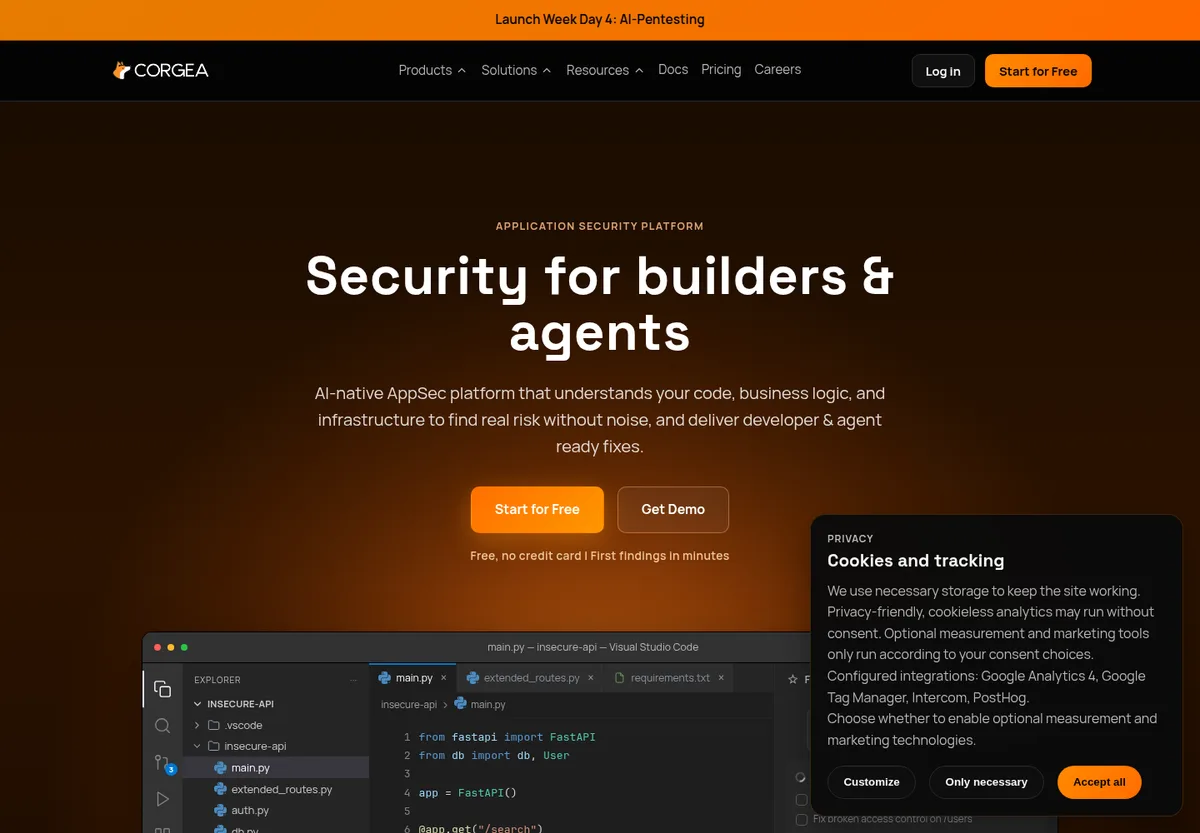
Corgea is an AI-native application security platform that finds exploitable vulnerabilities and helps fix them. It is built for teams that want depth in code detection and remediation, not just consolidated coverage.
What it is: AI-native SAST for custom code, with broader AppSec coverage across dependencies, secrets, containers, and IaC, plus autonomous AI pentesting.
Why teams choose it over Aikido: Where Aikido leads with all-in-one breadth, Corgea leads with AI-native depth. In the benchmark above, Corgea found 42 of 47 confirmed issues while Aikido found 13. Corgea combines static analysis, code context, framework understanding, reachability, and LLM-based reasoning to detect business-logic and authorization flaws, then proposes review-ready fixes. The BLAST AI-powered SAST whitepaper explains the architecture, while Corgea CodeIQ and endpoint-aware reachability analysis show how Corgea goes beyond traditional rule matching. Reachability-aware prioritization keeps the queue focused, and autonomous AI pentesting is a first-class capability rather than an add-on.
Where it falls short: Corgea is a newer vendor. If your priority is the widest possible feature checklist under one login with self-serve pricing, weigh breadth against depth for your program.
Best fit: Teams that want deeper AI-native detection, reachability-aware prioritization, review-ready fixes, and autonomous pentesting.
Pricing note: Corgea offers a free trial and quote-based plans, with AI SAST included in the developer bundle. See the pricing page.
2. Snyk
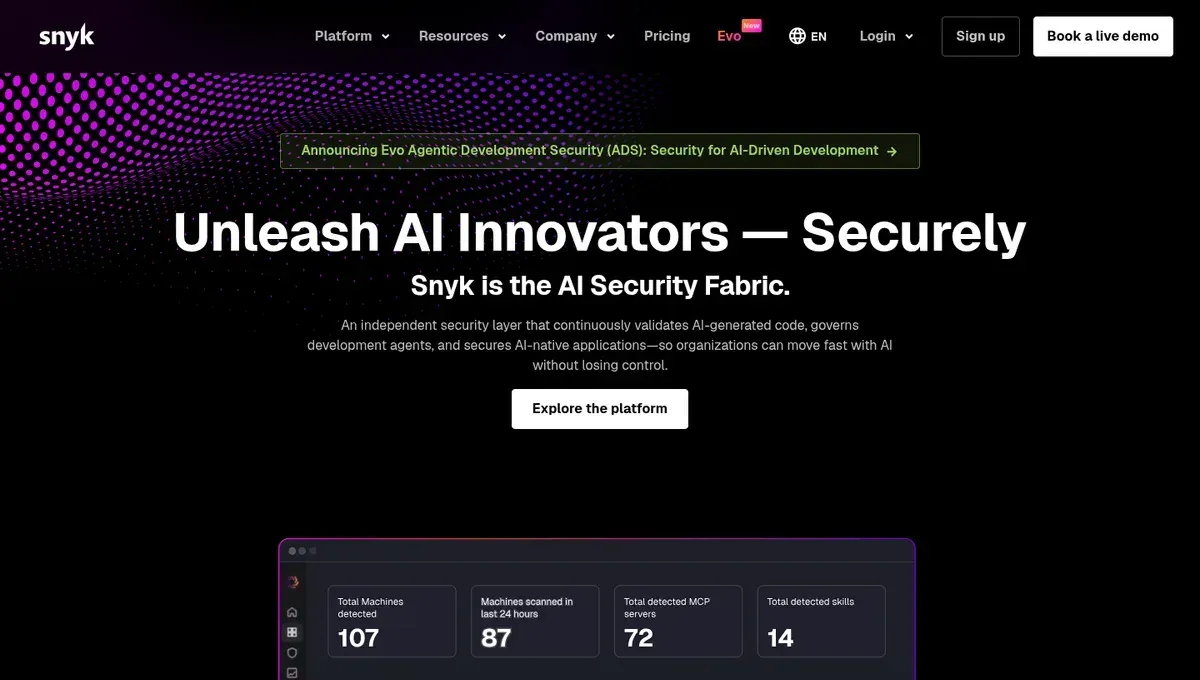
Snyk is a developer-first security platform with software composition analysis and Snyk Code for SAST.
What it is: A developer-oriented platform spanning SCA, SAST, container, and IaC security.
Why teams choose it over Aikido: Teams whose center of gravity is developer-first SCA with mature IDE and pull-request workflows often prefer Snyk. See the Snyk alternatives guide.
Where it falls short: Snyk is SCA-led, and cost can grow with the platform.
Best fit: Teams centered on developer-first dependency security.
Pricing note: Free and paid tiers, with enterprise pricing quote-based.
3. Semgrep
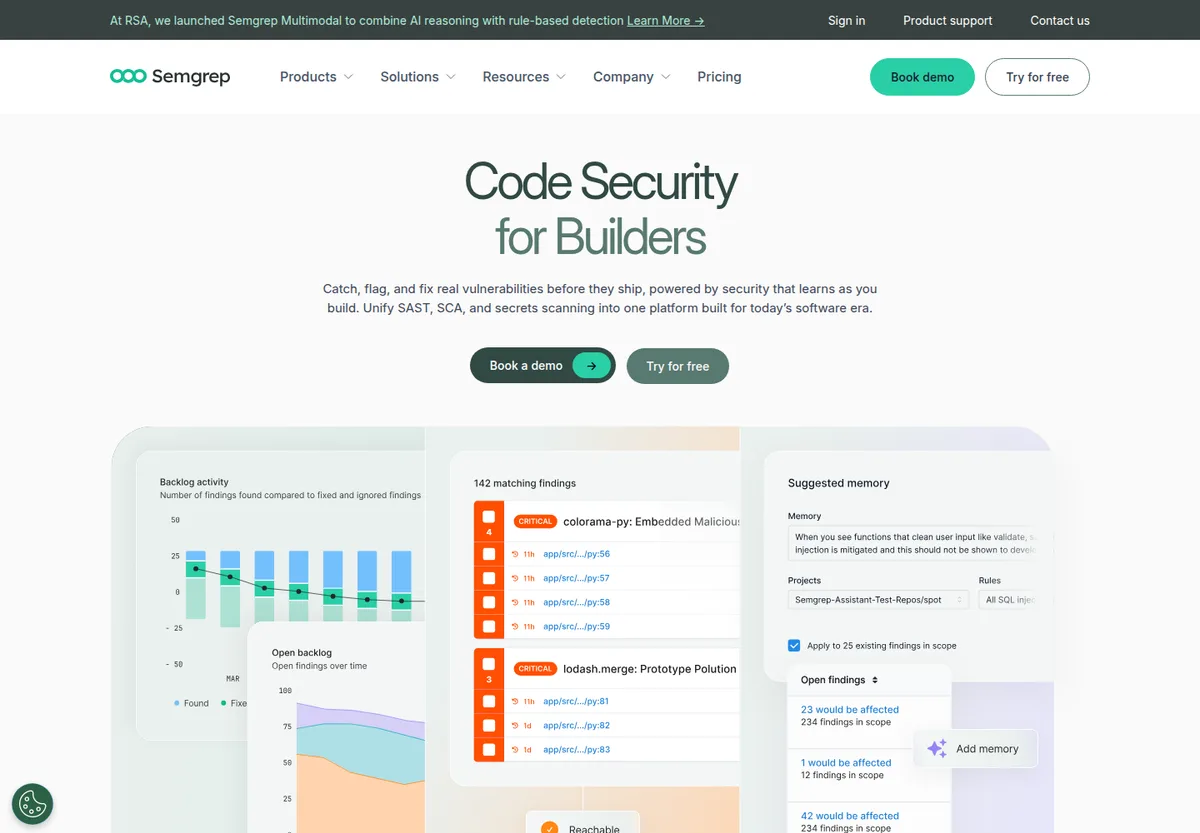
Semgrep is a developer-friendly static analysis platform with open-source rule control.
What it is: A fast SAST platform with strong rule authoring.
Why teams choose it over Aikido: Teams that want transparent, customizable SAST rather than a broad platform prefer Semgrep. See the Semgrep alternatives guide.
Where it falls short: Pattern-first detection can miss business-logic flaws, and custom rules need maintenance.
Best fit: Teams that value open-source rule control.
Pricing note: Free open-source engine plus paid tiers.
4. Checkmarx
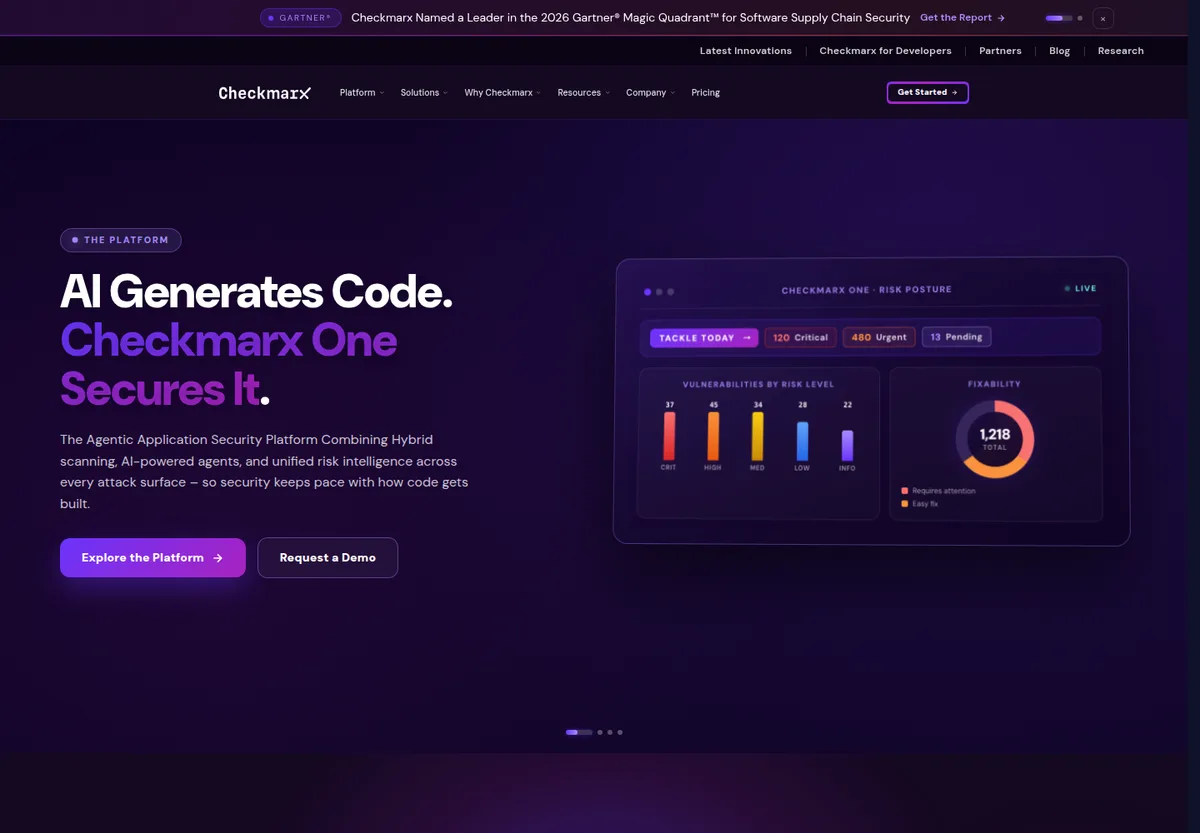
Checkmarx is a long-running enterprise AppSec vendor with SAST, SCA, IaC, and API security.
What it is: Enterprise SAST and AppSec platform tooling for governance-heavy programs.
Why teams choose it over Aikido: Enterprises that need mature policy, reporting, and procurement paths sometimes prefer an established enterprise platform. See the Checkmarx alternatives guide.
Where it falls short: Setup and operational ownership are heavier, and pricing is not publicly listed.
Best fit: Large security teams needing governance and reporting.
Pricing note: Enterprise quote. Pricing is not publicly listed.
5. Endor Labs
Endor Labs is best known for reachability-based software composition analysis with expanding code security.
What it is: An AppSec platform centered on dependency security, reachability, and prioritization.
Why teams choose it over Aikido: Teams focused on open-source risk and reachability find its prioritization compelling.
Where it falls short: Its SAST is newer than its SCA reputation.
Best fit: Teams focused on dependency risk and reachability.
Pricing note: Enterprise quote. Pricing is not publicly listed.
6. Veracode
Veracode is an enterprise application security platform with policy-driven SAST and remediation.
What it is: Enterprise static analysis and application security testing for governance-led programs.
Why teams choose it over Aikido: Compliance reporting, policy scanning, and Veracode Fix appeal to regulated organizations.
Where it falls short: The platform can feel heavy for lean teams.
Best fit: Compliance-led security programs.
Pricing note: Enterprise quote. Pricing is not publicly listed.
7. GitHub Advanced Security
GitHub Advanced Security uses CodeQL for code scanning plus native secret scanning and Copilot Autofix.
What it is: GitHub’s native application security suite.
Why teams choose it over Aikido: GitHub-native teams get SAST, secret scanning, and dependency review inside existing workflows.
Where it falls short: It is less natural outside GitHub, and it does not cover cloud posture the way Aikido does.
Best fit: Teams standardized on GitHub.
Pricing note: Per active committer for private repositories, free for public repositories.
8. Wiz Code
Wiz Code is the code security offering within the Wiz cloud security platform, focused on code-to-cloud context.
What it is: Code security integrated with a leading cloud security platform.
Why teams choose it over Aikido: Organizations that already run Wiz for cloud security may prefer to extend it into code, correlating code risk with cloud context.
Where it falls short: Based on public positioning, code SAST depth is secondary to the platform’s cloud security strength.
Best fit: Cloud-centric teams that want code-to-cloud correlation.
Pricing note: Enterprise quote. Pricing is not publicly listed.
9. OX Security
OX Security positions around application security posture management (ASPM) and risk consolidation.
What it is: An ASPM platform that correlates AppSec findings across code, pipelines, artifacts, and deployment context.
Why teams choose it over Aikido: Buyers consolidating many scanners want one operating layer for posture and prioritization.
Where it falls short: If you want a single scanner rather than a posture platform, ASPM breadth can add complexity.
Best fit: Security leaders consolidating AppSec signals into one program view.
Pricing note: Enterprise quote. Pricing is not publicly listed.
When to stay with Aikido
A fair comparison acknowledges where Aikido remains a strong choice. Stay with Aikido if:
- You want consolidated code, cloud, and runtime coverage under one platform.
- Transparent, self-serve pricing for the baseline platform is important to your buying process.
- Your team is lean and values one dashboard over best-of-breed depth in every category.
- Aikido’s automated fixes and coverage already meet your current risk needs.
- You have validated SAST recall on your own repositories and the missed-issue rate is acceptable.
- You prefer a fast, self-serve onboarding experience.
If those points describe your program, the incremental value of switching may be small. Focus on validating depth in your highest-risk area.
How to choose an Aikido alternative
Use a decision framework rather than a feature checklist.
- Choose Corgea if you want AI-native depth, reachability-aware prioritization, review-ready fixes, and autonomous AI pentesting.
- Choose Aikido (stay) if all-in-one breadth matters most and you have validated SAST recall on your own code.
- Choose Semgrep or OpenGrep if custom rules and open-source control matter most.
- Choose Checkmarx or Veracode if analyst recognition and legacy enterprise procurement matter most.
- Choose Snyk if developer-first SCA is the center of gravity.
- Choose Wiz Code if cloud-to-code correlation is the priority.
Then run a real bake-off. The best SAST tools guide explains how to design one, and the application security testing complete guide covers where SAST fits alongside SCA, secrets, IaC, and container scanning. Score confirmed true positives, false positives, missed known issues, coverage, fix acceptance, developer friction, and total cost.
How to evaluate depth behind an all-in-one platform
The main risk with any all-in-one platform is buying breadth and discovering shallow depth in the one area that matters most to you. Evaluate depth deliberately.
- Rank your risk areas first. Decide whether custom-code SAST, dependency risk, secrets, IaC, container security, or cloud posture is your highest priority, then evaluate that capability as if it were a standalone purchase.
- Test SAST on logic-heavy code. All-in-one tools often lead with dependency and configuration scanning. Confirm the code SAST detects business-logic and authorization flaws, not just common patterns.
- Separate coverage from quality. A capability that is listed is not the same as a capability that is deep. For each checkbox, run a real test and score detection accuracy and false positives.
- Probe autofix and pentesting claims. If automated fixes and application testing matter, verify fix quality and, for autonomous or agentic testing, confirm scope, supported application types, and the evidence produced.
- Check prioritization. Confirm how the platform decides what to fix first. Reachability-aware prioritization, which focuses on exploitable and reachable issues, is more valuable than a long, undifferentiated list of findings across many scanners.
- Validate reporting and ownership. As your program matures, you will need SLA tracking, ownership mapping, and audit-ready reporting, so confirm these exist rather than assuming an all-in-one tool includes them.
How to run an Aikido-to-Corgea pilot
- Pick representative repositories and applications. Include a high-change service, a legacy service with known noise, and a security-sensitive service with auth, payments, or admin workflows.
- Define ground truth. Use recently fixed vulnerabilities, pentest findings, seeded issues, and known false positives so detection and noise are scored on the same evidence.
- Compare capability by capability. Line up SAST, SCA, secrets, IaC, and containers side by side rather than accepting a single all-in-one score.
- Score fixes, not just findings. For each generated fix, verify it compiles, passes tests, preserves behavior, and resolves the root cause, then measure developer acceptance.
- Weigh pricing against outcomes. Aikido publishes pricing, which helps budgeting, but compare total cost of ownership including triage, remediation effort, and any separately metered AI audit usage.
The best SAST tools guide includes a reusable bake-off template, and the how to reduce false positives in SAST guide covers scoring noise consistently across tools.
Questions to ask Aikido alternatives before you switch
- For my single highest-risk area, how deep is the tool compared with a best-of-breed point solution?
- Does the code SAST detect business-logic and authorization flaws, or mostly common patterns?
- Which languages and frameworks are supported at production depth, and how is multi-file data flow handled?
- Are automated fixes validated, and can developers review the patch before merge?
- If autonomous or agentic testing is offered, what is the scope, what application types are supported, and what evidence is produced?
- If deeper AI audit is separate from baseline SAST, what does a normal scan cost at your repository size?
- How does total cost of ownership compare once triage and remediation effort are included, not just the published license price?
Answering these on your own repositories and applications, rather than from a feature page, is the fastest way to separate real capability from breadth.
Related AppSec tool comparisons
- Best Snyk alternatives
- Best Semgrep alternatives
- Best Checkmarx alternatives
- Best depthfirst alternatives
- Best SAST tools in 2026
Frequently asked questions about Aikido alternatives
What is the best Aikido alternative in 2026?
There is no single best Aikido alternative for every team. Corgea is a strong fit when SAST depth, AI-native detection, reachability-aware prioritization, review-ready fixes, and autonomous AI pentesting matter most. In a July 2026 benchmark, Corgea found 42 of 47 confirmed issues while Aikido found 13. Snyk suits developer-first SCA, Checkmarx and Veracode fit enterprise governance, and Wiz Code suits cloud-centric teams.
Is Corgea an Aikido alternative?
Yes. Corgea is an AI-native application security platform that competes with Aikido on SAST and also covers dependencies, secrets, IaC, and containers, plus autonomous AI pentesting. Teams evaluate Corgea against Aikido when they want deeper AI-native remediation and prioritization rather than all-in-one breadth.
How much does Aikido cost, and are there cheaper alternatives?
Aikido publishes tiered pricing publicly, including a free tier, with quotes for larger plans. In our July 2026 benchmark account, Aikido AI Code Audit was shown as a separate 20-credit run, credits were shown at $1 each, and the purchase dialog showed a 100-credit minimum. Cheaper alternatives depend on scope; compare total cost of ownership, including triage and remediation effort, not just license price.
What is the difference between Aikido and Corgea?
Aikido positions as an all-in-one platform that secures code, cloud, and runtime with automated fixes. Corgea is AI-native and focuses on deep code detection, reachability-aware prioritization, review-ready fixes, and autonomous AI pentesting. In the July 2026 SAST benchmark covered here, Corgea achieved 89.36% recall and 85.71% F1, while Aikido achieved 27.66% recall and 41.94% F1. Aikido’s limitation in this benchmark was its OpenGrep-based traditional static analysis layer: good for known patterns, weaker for broader context and custom application logic.
Which Aikido alternative is best for autonomous pentesting?
If autonomous testing is a priority, evaluate Corgea AI pentesting, which is positioned around agentic security testing alongside AI-native SAST. Confirm scope, supported application types, and evidence quality during a pilot on your own applications.
Are there enterprise Aikido alternatives?
Yes. Checkmarx, Veracode, and Wiz Code are common enterprise comparisons depending on whether your priority is enterprise SAST governance or cloud-to-code security. Corgea is also evaluated by teams that want AI-native depth with enterprise coverage.
How should teams evaluate Aikido competitors?
Evaluate Aikido competitors on your own repositories and applications. Measure confirmed true positives, false positives, missed known issues, coverage across SAST, SCA, secrets, IaC, and containers, fix acceptance rate, developer workflow friction, and total cost of ownership rather than raw feature counts.
How did Corgea compare to Aikido in the benchmark?
Corgea found 42 of 47 source-confirmed issues, with 82.35% precision, 89.36% recall, and 85.71% F1. Aikido found 13 of 47, with 86.67% precision, 27.66% recall, and 41.94% F1. Aikido was slightly more precise, but Corgea found 29 more confirmed vulnerabilities.
What should an Aikido PoC measure?
Seed known vulnerabilities and score misses, not just false positives. Test business logic, authz, IDOR, SSRF, open redirect, secrets, and multi-file context. Compare default SAST and AI Code Audit separately, and score Autofix on behavior preservation, not only whether a patch appears.
Is Aikido Code Audit the same as default Aikido SAST?
No. In a public Reddit reply, Aikido’s CEO said default SAST is OpenGrep-based and positioned Code Audit for complex vulnerabilities like business logic issues or cross-tenant data leaks. Buyers should evaluate both layers explicitly and confirm whether deeper AI analysis is included or credit-metered.
What should buyers ask about Aikido Autofix?
Test Autofix on business logic changes, not only simple SQL injection. Require evidence that generated fixes preserve behavior, preferably tests or reviewable diffs. Ask whether fixes are agentic, whether unit tests are generated, and how CI integration handles failed or risky patches.
What should microservice teams ask about Aikido fair use or pricing?
Ask how fair-use limits apply to large microservice architectures, repo count, scan frequency, and Code Audit usage. One practitioner reported that per-seat pricing looked attractive, but fair-use limits changed the total-cost picture for a large microservice architecture. Treat that as a diligence question and compare total usage cost across your real repo portfolio, not a single pilot repository.
The bottom line on Aikido alternatives
Aikido is a capable all-in-one platform, especially for teams that value breadth. But if your team is comparing Aikido alternatives because SAST depth, missed vulnerabilities, per-use AI audit costs, review-ready fixes, and autonomous pentesting matter, book a Corgea demo. You can also explore Corgea AI SAST, autonomous AI pentesting, and current pricing.
Corgea is not affiliated with Aikido. This comparison is based on public information, product positioning, and the July 2, 2026 benchmark summarized above.